
This guest commentary is authored by Emily Filloy, Marcia Henry, Jan Malvin, Alison McDonald and Shelly Weintraub, on behalf of Educators for Democratic Schools.

Among the major decisions facing the Oakland School Board this fall will be votes on the future of nine charter schools. Renewals have backed up because of extensions granted due to the pandemic. In considering whether to continue these schools – all operated with public funds, but governed by private corporate boards and thus not accountable to the public – the OUSD Board should ask some hard questions. Do these nine schools offer their students a truly equitable education? Do they improve the overall quality of public education in Oakland? Do they abide by the requirements of state law? We urge the Board to carefully consider these important questions:
1) Does the charter school’s student population reflect the district as a whole, in terms of race/ethnicity, students with disabilities, and English Language Learners, as state law requires? Charter schools must describe how they will achieve a balance, and yet one charter school facing renewal serves a 97% Latino student body, while 46% of OUSD students are Latino. That same school serves 2% Black students, compared with 21% Black students in OUSD. Three other charter schools facing renewal have student bodies that are more than 90% Latino.
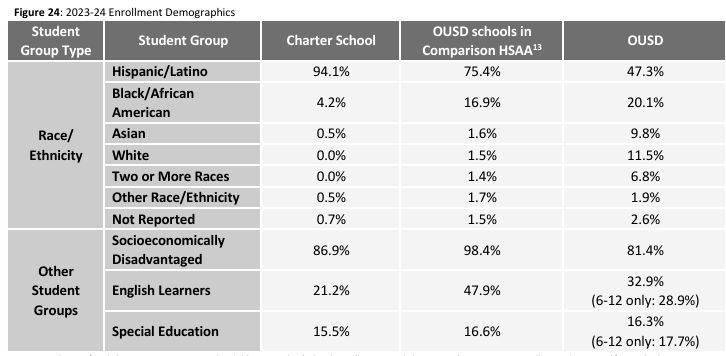
District schools, which must serve all students, are far more integrated by race and ethnicity than the charter schools. And data shows other forms of segregation as well; charter schools serve fewer foster youth, English Language Learners, and students with disabilities.
2) Are most teachers and administrators well-qualified, as state law requires? Teachers in all publicly-funded schools must have valid state teacher credentials. And yet at one Oakland charter school facing renewal, 70% of current teachers not only lack credentials; they are substitutes. At four other charter schools up for renewal, fewer than half the teachers are credentialed. In OUSD public schools, 80% of the teachers have credentials, comparing favorably with 89% statewide.
3) Is the charter school doing its fair share educating students with special needs, as state law requires? The charter sector serves some students with special needs, but fewer than than OUSD. In OUSD, 16% of students have disabilities; while the average of charter schools up for renewal is 13%.
However, there is a huge disparity in serving students with extensive needs. These students (e.g., those with physical disabilities, autism, hearing or visual impairment, or emotional challenges) are dramatically underrepresented in charter schools. Costs of supporting them, including transportation when appropriate, are far greater than the costs to support students who need, for example, speech therapy.
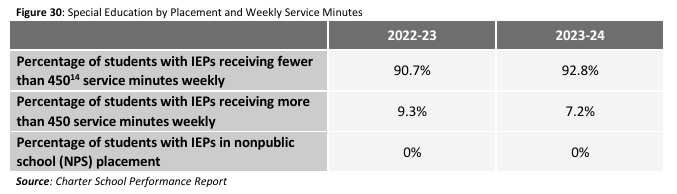
Students with extensive needs may require individual attendants, emotional and behavioral therapy, or adapted physical education. When charter schools do not serve a fair proportion of students with extensive needs, a vastly disproportionate cost falls on the district’s public schools.
These are hard questions, and Oakland needs its School Board members to demand detailed, well-documented answers. AB 1505, passed in 2019, imposed more rigorous oversight of charter school renewals. The OUSD Board must take its oversight obligation seriously and show little tolerance for schools that do not serve all students. If the Board thoroughly scrutinizes the data and adheres faithfully to its obligation to act in Oakland students’ best interest, it likely will refuse renewal for at least some of the nine charters before it.
The resulting closures will disrupt the affected school communities, as closing schools is inevitably traumatic. Even as the Board acts to follow state law, uphold equity, and avoid promoting segregation, OUSD must find a way to welcome charter students, families, and staff back into the public system with open arms.
Educators for Democratic Schools is an organization of mostly retired Oakland educators concerned about privatization of our public schools. We appreciate their partnership in bringing greater transparency to the charter renewal process. For more information, reach out to EDS at edsOakland@gmail.com or follow them on facebook: https://www.facebook.com/EDSOakland/
#charterrenewals #ousd
 Parents United for Public Schools