
Experts agree: Enrollment will continue to decline over the next five years
It has been all over the news, especially in California: declining birth rates and families escaping the high cost of living mean that there are fewer school age children to attend our schools, whether public or charter.
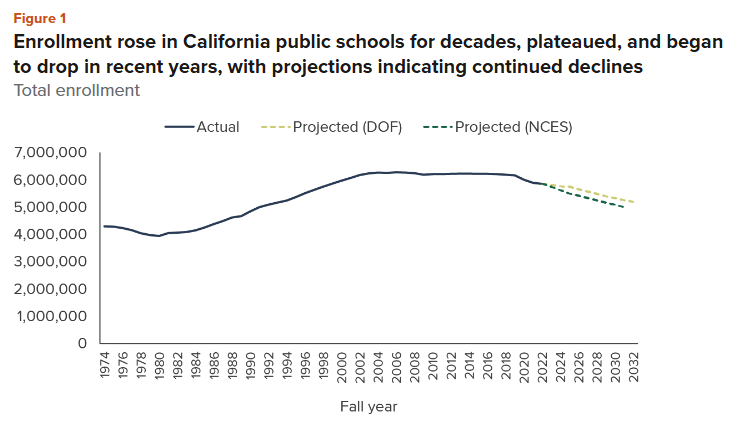
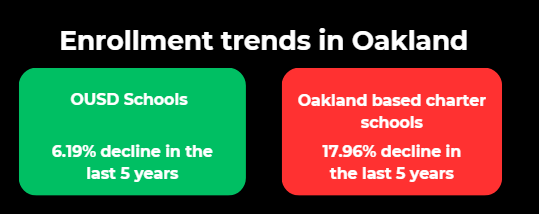
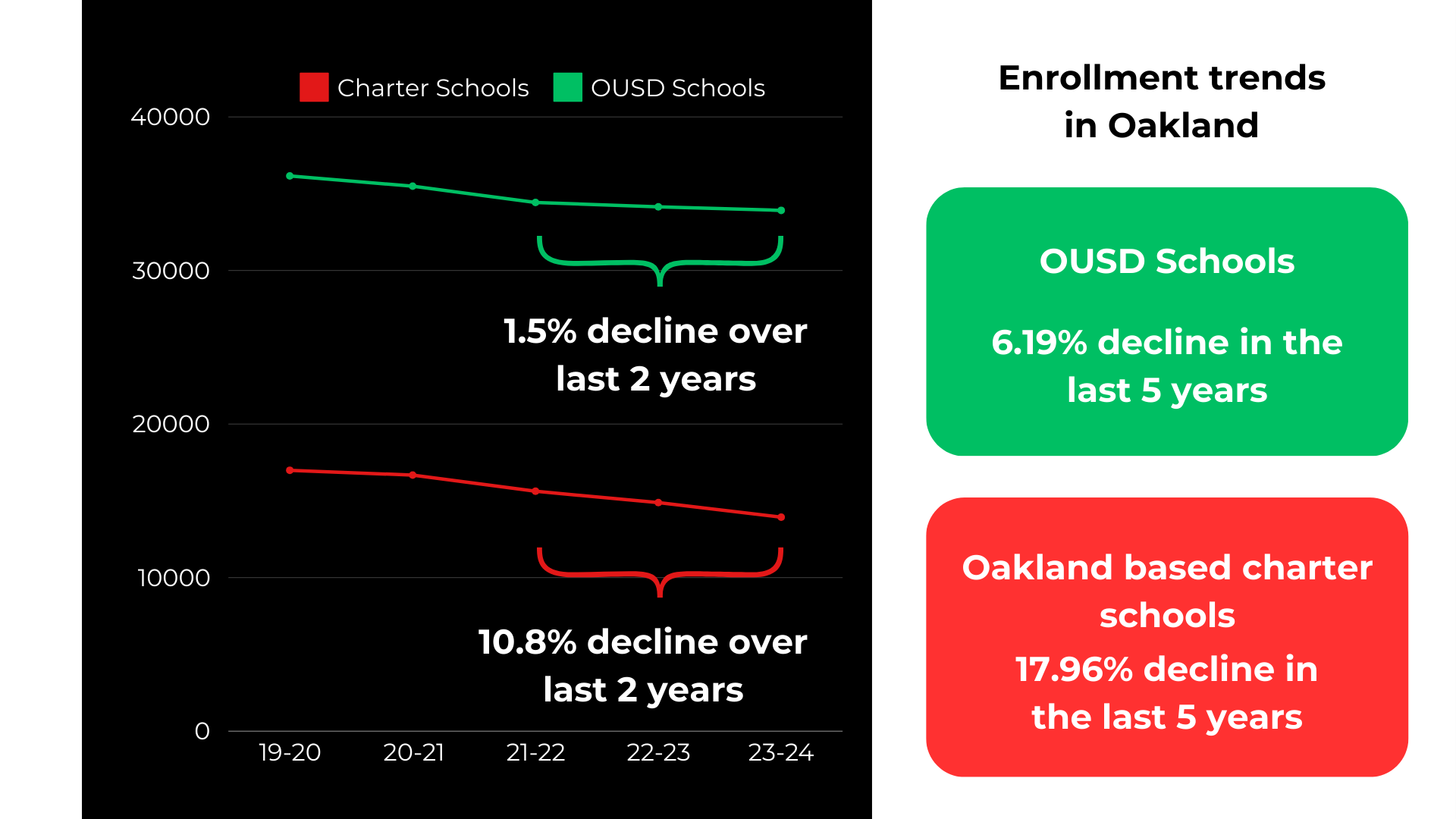
This trend is apparent in Oakland as well, with OUSD Schools declining an average of 1.2% over each of the last five years, and projected enrollment decreases in future. OUSD’s loss pales in comparison, however, to the decline in charter school enrollment over the same period. Charter school enrollment declined 3 times faster than OUSD over the 5 year period, and 5 times faster over the last two years post pandemic. In other words, while OUSD enrollment loss has slowed down over time, charter school enrollment loss has accelerated.
Despite the overwhelming evidence that enrollment losses are likely to continue, 4 of the 6 charter schools who have already submitted renewal petitions are projecting substantial enrollment growth over their five year term.
Most charter schools didn’t meet their enrollment projections in the current term
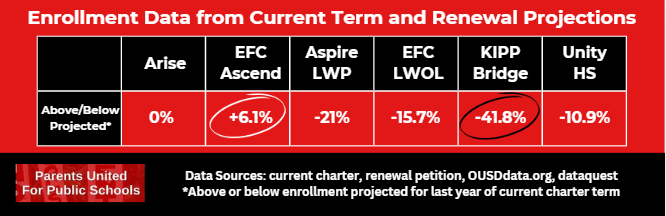
“Enrollment drives revenue” is something we hear a lot when discussing OUSD’s budget. Try to imagine the reaction of the County Superintendent who oversees the OUSD budget if we submitted a budget with a projected multi-year growth of 26%! Like OUSD, charter schools build their budgets based on “enrollment projections” of the number of students that they expect to enroll for each of the years of their proposed renewed charter. Those projections establish the budget and what kinds of staffing and programs that the charter school is able offer to students, and it is on the basis of that proposed budget and programming that an authorizing board decides whether to approve or deny a charter renewal. 4 of the 6 charter schools currently seeking renewal were already between 11% and 42% below what their budget was built on and their charter renewal was evaluated for1.
For instance, KIPP Bridge projected an enrollment of 841 students for 2021-22, but actually realized only 537 students, a decrease of 42%. That translates to about $2.9 million less revenue out of an $8.3 million budget. That means fewer classroom teachers are needed (and so won’t be hired) but it also means less money overall for music, art, athletics, field trips, tutoring, specialized support and other things promised in the program description in the charter. Further, it also means that the per pupil cost of fixed and administrative costs goes up and must be directed away from all of those programmatic extras to cover those costs.
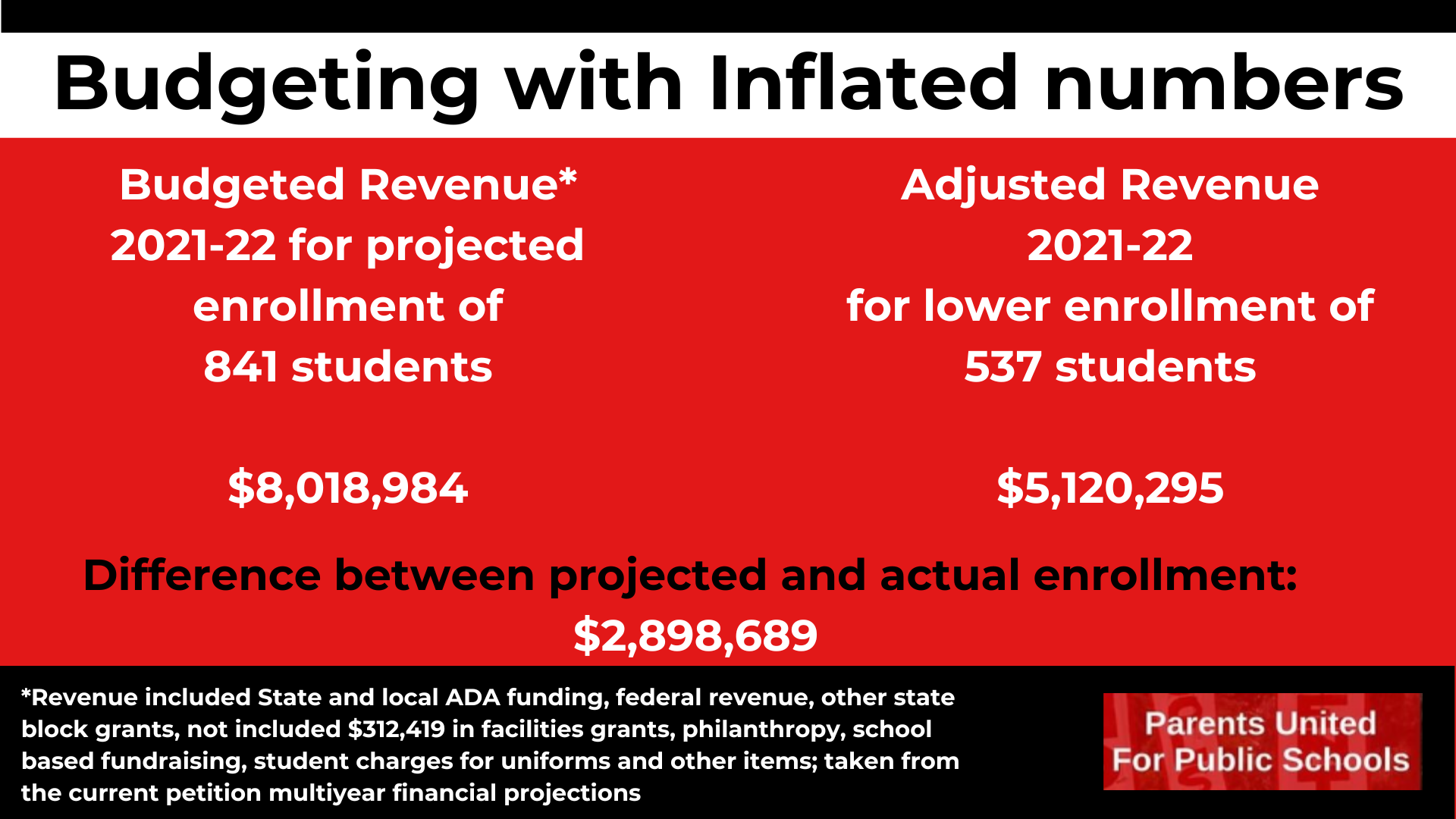
The OUSD Board should not approve any charter that is based on inherently unreasonable enrollment projections
Making accurate, reasonable enrollment projections in the charter petition is critical to ensuring that the authorizer can appropriately evaluate whether the charter school is demonstrably likely to successfully implement the program. It is simply not possible to successfully implement a program as described in the petition with 40% less revenue than you were planning for. Projecting a significant rise in enrollment is inherently unreasonable given the history and expert analysis that enrollment will be declining and OUSD should not be approving any charter that has overstated its enrollment in a way that will negatively impact their ability to implement the full program for students that is the basis of the charter.
These patently unreasonable and unattainable enrollment projections could be the basis for the following findings:
(1) under 47605c1: The charter school presents an unsound educational program because parents and students who are currently enrolled are likely to have their school close mid-year, which creates instability for students and families
(2) under 47605c2: The petitioners are demonstrably unlikely to successfully implement the program set forth in the petition because the program relies on revenue that is based on unreasonable enrollment projections.
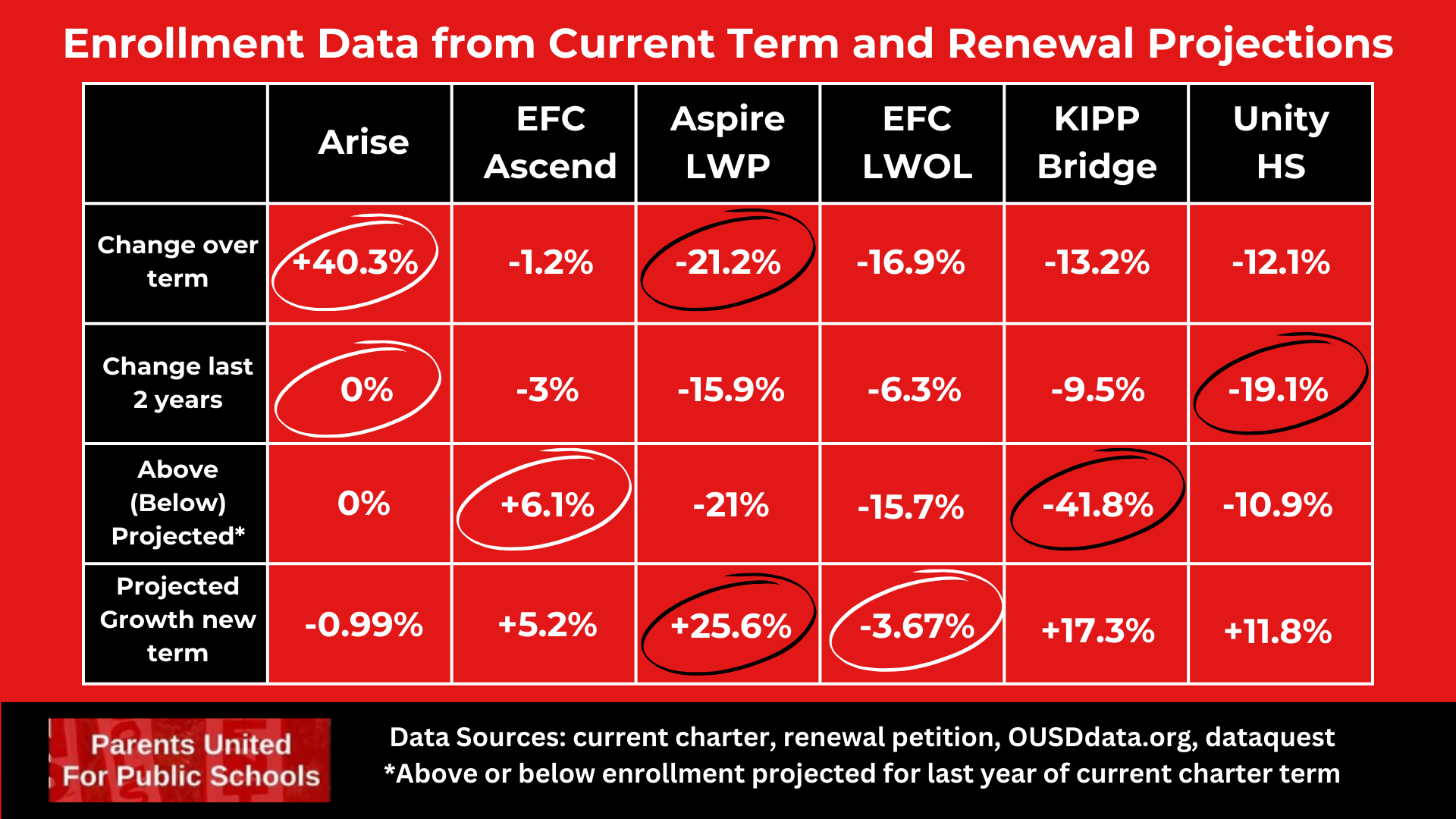
Deeper dive into charter schools which have already submitted their renewal petitions
Arise High School
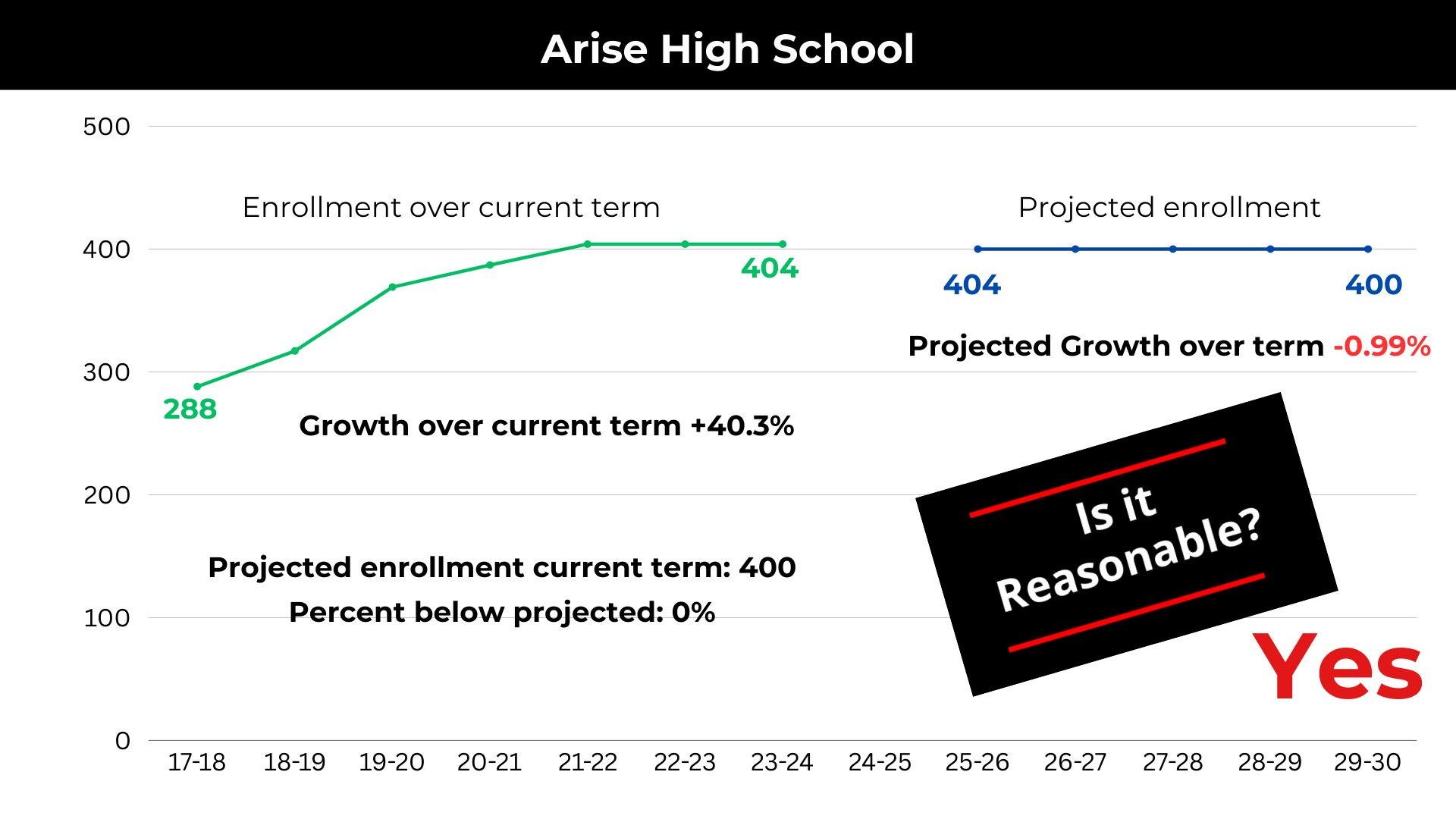
Arise High School has had consistently steady enrollment, even during and since the pandemic when most other charter schools declined at an average rate of 5% per year. Arise’s projection of continued even enrollment is reasonable.
Aspire Lionel Wilson Prep
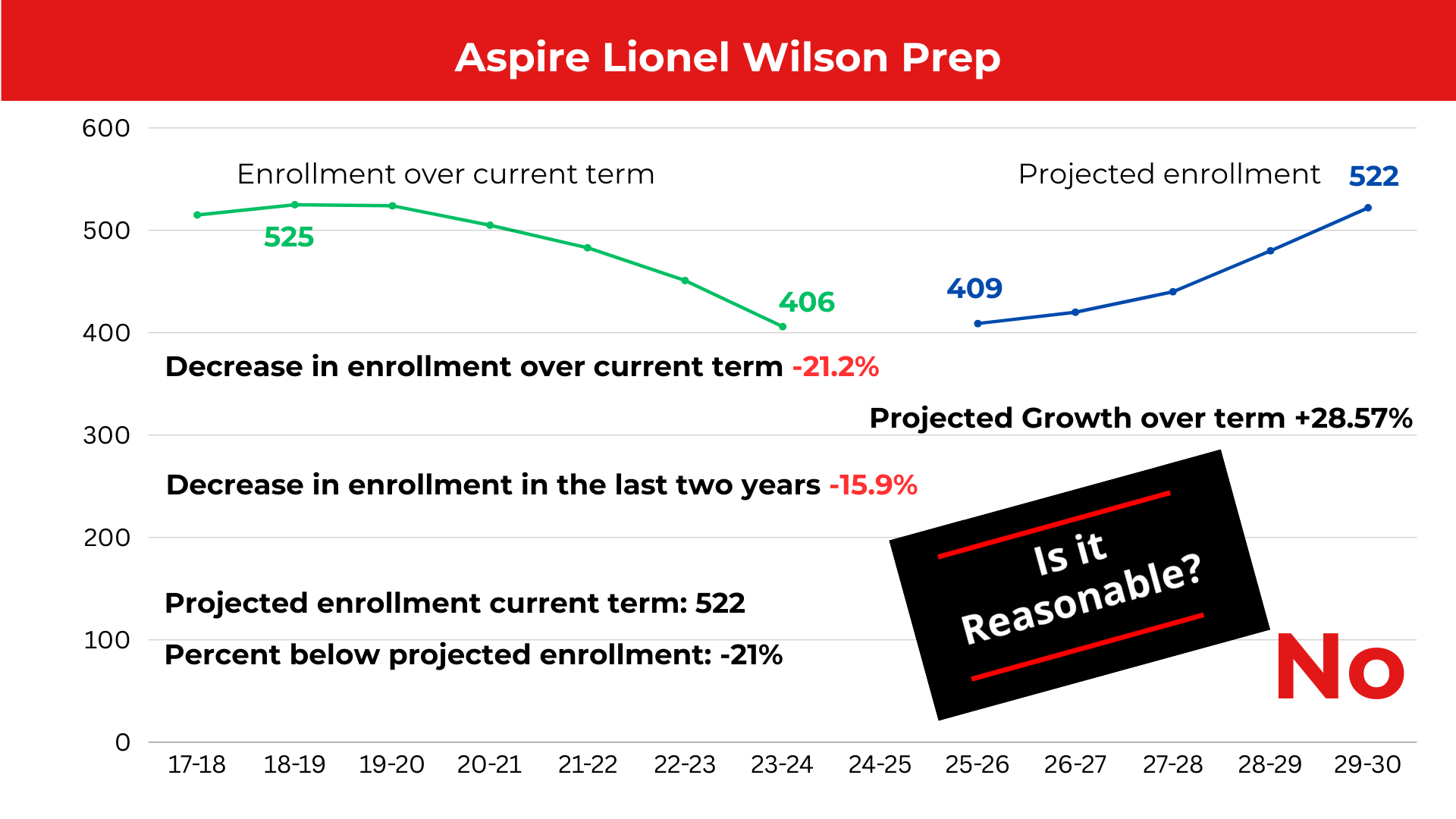
Aspire Lionel Wilson Preparatory Academy (“Aspire LWP”) has suffered a significant loss in enrollment since the beginning of the pandemic from which they have not recovered. Enrollment is down from a high of 525 to 406 in 2023-24 (the most recent official data from the state). While OUSD and most charter school’s enrollment loss slowed down in the last two years, it has continued to accelerate for Aspire LWP, down 15.9% over their last two years alone. In the pandemic years of remote learning, enrollment was down 4% each year. But in the last two years, enrollment fell 6.6% in 2022-23 and 10% in 2023-24, twice the rate of the pandemic enrollment loss.
Given that, it is inherently unreasonable for Aspire LWP to be projecting a nearly 30% growth over the next charter term. It is hard to turn around steep enrollment decline, but it is frankly impossible in a time when enrollment is expected to continue to decline as is projected for California. If OUSD projected a 30% growth and based its multiyear projections on that, the county trustee would reject it as inherently unreasonable. OUSD should do the same here. The fiscal projections are not reasonable, making the programmatic offerings not realistic.
The OUSD staff report for Aspire LWP had a fairly in depth discussion about the unreasonable enrollment projections, stating that the petition “does not accurately project the financial reality for the 2025-26, 2026-27, and 2027-28 school years” and further that the projections as stated in the petition and the assumptions of the Multi-year budget did not match, resulting in an even greater over projection of revenue:
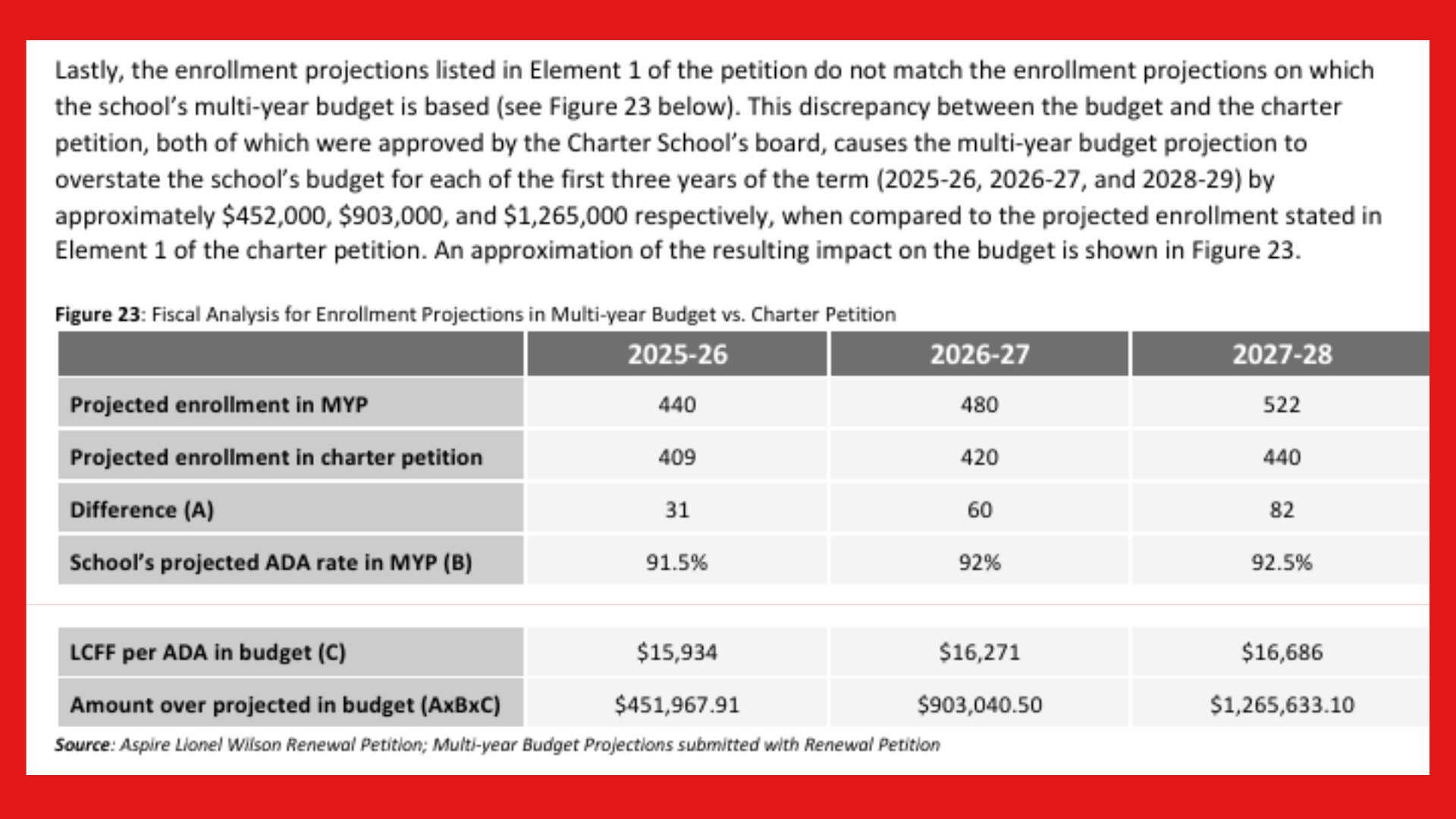
OUSD Charter Staff also stated that “As shown below, the adopted budget for the 2023-24 school year was based on substantially over projected enrollment assumptions, which together with the MYBP submitted in the renewal petition, demonstrates a concerning pattern of the school’s governing board approving budgets that rely on unrealistic enrollment figures” (emphasis added).
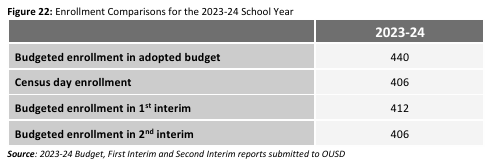
Based on all of this, it is clear that even OUSD believes that the enrollment projections are inherently unreasonable. Despite that, OUSD staff recommends approval, which is surprising and irresponsible. This petition contains ample “challenges” that could be used as findings supporting a denial of the Aspire LWP petition, including the unreasonable enrollment assumptions2. The OUSD board must act as a reasonable, rational authorizer and deny the petition based on all of the findings, including this one.
Education for Change Ascend

Education for Change (“EFC”) Ascend had a moderate enrollment decrease over its term, including a 3% loss over the last two years, but because they were at one time 11% above projected, they largely absorbed that decline and as of this year are still ahead of their projections by 21 students.
Nonetheless, EFC Ascend is projecting a 5.2% growth, including a 4.4% growth next year. While not as significant as the growth some of the other charter schools are claiming, it is still a substantial single year growth that may not be achieved, and in fact may decline. OUSD Staff should ask EFC Ascend for its census day enrollment for 2024-25 before the hearing date of October 10th to see whether EFC Ascend’s enrollment has made some recovery (gained students) or if the trend of continued declining enrollment continues, the OUSD Board should look carefully at the financial projections to determine whether this charter school will be demonstrably likely to implement the program with inaccurate financial projections.
Education for Change Learning without Limits
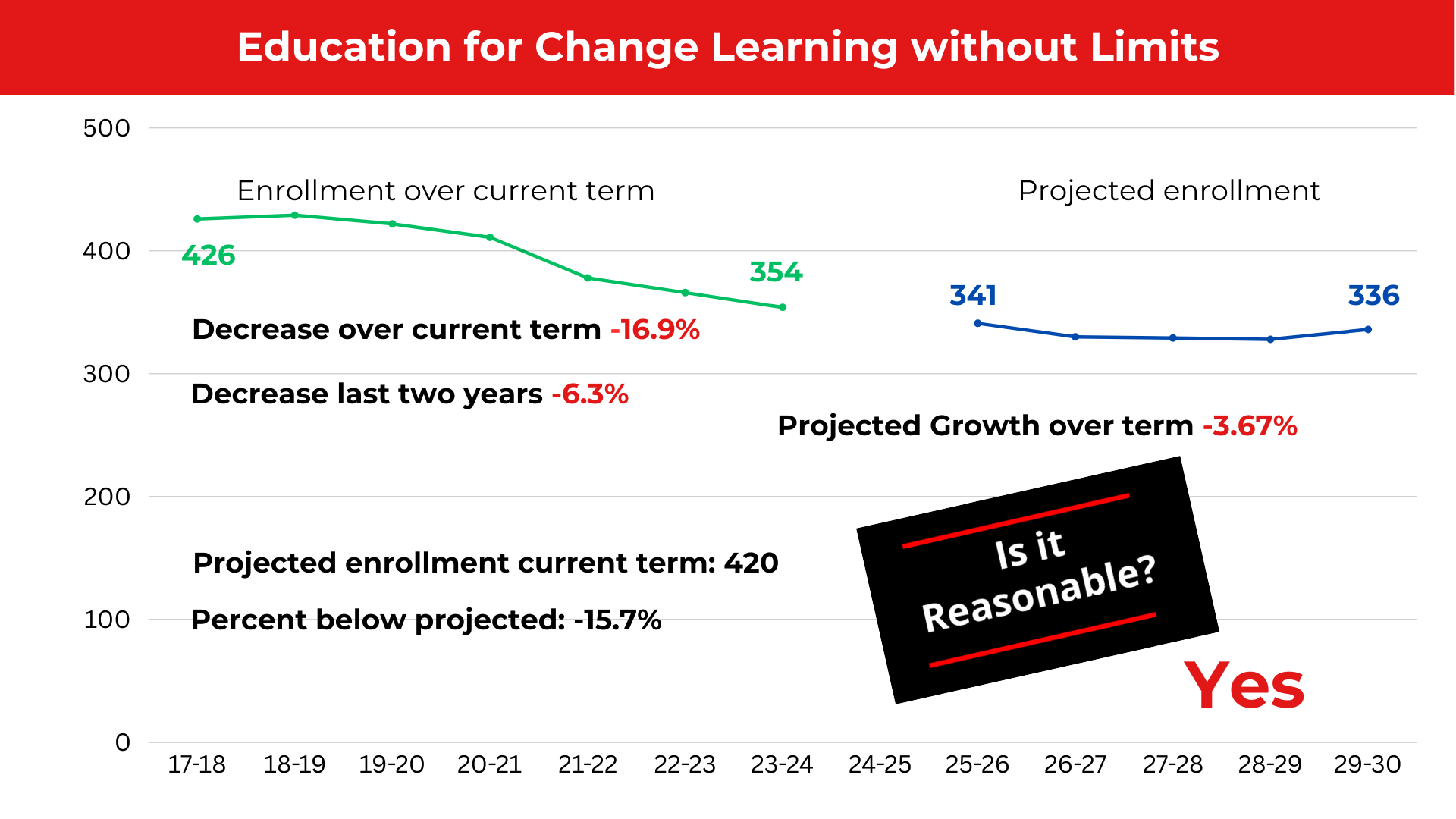
EFC Learning without Limits is projecting a slight decline in enrollment, which is reasonable and consistent with its history. However, the charter school identified the “maximum enrollment” as 420, which is NOT reasonable, and the board should require EFC to change that to the 341 maximum enrollment specified in the contract. This is an attempt by this and two other charter schools (KIPP Bridge and Unity High School) to circumvent the following OUSD oversight language in the charter petition”
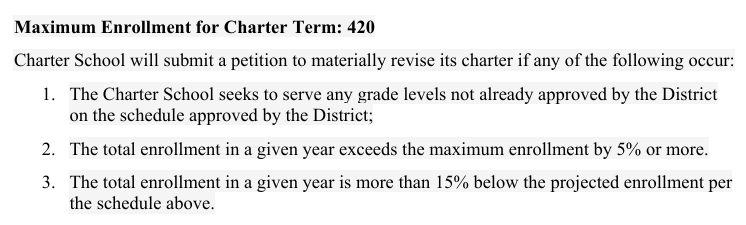
By including a maximum enrollment well above their enrollment projections, they will technically fail to trigger a material revision as the required language refers to “maximum enrollment” instead of “projected enrollment” as is required in item 3.3 This is not appropriate and the board should make clear that this must be changed and that OUSD will continue to base the need for a material revision on the projected enrollment and not any artificial “maximum enrollment” stated by the charter school itself.
KIPP Bridge
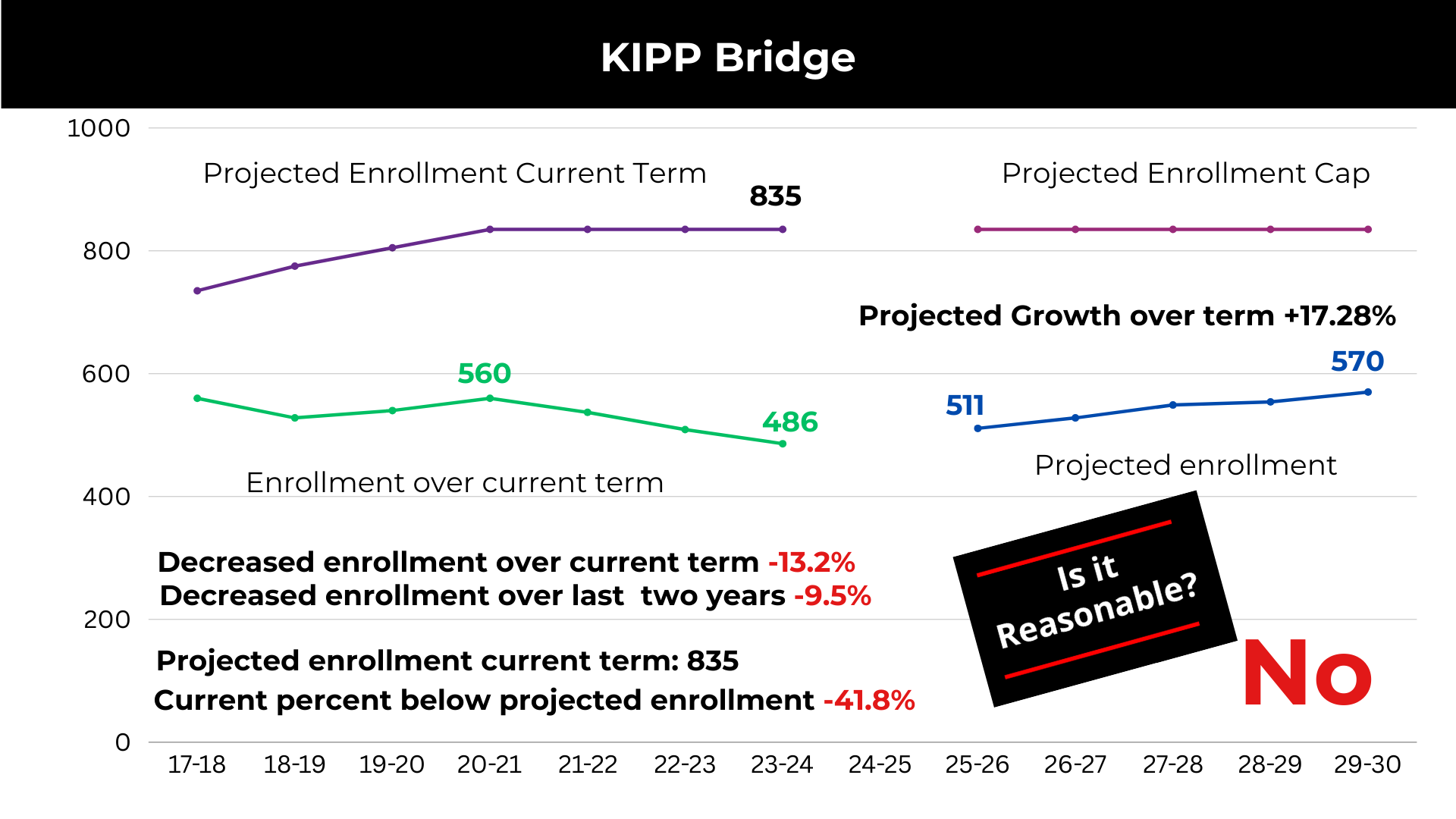
Of the charter schools with inflated enrollment projections, KIPP Bridge’s numbers are the most egregious. KIPP Bridge is current 42% below their projected enrollment of 835, and enrollment has declined over the past two years alone by 9.5%. But looking at their numbers over the course of their entire current charter term, they never came even close to meeting their projected enrollment, and should have been required to request a material revision long ago.4
For the charter school to be now projecting an increase in enrollment over the next 5 years of more than 17% is unreasonable on its face, and this board should not approve this charter unless those numbers are changed, which at this point requires that KIPP Bridge withdraw their petition and start over. Simply substituting new numbers for old numbers will not fix the problem, the fiscal analysis and program offerings will still be based on the prior, patently unreasonable numbers. If KIPP Bridge insists on pushing forward with this petition5 OUSD must deny the renewal petition.
Unity High School

Oakland Unity High School was unusual for Oakland based charter school in that they initially gained enrollment during the pandemic, gaining 21 students from 2019-20 to 2021-22. Since the return to in person education, Unity High School experienced a sharp decline in enrollment over the last two years of 20%, a significant loss. Despite that, Unity High School is projecting 12% growth over the charter term, including a 4% increase by next year. It is important to look at the 2024-25 census day enrollment to see where Unity High School stands right now, but if enrollment is continuing to decline at or near the rate currently being experienced, Unity High School will be experiencing significant financial difficulties which will make it virtually impossible to run a successful high school program.6
OUSD must be a responsible authorizer and ensure enrollment projections, budgets and academic offerings are reasonable and that the charter school is demonstrably likely to successfully implement the program set forth in the petition.
For too long, OUSD has rubberstamped charter renewals, absent really egregious problems, so much so that charter leaders are objecting to answering reasonable questions from board members. As the authorizer, OUSD has an obligation to ensure that the charter school is demonstrably likely to successfully implement the program, and should use what has happened in the current term as evidence of that, including student progress for all subgroups to state standards and how well the school met its own benchmarks, which includes enrollment and fiscal goals. In this context of declining enrollment statewide, the OUSD board must look closely at the enrollment projections, as enrollment drives revenue which makes a successful program possible.

- OUSD should have required these schools to request a material revision pursuant to its own “Material Revision Handbook” which requires it when the charter has “increasing or decreasing enrollment, respectively, above or below the number originally projected in the charter petition” and requires an “An analysis of the proposed change’s impact on staffing, budget, and facilities”. Going forward, OUSD should follow the practice of the Alameda County Board of Education of regularly requiring material revisions for any decreases in enrollment below projections. ↩︎
- Other findings could be based on: the failure of middle school grades to meet state standards in both math and ELA post pandemic (while being significantly below OUSD post pandemic); failure of HS to meet state standards (or OUSD average) in Math, resulting in just 9% of students who met or exceeded standards in math; failure to show meaningful differentiation or academic discourse; Enrollment demographics do not reflect the diversity of OUSD schools; and serving only a minimal number of students with moderate/severe disabilities based on service minutes. ↩︎
- OUSD should revise this required language to make that change clear. In addition, OUSD should revise item 3 to read 10% as was previously required language used by OUSD (and for some reason was changed without notice) and is also the best practice established by the Alameda County Board of Education. ↩︎
- The charter school office has stated that they did not require a material revision due to low enrollment because it was not explicitly contained in all prior petitions, but that does not prevent them from doing their due diligence to review the fiscal sustainability and ability to meet the promises in their charter of a charter school which they authorize, and a charter school that is 25% or more below projections clearly is not functioning as set forth in the charter due to a lack of revenue. ↩︎
- Although not covered in this post, KIPP Bridge also has significant issues with the accuracy of its financial data submitted as part of this petition which should require them to withdraw to correct those mistakes anyway. OUSD should make clear that the enrollment projections must be fixed, and also that the “maximum enrollment” must be no more than their projected enrollment as discussed with EFC Learning without Limits, above. ↩︎
- Unity High School also has overstated its maximum enrollment and OUSD should require them to adjust it from 450 to the maximum enrollment in the petition. ↩︎
#ousd #charterrenewals
 Parents United for Public Schools