

In a previous post, we discussed how KIPP Bridge and three other charter schools have over-projected their enrollment in their renewal petitions, and how that impacts their budget and thus their ability to successfully implement their academic program. The example above from 2021-22 makes clear that not achieving projected enrollment means a significant decrease in expected revenue. That is why forecasting enrollment accurately is so important. The Alameda County Board of Education recently rejected a material revision in part due to projected enrollment growth in a time of overall county decline, especially given the Charter school’s inability in the past to meet their own enrollment projections (like KIPP Bridge, who is currently 42% below its own projections):

So KIPP Bridge already has a problem: the Oakland Unified School District (OUSD) Board has in front of it a financial forecast based on enrollment projections that are inherently unreasonable.
Digging deeper into the financial package in the KIPP Bridge charter petition reveals other big problems as well. Not only is the budget based on inflated enrollment projections, but KIPP Bridge calculates its projected revenue (based on those inflated enrollment numbers) incorrectly, using as its “Local District” a school district in East Palo Alto, not Oakland, which results in hundreds of thousands of dollars less in revenue than they claim. In addition, even their own math with the incorrect “Local District” doesn’t add up, and lastly, they project a ridiculously high tk-3 State allocation of $34,339 per student, a number they seemingly pulled out of thin air.
Any of these errors would make an accountant cringe; taken in total, combined with the enrollment over-projections, make the entire financial analysis unreliable, and it must be redone in order for the OUSD Board to be able to determine whether to renew KIPP Bridge’s charter. Merely crossing out a few numbers and penciling in new calculations will not fix the problem. The entire foundation of the petition – the expected revenue – is flawed. If KIPP Bridge does not withdraw its petition and make all of the necessary corrections needed to make it accurate (including rationalizing the enrollment projections), and adjusting the programmatic offerings and staffing accordingly, the OUSD board must deny the petition as being non-comprehensive with an unsound program that they are demonstrably unlikely to successfully implement.
KIPP Bridge incorrectly uses the Unduplicated Pupil Percentage (UPP)1 of a district in East Palo Alto to calculate its state funding
School funding in California dramatically changed in 2013 to give greater funding to school districts that serve higher-need students with a funding formula known as the “Local Control Funding Formula” or “LCFF”. Under this funding model, all school districts and charter schools receive base grants, possible grade span allocations and a “supplemental” grant equal to 20% x UPP% x Base grant to provide additional assistance to higher need students. In addition, some Districts and Charter Schools also receive “concentration grants” which are tied to the lesser of either the Local District or the Charter School’s UPP. All of that is then added up to the per pupil LCFF funding: the sum of the base + grade span + supplemental + concentration2.

In the LCFF Calculator submitted as part of the KIPP Bridge charter petition, KIPP Bridge lists “Ravenswood City Elementary District” as its “Local District”. That is clearly an error – the “Local District” is the district in which the charter school geographically resides and should be OUSD.
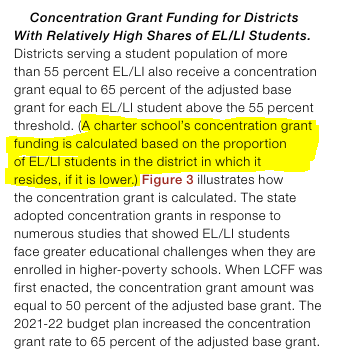
The law is clear. Under Education Code section 42238.02(f)(2)(A), the UPP percentage for concentration grants “shall not exceed” the UPP of “the school district in which the charter school is physically located.” That section goes on to say that if a charter school is physically located in more than one school district, the grant shall not exceed that of the higher UPP percentage.

KIPP is a large corporate charter chain with approximately 280 schools nationwide, including 17 in Northern California (“KIPP Norcal”). KIPP Bridge is a single school within the KIPP Norcal charter system. Each individual charter school is its own Local Education Agency (“LEA”), even when they are affiliated with a charter chain3. In Oakland, the only charter school which has geographic locations in more than one school district is Yu Ming Charter School, a county authorized charter school with locations in Oakland and San Lorenzo.
Instead of using OUSD as its “local district” KIPP Bridge lists Ravenswood City Elementary District in East Palo Alto as its local district, which has a higher UPP of 90.9% than OUSD’s UPP of 81.47%. To be clear, this forum shopping won’t work when the state does its calculations and makes the actual allocations, but it has the impact in this case of inflating the budget on paper for the purposes of renewal. So not only is KIPP Bridge going to have fewer students than projected, it will also have fewer concentration dollars on top of that. If KIPP Bridge used the correct local district, it would show less revenue, $358,141 in year 1 and rising each year as the inflated enrollment projections kick in. If it used more reasonable enrollment projections, it could receive $750,000 or more less revenue per year.
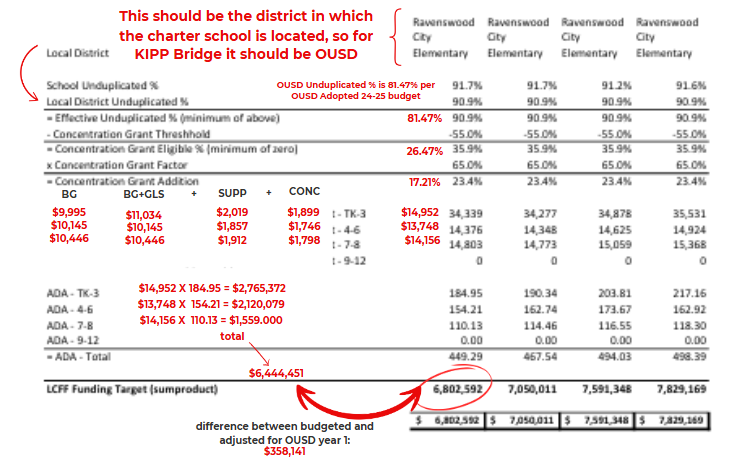
Even when using the incorrect district, KIPP Bridge’s numbers just don’t add up
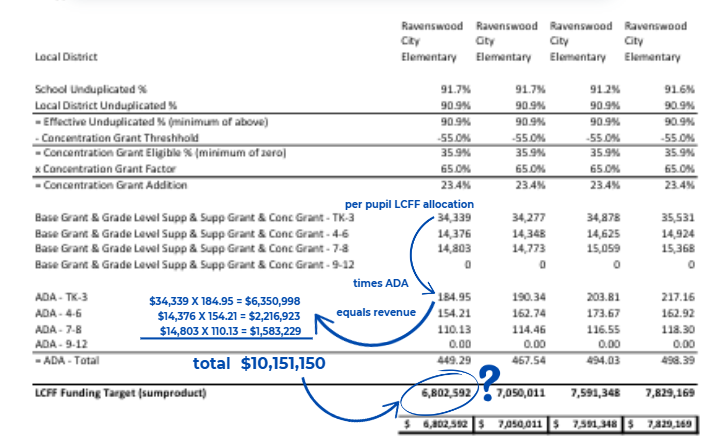
To calculate the LCFF funding for each year, you add up the Base + Grade Level grants plus the supplemental and concentrations grants to reach a per pupil allocation for each grade level. Then you multiply that per pupil allocation by the expected Average Daily Attendance (“ADA”)4 to reach the LCFF revenue. KIPP Bridge identified their per pupil allocation by grade level in the chart above as $34,339, $14,376 and $14,803 for TK-3, 4-6 and 7-8 respectively. Using their ADA numbers provided below that, their total LCFF allocation should be $10,151,150, but instead they list $6,802,392. We are not clear on how an “LCFF Calculator” could make such a mistake, generally you fill in the assumptions and the calculator spits out the total. We are clear, however, that this is something that anyone with even the slightest financial/budgetary knowledge would catch and is something that the OUSD staff reviewing the budget should have caught.
KIPP uses a TK-3 per pupil allocation that is wildly inaccurate and seemingly made up
The answer to why there is a massive $3.3 million miscalculation is that KIPP Bridge’s per pupil allocation for TK-3 students is based on a number that was seemingly snatched out of thin air: $34,339 in year one, rising to $35,531 in year four per TK-3 student at KIPP Bridge. We all wish that schools were funded at that rate instead of the $14,952 per pupil that is the actual funding, but budgets aren’t built on wishes (usually).

Any financial professional or charter office staff member should have immediately caught that mistake. By contrast, the EFC Learning without Limits petition identifies as the state allocation $15,304.53 per ADA for 2025-26.

Just the difference between the TK-3 and other allocations should have been a huge red flag, and we truly cannot explain why it was not caught. The fact that they ultimately didn’t use that per pupil allocation in their LCFF numbers is unimportant. Financial documents must be accurate and must be re-creatable in order to be trustworthy. The KIPP Bridge Petition financial information is so riddled with errors as to be inherently suspect and cannot form the basis for an evaluation of not just the budget but also all expenditures that make up the programs described. This is not a small mistake, this is a series of significant mistakes that make clear that KIPP Norcal copied and pasted together information without giving OUSD the respect of preparing a thoughtful and accurate petition for their real consideration. OUSD should make it clear that the KIPP Bridge petition must be withdrawn, corrected and resubmitted. If they are unwilling to do so, KIPP Bridge will have failed to meet the standards necessary for renewal by presenting a non-comprehensive petition with an unsound program that KIPP Bridge is demonstrably unlikely to successfully implement as described. KIPP Bridge should start over with its budget, using significantly more reasonable enrollment projections, a “maximum enrollment” equal to the highest of those reasonable enrollment projections, and the proper “Local District” UPP for concentration grant funds. It must also adjust its staffing projections as well as the entire academic program and support services that they offer to match the lower revenue projections. Anything less is simply inadequate and the petition would be appropriately denied. The OUSD Board must finally takes it role as an authorizer seriously and act responsibly and within the law to ensure the charter school is meeting its obligations to the public and to its students.
- The Unduplicated Pupil Percentage is the total percentage of Low-Income students, Foster Youth or English Learners, with each student being counted just once. So if a student is both Low-Income and a Foster Youth, they are only counted once. For more information about the UPP and the Local Control Funding Formula: https://abgt.assembly.ca.gov/system/files/2024-02/lao-lcff-overview.pdf ↩︎
- if the UPP is more than 55% ↩︎
- Aspire Lionel Wilson Prep is part of the Aspire Public Schools charter chain with schools in multiple cities, yet they appropriately used Oakland as their local district. https://resources.finalsite.net/images/v1722564903/ousdorg/ad5vrdgqqibazlkcbfzi/AspireLionelWilson2025-26RenewalPetition.pdf ↩︎
- In California, schools are funded not by the number of students enrolled, but by the average attendance for those students. https://edsource.org/glossary/average-daily-attendance-ada#:~:text=The%20total%20number%20of%20days%20of%20student%20attendance,counting%20students%20on%20a%20given%20day%20in%20October.%29 ↩︎
 Parents United for Public Schools