Why does OUSD keep trying to close schools to balance its budget when it clearly doesn’t work? The answer might be that the people pushing that narrative aren’t interested in our budget, they are interested in our buildings.

Outgoing Superintendent Dr. Johnson-Trammell has long argued that Oakland Unified School District (“OUSD”) must close schools in order to be fiscally sustainable, yet the majority of our elected school board has resisted that call, rescinding a decision to close schools in 2023, and rejecting a new plan to close and merge schools last fall. The argument is that we have too many schools for our declining enrollment, and that some schools are “underutilized” and not generating enough revenue (dependent on the Average Daily Attendance or “ADA”) to pay for itself, as if each school is a McDonald’s that needs to show a profit to stay open. We need to balance our budget as a unified system, and we need to offer accessible public education to Oakland’s kids, but we are not willing to have a real conversation about what that looks like. 

Much is made about the fact that OUSD has more schools than many other California school districts per ADA. The question is, why does that matter and are we talking about public schools in the right way?

OUSD does have more schools per student than most medium to large school districts, but does that mean we have “too many schools”? Part of how you answer that question may depend on what you see as the purpose of public education and what our constitutional obligation to provide a free public education to all children requires of us. A child who can no longer go to school because her neighborhood public school has closed has no access to public education.

OUSD has argued that elementary students can walk 2 miles to school, but experts agree that is 2 to 4 times more than is reasonable. 

It is important to note that OUSD does not provide transportation to most students, no yellow school buses pick kids up and take them to their neighborhood school, which means that if you do not have a car, you must walk to school or take public transit. Especially for elementary age students who most agree cannot take the bus on their own, there is a limit to how far a young child can be reasonably asked to walk to school. So long as Oakland does not provide transportation to all students, closing schools removes access to public education for many students and as such is not acceptable.

OUSD has fewer schools per square mile than most comparable school districts, most of whom provide transportation to school

So long as we are not providing transportation to students, every student needs a neighborhood public school within walking distance. Ideally, that would mean you would have at least 1 elementary school per square mile spread out evenly so that no child would have to walk more than 1/2 mile to get to school. Fontana Unified School District has approximately the same number of students as OUSD on 25 fewer campuses and has been used by OUSD as an example of a district that is “right sized”. Fontana is 52 square miles, which means they have 0.87 schools per square mile. They also provide transportation to all students who live certain distances from their neighborhood school, as shown below.

Oakland is 78 square miles and has 69 active campuses across Oakland. A sampling of ten medium to large school districts with a UPP (Unduplicated Pupil Percentage) greater than 50% (including Fontana) shows that the average number of schools per square mile  is 1.06.  As you can see, Oakland is at 0.88 schools per square mile which is about 2/10ths of a mile below the average and just about the same as Fontana. For comparison, Piedmont Unified has 371 ADA per school and 3 schools per square mile, fewer students per school and more schools per square mile.

OUSD only provides transportation to certain disabled students. The majority of these other school districts provide transportation beyond that to all students who qualify (usually based on location), and the only two districts that do not have approximately twice the number of schools per square mile as OUSD does. If we think about public education as a common good that must be accessible to all students, the number of schools per square mile, especially when you fail to provide transportation, is a more relevant number than the number of students per school. 

So who is pushing OUSD to close schools, anyway?

The people you most often see pushing school closures, in addition to our Superintendent and certain board members (mostly no longer on board) are charter school advocates (because the primary barrier to charter school growth is access to facilities) and mostly white/affluent parents whose children attend “hills” schools, because they believe that their schools will be spared because they are “fully enrolled” and “high performing”. We have seen (with Kaiser and Hillcrest) that those parents will change their tune when their school is targeted.

“Lack of access to affordable school buildings is the single immediate and overwhelming factor containing [charter school] growth.”

So why do charter advocates care about public school closures? The answer is simple: real estate. The Center on Reinventing Public Education (“CRPE”) is a right-wing charter school think tank that understands that without facilities, it is hard to growth the “market share” of charter schools, especially in the Bay Area where real estate is so expensive.

At OUSD board meetings where school closures are on the agenda, the only people speaking in favor of them are those charter school advocates, as pointed out in 2019 by Director Hutchinson.

For many years, GO Public Schools (“GO”) flooded school board elections to stack the board with directors who would further privatize OUSD and rubberstamp the growth of charter schools. Groups like Families in Action for Justice (or Education) have taken over GO’s role in school board elections, supporting candidates who support the continued and ongoing privatization of OUSD, including through charter school growth. Interestingly but not coincidentally, the most vocal supporters of the “Bankrupt” narrative being pushed by Director Hutchinson have mostly been Families in Action members, and Director Hutchinson has now taken to endorsing those same school board candidates (Salop, Aikens, Berry and Thompson in the last election) as both Families in Action and the new anti-progressive, anti-union group “Empower Oakland”.

Under Prop 39, closed district campuses must be offered to charter schools

We have posted before about Prop 39, the law that requires school districts to provide space in its schools for charter schools who ask for it in return for a “facilities use fee” that is significantly lower than for publicly owned spaces, usually less than $5 per square foot per year (not per month). Every year, OUSD receives between 5 and 17 requests for space in OUSD schools. Most of our previously closed schools are already spoken for, so charter schools have to “co-locate” with district schools unless there are newly vacant properties through school closures.
OUSD has a long history of closing schools since 2003. From 2004 to 2018 OUSD closed 18 schools, and 14 of them became new homes for charter schools. It is no surprise, then, that charter school advocates urge OUSD to “be bold” and close schools.


There are substantial errors in the KIPP Bridge Charter Petition which make it impossible for the OUSD Board to evaluate whether KIPP Bridge is demonstrably likely to successfully implement its program

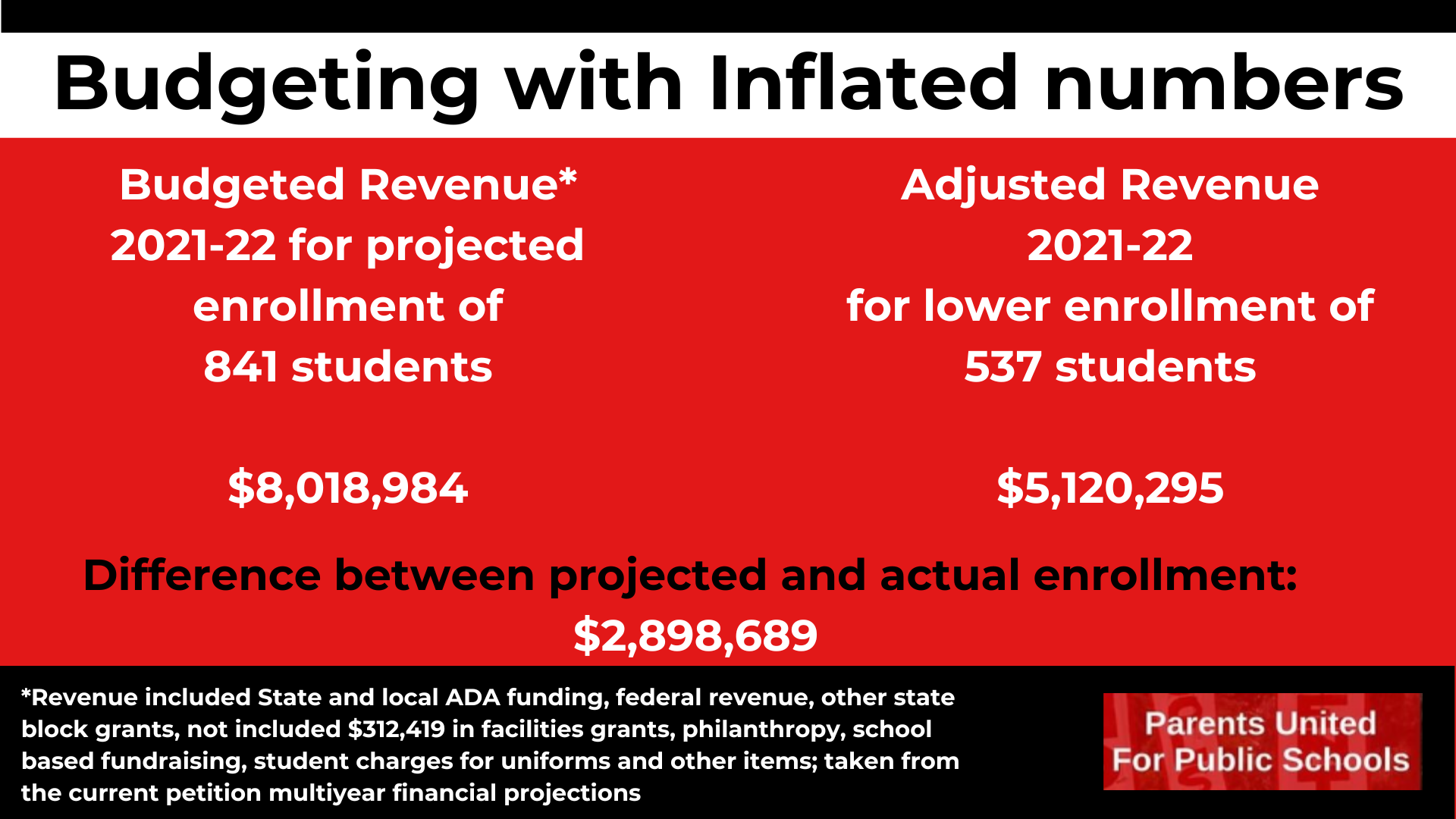
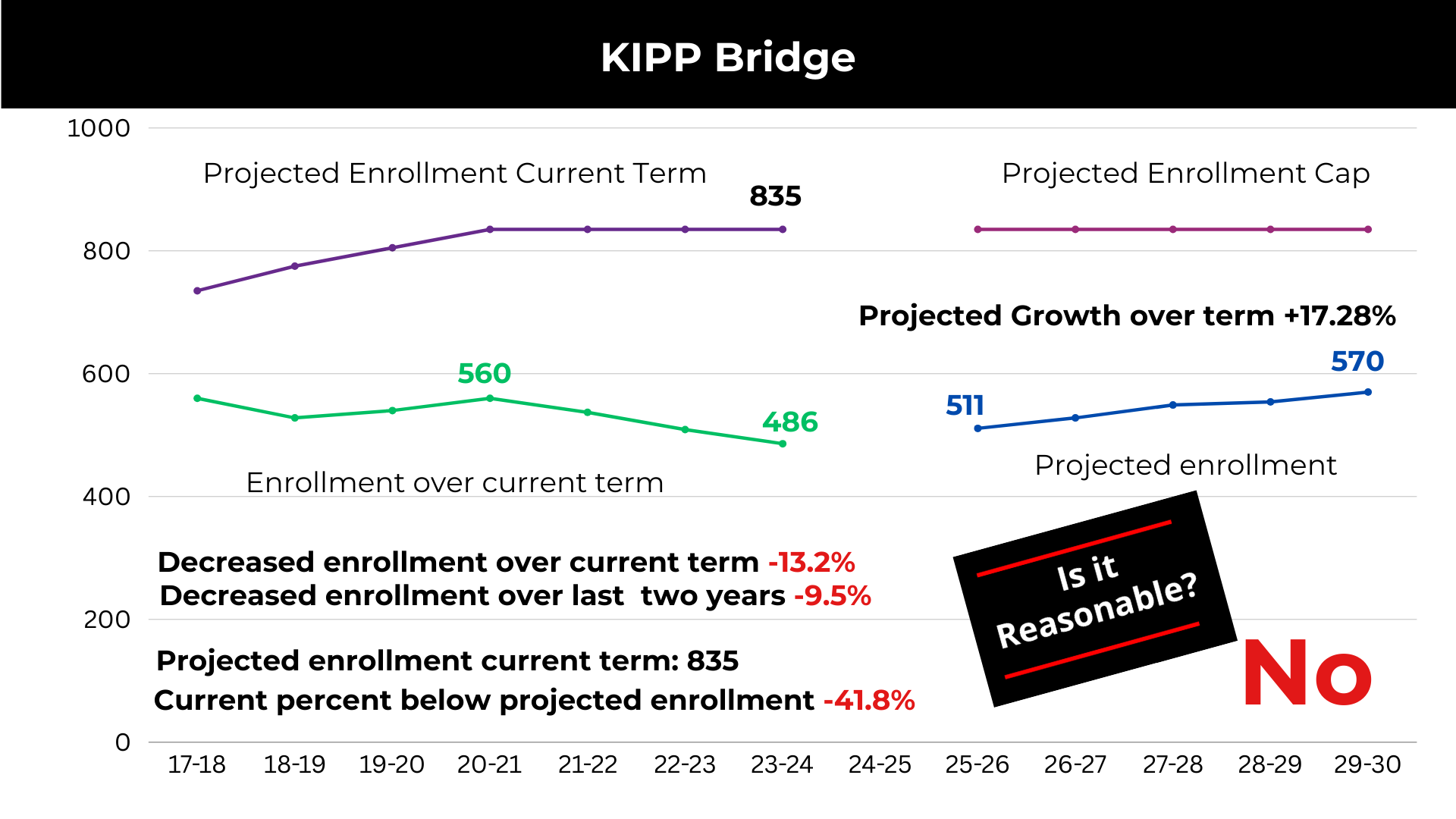
In a previous post, we discussed how KIPP Bridge and three other charter schools have over-projected their enrollment in their renewal petitions, and how that impacts their budget and thus their ability to successfully implement their academic program. The example above from 2021-22 makes clear that not achieving projected enrollment means a significant decrease in expected revenue. That is why forecasting enrollment accurately is so important. The Alameda County Board of Education recently rejected a material revision in part due to projected enrollment growth in a time of overall county decline, especially given the Charter school’s inability in the past to meet their own enrollment projections (like KIPP Bridge, who is currently 42% below its own projections):

Alameda County Board of Education Staff Report, May 14, 2024

So KIPP Bridge already has a problem: the Oakland Unified School District (OUSD) Board has in front of it a financial forecast based on enrollment projections that are inherently unreasonable.

Digging deeper into the financial package in the KIPP Bridge charter petition reveals other big problems as well. Not only is the budget based on inflated enrollment projections, but KIPP Bridge calculates its projected revenue (based on those inflated enrollment numbers) incorrectly, using as its “Local District” a school district in East Palo Alto, not Oakland, which results in hundreds of thousands of dollars less in revenue than they claim. In addition, even their own math with the incorrect “Local District” doesn’t add up, and lastly, they project a ridiculously high tk-3 State allocation of $34,339 per student, a number they seemingly pulled out of thin air.

Any of these errors would make an accountant cringe; taken in total, combined with the enrollment over-projections, make the entire financial analysis unreliable, and it must be redone in order for the OUSD Board to be able to determine whether to renew KIPP Bridge’s charter. Merely crossing out a few numbers and penciling in new calculations will not fix the problem. The entire foundation of the petition – the expected revenue – is flawed. If KIPP Bridge does not withdraw its petition and make all of the necessary corrections needed to make it accurate (including rationalizing the enrollment projections), and adjusting the programmatic offerings and staffing accordingly, the OUSD board must deny the petition as being non-comprehensive with an unsound program that they are demonstrably unlikely to successfully implement.

KIPP Bridge incorrectly uses the Unduplicated Pupil Percentage (UPP)1 of a district in East Palo Alto to calculate its state funding

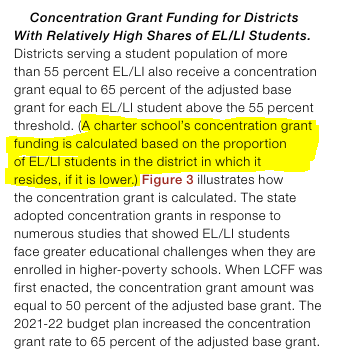
School funding in California dramatically changed in 2013 to give greater funding to school districts that serve higher-need students with a funding formula known as the “Local Control Funding Formula” or “LCFF”. Under this funding model, all school districts and charter schools receive base grants, possible grade span allocations and a “supplemental” grant equal to 20% x UPP% x Base grant to provide additional assistance to higher need students. In addition, some Districts and Charter Schools also receive “concentration grants” which are tied to the lesser of either the Local District or the Charter School’s UPP. All of that is then added up to the per pupil LCFF funding: the sum of the base + grade span + supplemental + concentration2.

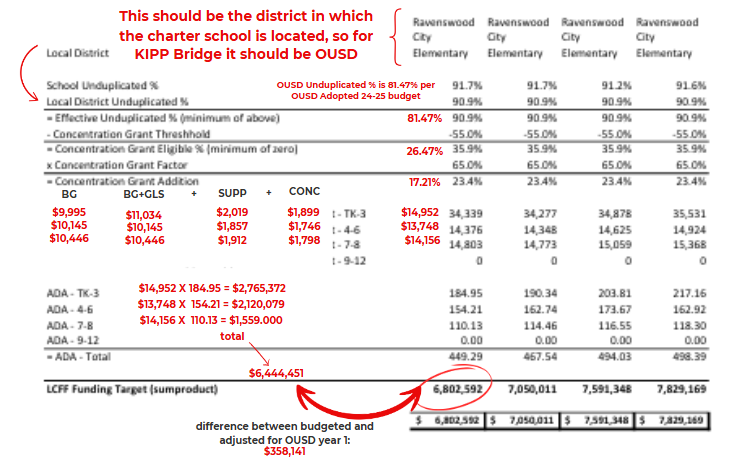
In the LCFF Calculator submitted as part of the KIPP Bridge charter petition, KIPP Bridge lists “Ravenswood City Elementary District” as its “Local District”. That is clearly an error – the “Local District” is the district in which the charter school geographically resides and should be OUSD.

The law is clear. Under Education Code section 42238.02(f)(2)(A), the UPP percentage for concentration grants “shall not exceed” the UPP of “the school district in which the charter school is physically located.” That section goes on to say that if a charter school is physically located in more than one school district, the grant shall not exceed that of the higher UPP percentage.

KIPP is a large corporate charter chain with approximately 280 schools nationwide, including 17 in Northern California (“KIPP Norcal”). KIPP Bridge is a single school within the KIPP Norcal charter system. Each individual charter school is its own Local Education Agency (“LEA”), even when they are affiliated with a charter chain3. In Oakland, the only charter school which has geographic locations in more than one school district is Yu Ming Charter School, a county authorized charter school with locations in Oakland and San Lorenzo.

Instead of using OUSD as its “local district” KIPP Bridge lists Ravenswood City Elementary District in East Palo Alto as its local district, which has a higher UPP of 90.9% than OUSD’s UPP of 81.47%. To be clear, this forum shopping won’t work when the state does its calculations and makes the actual allocations, but it has the impact in this case of inflating the budget on paper for the purposes of renewal. So not only is KIPP Bridge going to have fewer students than projected, it will also have fewer concentration dollars on top of that. If KIPP Bridge used the correct local district, it would show less revenue, $358,141 in year 1 and rising each year as the inflated enrollment projections kick in. If it used more reasonable enrollment projections, it could receive $750,000 or more less revenue per year.

Even when using the incorrect district, KIPP Bridge’s numbers just don’t add up

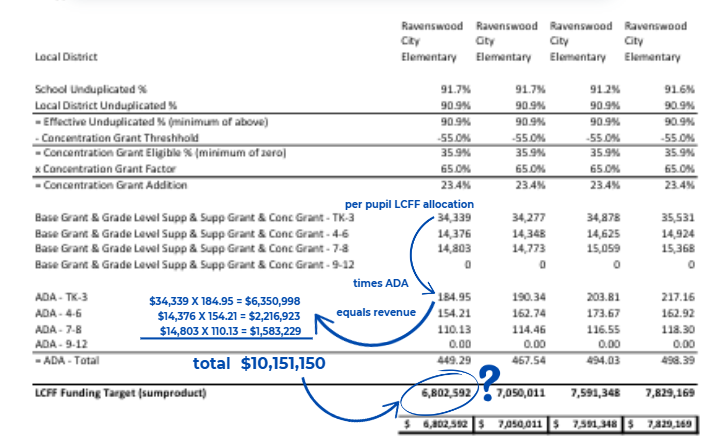
To calculate the LCFF funding for each year, you add up the Base + Grade Level grants plus the supplemental and concentrations grants to reach a per pupil allocation for each grade level. Then you multiply that per pupil allocation by the expected Average Daily Attendance (“ADA”)4 to reach the LCFF revenue. KIPP Bridge identified their per pupil allocation by grade level in the chart above as $34,339, $14,376 and $14,803 for TK-3, 4-6 and 7-8 respectively. Using their ADA numbers provided below that, their total LCFF allocation should be $10,151,150, but instead they list $6,802,392. We are not clear on how an “LCFF Calculator” could make such a mistake, generally you fill in the assumptions and the calculator spits out the total. We are clear, however, that this is something that anyone with even the slightest financial/budgetary knowledge would catch and is something that the OUSD staff reviewing the budget should have caught.

KIPP uses a TK-3 per pupil allocation that is wildly inaccurate and seemingly made up

The answer to why there is a massive $3.3 million miscalculation is that KIPP Bridge’s per pupil allocation for TK-3 students is based on a number that was seemingly snatched out of thin air: $34,339 in year one, rising to $35,531 in year four per TK-3 student at KIPP Bridge. We all wish that schools were funded at that rate instead of the $14,952 per pupil that is the actual funding, but budgets aren’t built on wishes (usually).

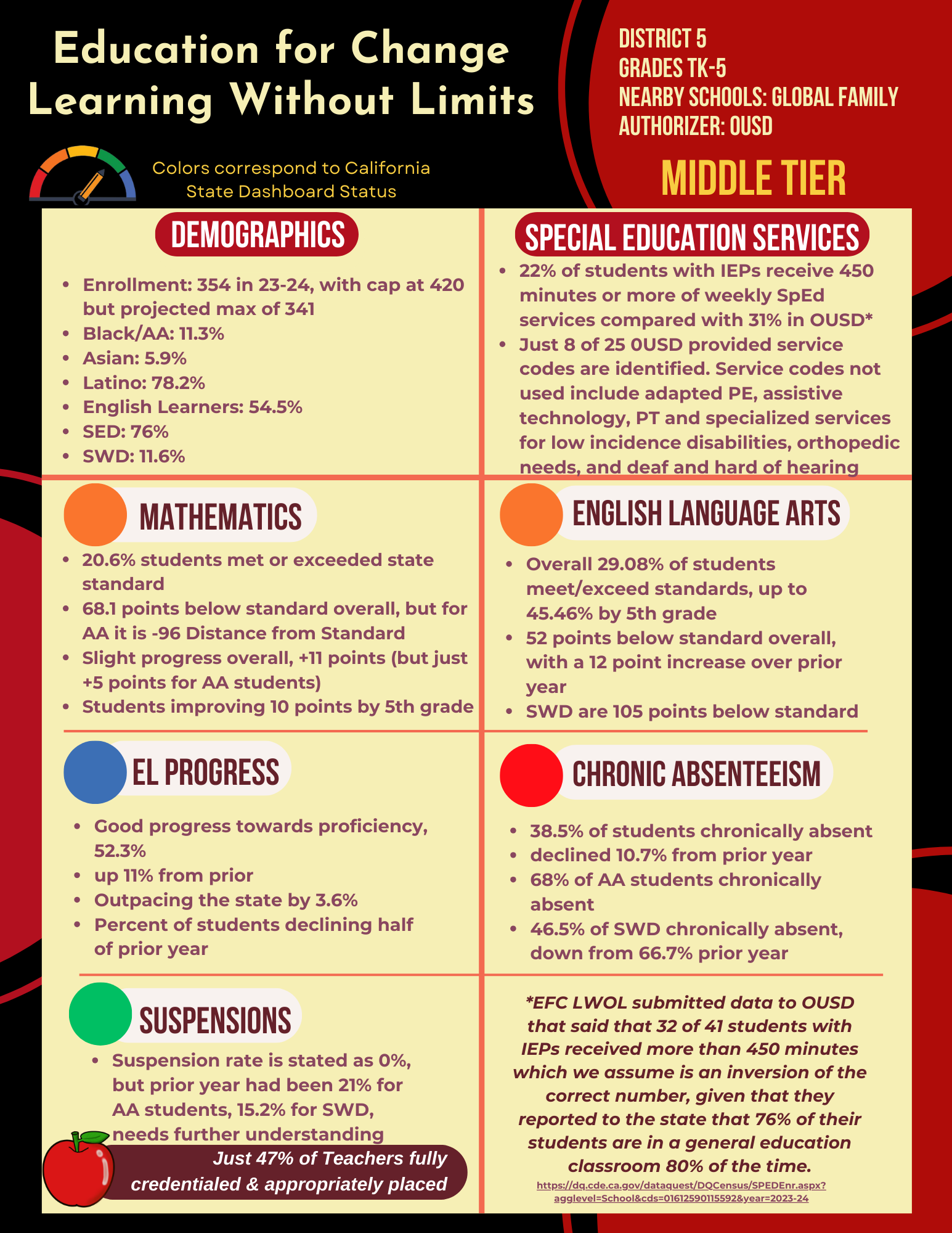
Any financial professional or charter office staff member should have immediately caught that mistake. By contrast, the EFC Learning without Limits petition identifies as the state allocation $15,304.53 per ADA for 2025-26.

Just the difference between the TK-3 and other allocations should have been a huge red flag, and we truly cannot explain why it was not caught. The fact that they ultimately didn’t use that per pupil allocation in their LCFF numbers is unimportant. Financial documents must be accurate and must be re-creatable in order to be trustworthy. The KIPP Bridge Petition financial information is so riddled with errors as to be inherently suspect and cannot form the basis for an evaluation of not just the budget but also all expenditures that make up the programs described. This is not a small mistake, this is a series of significant mistakes that make clear that KIPP Norcal copied and pasted together information without giving OUSD the respect of preparing a thoughtful and accurate petition for their real consideration. OUSD should make it clear that the KIPP Bridge petition must be withdrawn, corrected and resubmitted. If they are unwilling to do so, KIPP Bridge will have failed to meet the standards necessary for renewal by presenting a non-comprehensive petition with an unsound program that KIPP Bridge is demonstrably unlikely to successfully implement as described. KIPP Bridge should start over with its budget, using significantly more reasonable enrollment projections, a “maximum enrollment” equal to the highest of those reasonable enrollment projections, and the proper “Local District” UPP for concentration grant funds. It must also adjust its staffing projections as well as the entire academic program and support services that they offer to match the lower revenue projections. Anything less is simply inadequate and the petition would be appropriately denied. The OUSD Board must finally takes it role as an authorizer seriously and act responsibly and within the law to ensure the charter school is meeting its obligations to the public and to its students.

  1. The Unduplicated Pupil Percentage is the total percentage of Low-Income students, Foster Youth or English Learners, with each student being counted just once. So if a student is both Low-Income and a Foster Youth, they are only counted once. For more information about the UPP and the Local Control Funding Formula: https://abgt.assembly.ca.gov/system/files/2024-02/lao-lcff-overview.pdf ↩︎
  2. if the UPP is more than 55% ↩︎
  3. Aspire Lionel Wilson Prep is part of the Aspire Public Schools charter chain with schools in multiple cities, yet they appropriately used Oakland as their local district. https://resources.finalsite.net/images/v1722564903/ousdorg/ad5vrdgqqibazlkcbfzi/AspireLionelWilson2025-26RenewalPetition.pdf ↩︎
  4. In California, schools are funded not by the number of students enrolled, but by the average attendance for those students. https://edsource.org/glossary/average-daily-attendance-ada#:~:text=The%20total%20number%20of%20days%20of%20student%20attendance,counting%20students%20on%20a%20given%20day%20in%20October.%29 ↩︎

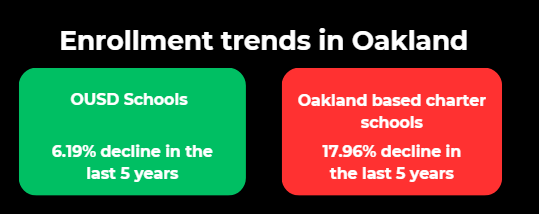
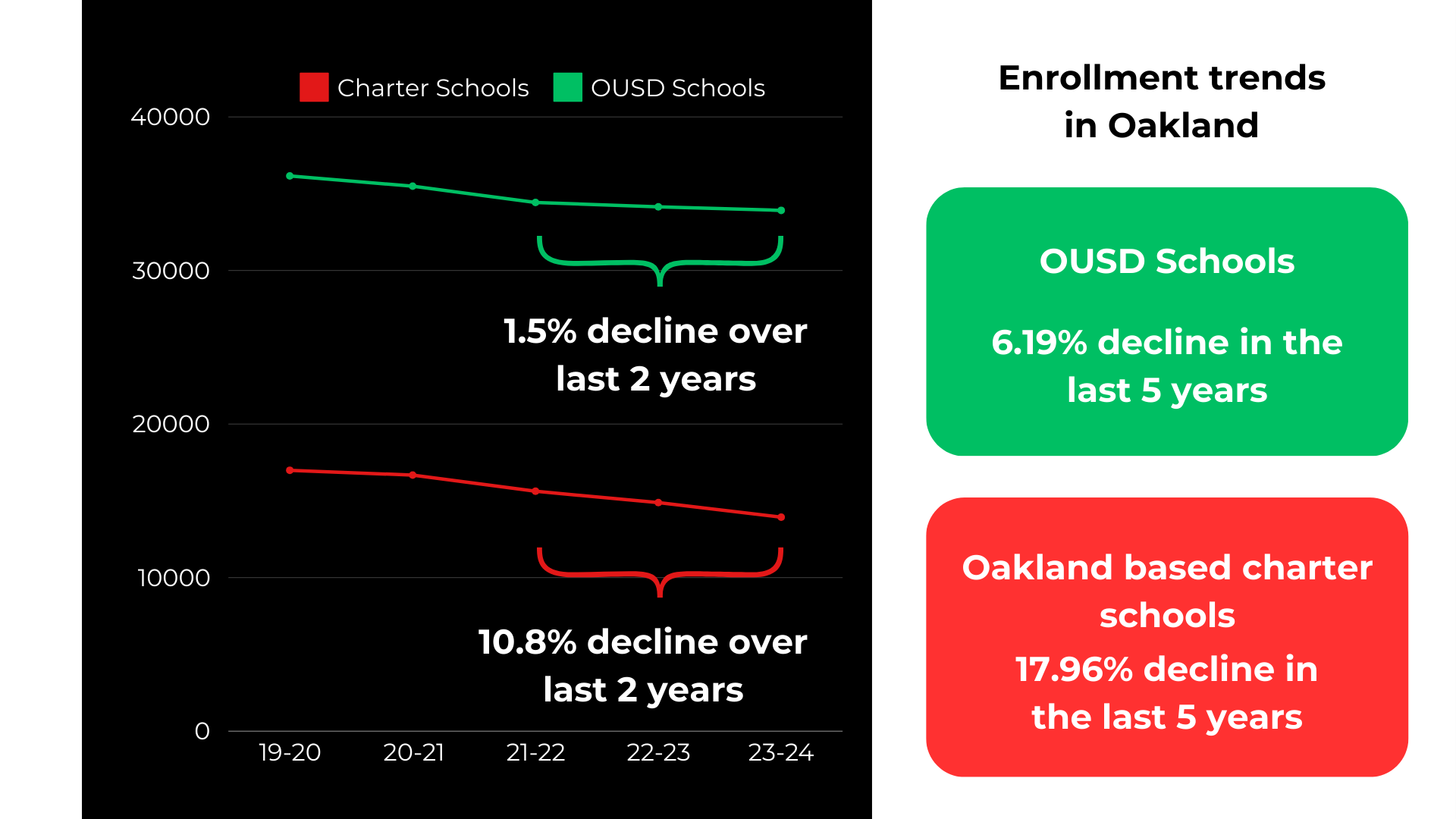
Charter School enrollment declined 11% over the last two years (and nearly 20% over the last five), so why are most charter schools projecting enrollment increases of between 5% and 30% in their charter renewals, and what should OUSD do about it?

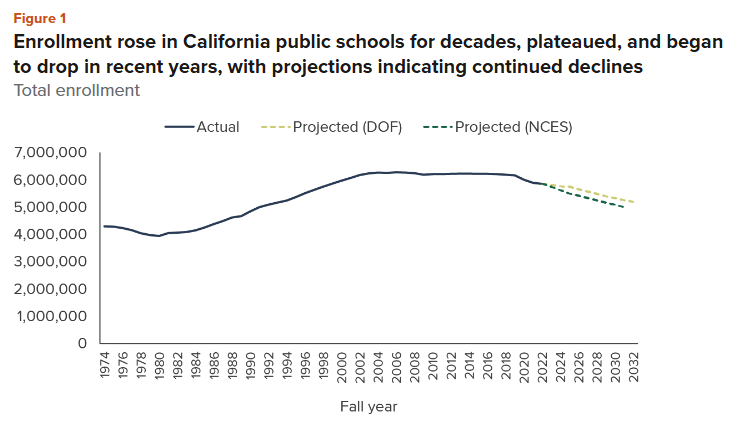
Experts agree: Enrollment will continue to decline over the next five years

It has been all over the news, especially in California: declining birth rates and families escaping the high cost of living mean that there are fewer school age children to attend our schools, whether public or charter.

https://www.ppic.org/publication/factors-and-future-projections-for-k-12-declining-enrollment/

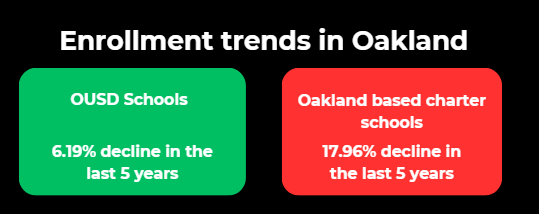
This trend is apparent in Oakland as well, with OUSD Schools declining an average of 1.2% over each of the last five years, and projected enrollment decreases in future. OUSD’s loss pales in comparison, however, to the decline in charter school enrollment over the same period. Charter school enrollment declined 3 times faster than OUSD over the 5 year period, and 5 times faster over the last two years post pandemic. In other words, while OUSD enrollment loss has slowed down over time, charter school enrollment loss has accelerated.

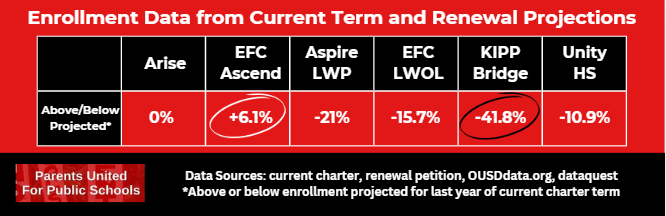
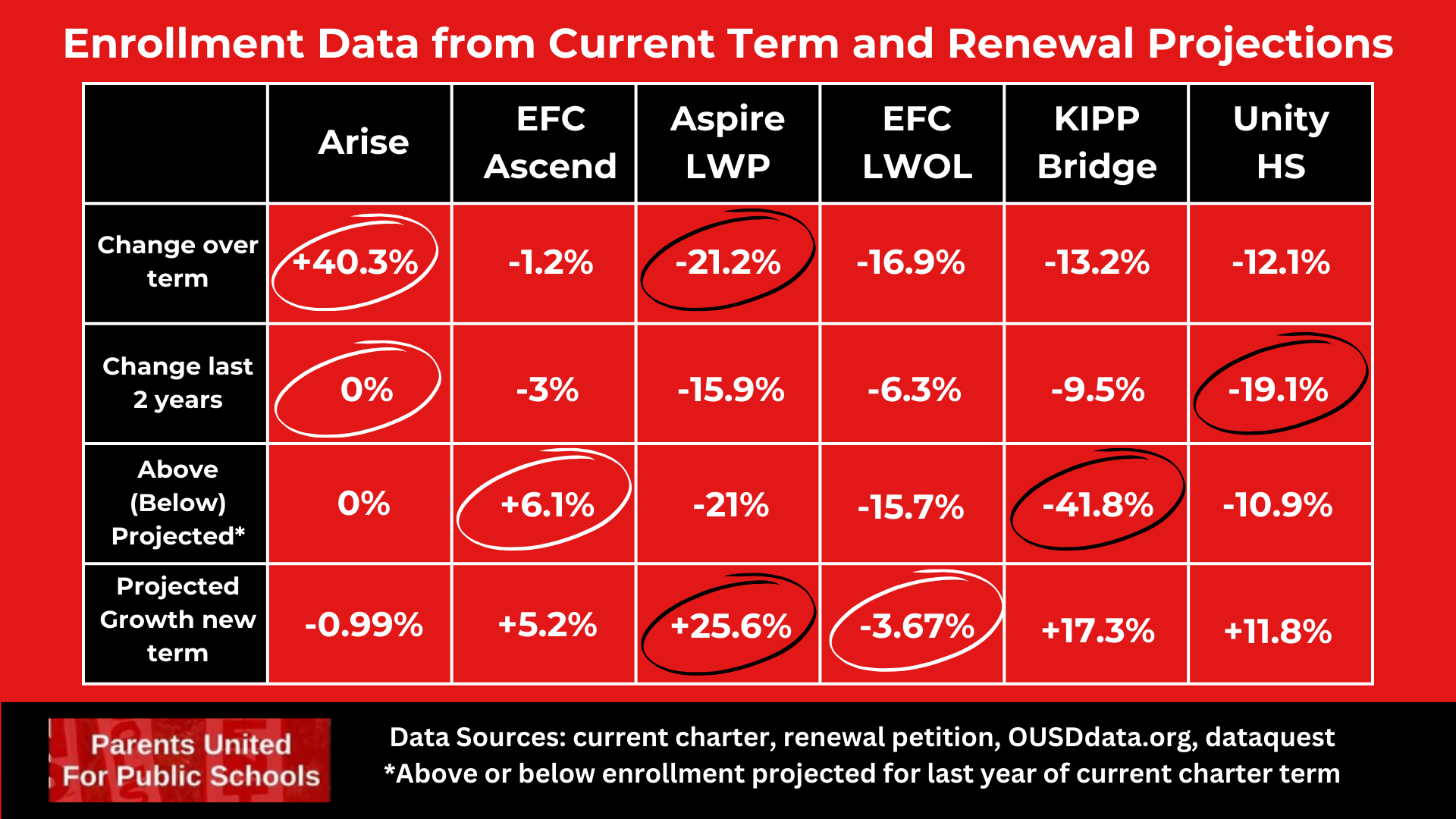
Despite the overwhelming evidence that enrollment losses are likely to continue, 4 of the 6 charter schools who have already submitted renewal petitions are projecting substantial enrollment growth over their five year term.

Most charter schools didn’t meet their enrollment projections in the current term

“Enrollment drives revenue” is something we hear a lot when discussing OUSD’s budget. Try to imagine the reaction of the County Superintendent who oversees the OUSD budget if we submitted a budget with a projected multi-year growth of 26%! Like OUSD, charter schools build their budgets based on “enrollment projections” of the number of students that they expect to enroll for each of the years of their proposed renewed charter. Those projections establish the budget and what kinds of staffing and programs that the charter school is able offer to students, and it is on the basis of that proposed budget and programming that an authorizing board decides whether to approve or deny a charter renewal. 4 of the 6 charter schools currently seeking renewal were already between 11% and 42% below what their budget was built on and their charter renewal was evaluated for1.

For instance, KIPP Bridge projected an enrollment of 841 students for 2021-22, but actually realized only 537 students, a decrease of 42%. That translates to about $2.9 million less revenue out of an $8.3 million budget. That means fewer classroom teachers are needed (and so won’t be hired) but it also means less money overall for music, art, athletics, field trips, tutoring, specialized support and other things promised in the program description in the charter. Further, it also means that the per pupil cost of fixed and administrative costs goes up and must be directed away from all of those programmatic extras to cover those costs.

The OUSD Board should not approve any charter that is based on inherently unreasonable enrollment projections

Making accurate, reasonable enrollment projections in the charter petition is critical to ensuring that the authorizer can appropriately evaluate whether the charter school is demonstrably likely to successfully implement the program. It is simply not possible to successfully implement a program as described in the petition with 40% less revenue than you were planning for. Projecting a significant rise in enrollment is inherently unreasonable given the history and expert analysis that enrollment will be declining and OUSD should not be approving any charter that has overstated its enrollment in a way that will negatively impact their ability to implement the full program for students that is the basis of the charter.

These patently unreasonable and unattainable enrollment projections could be the basis for the following findings:

(1) under 47605c1: The charter school presents an unsound educational program because parents and students who are currently enrolled are likely to have their school close mid-year, which creates instability for students and families

(2) under 47605c2: The petitioners are demonstrably unlikely to successfully implement the program set forth in the petition because the program relies on revenue that is based on unreasonable enrollment projections.

Deeper dive into charter schools which have already submitted their renewal petitions

Arise High School

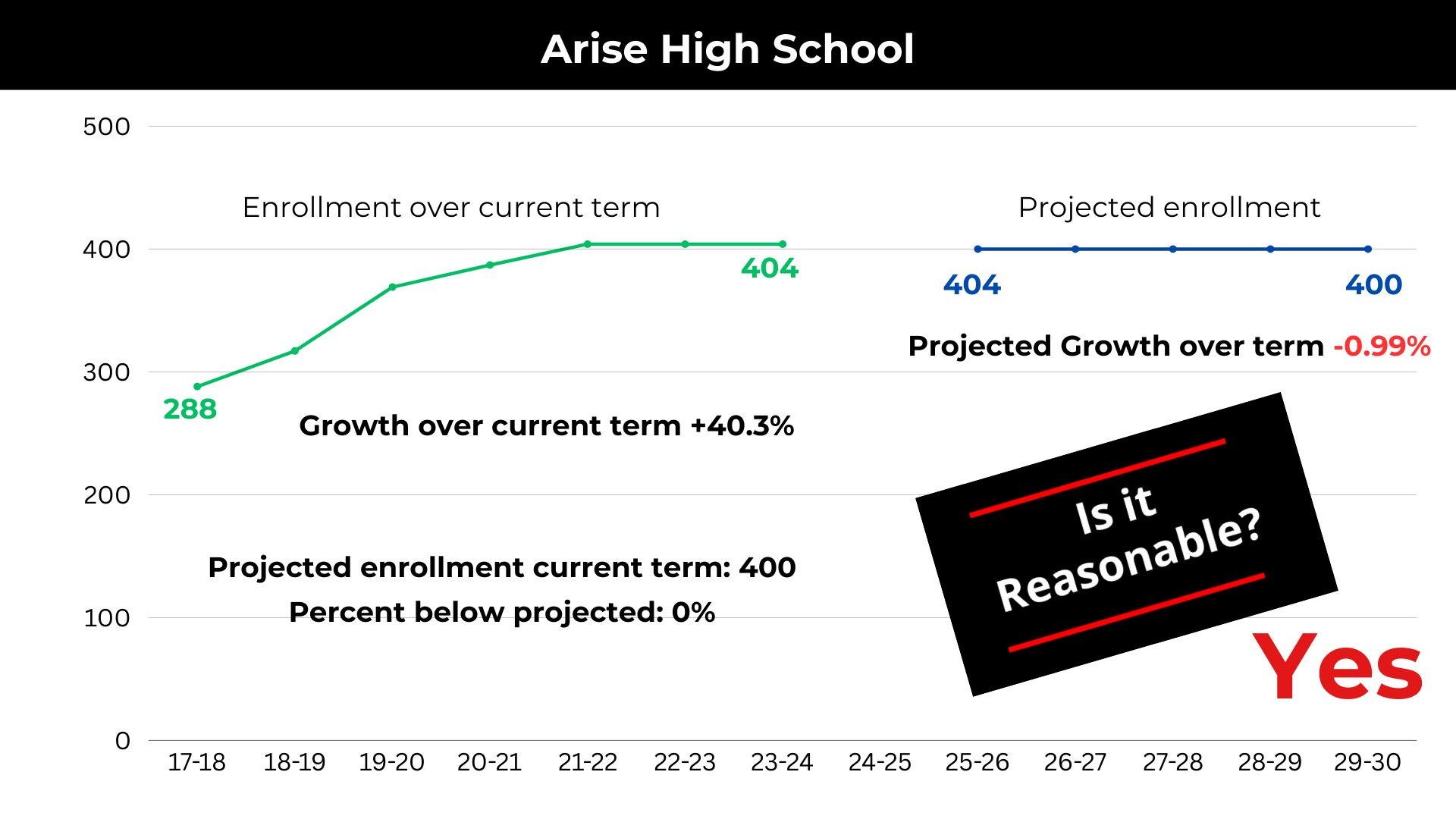
Arise High School has had consistently steady enrollment, even during and since the pandemic when most other charter schools declined at an average rate of 5% per year. Arise’s projection of continued even enrollment is reasonable.

Aspire Lionel Wilson Prep

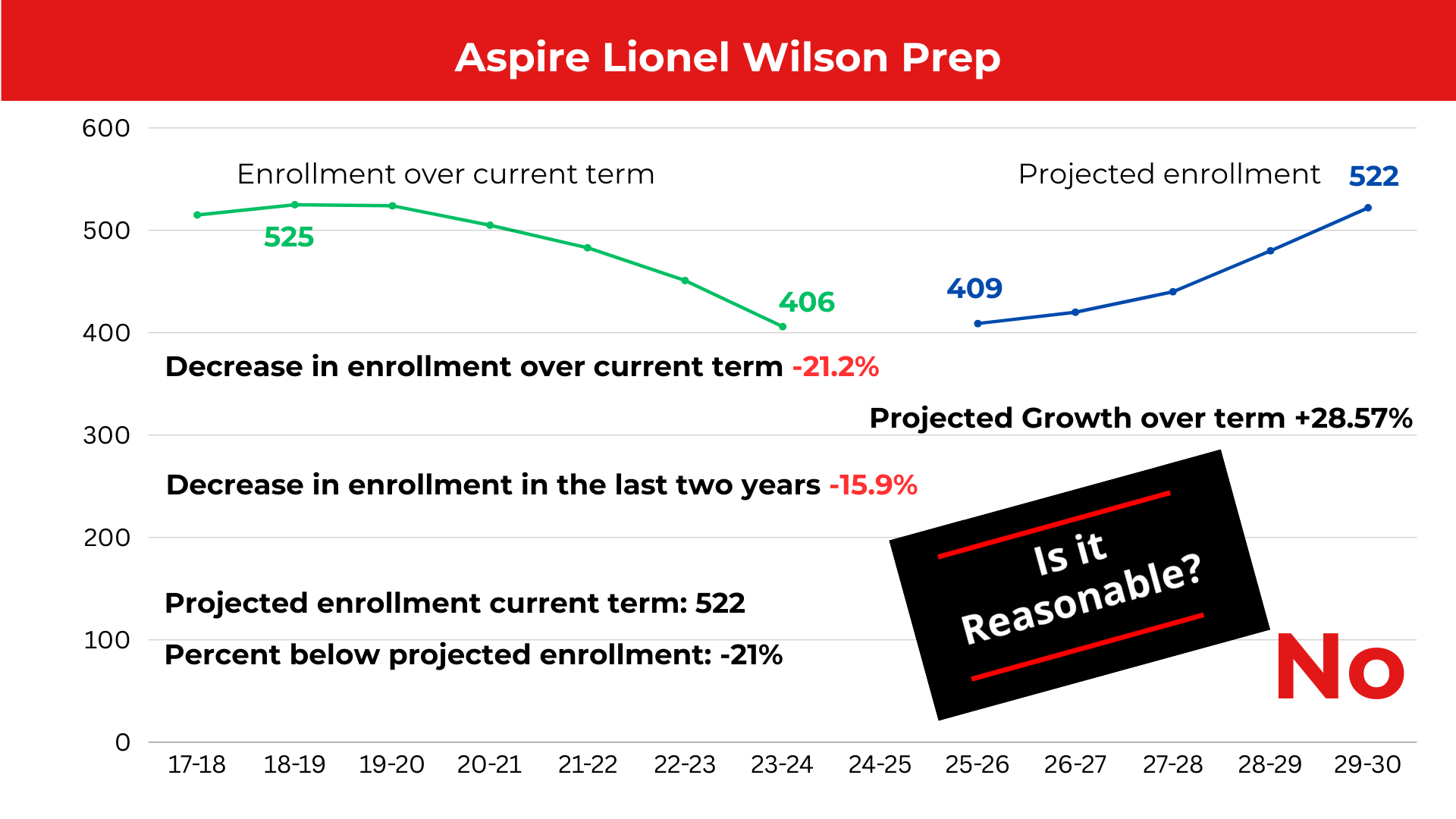
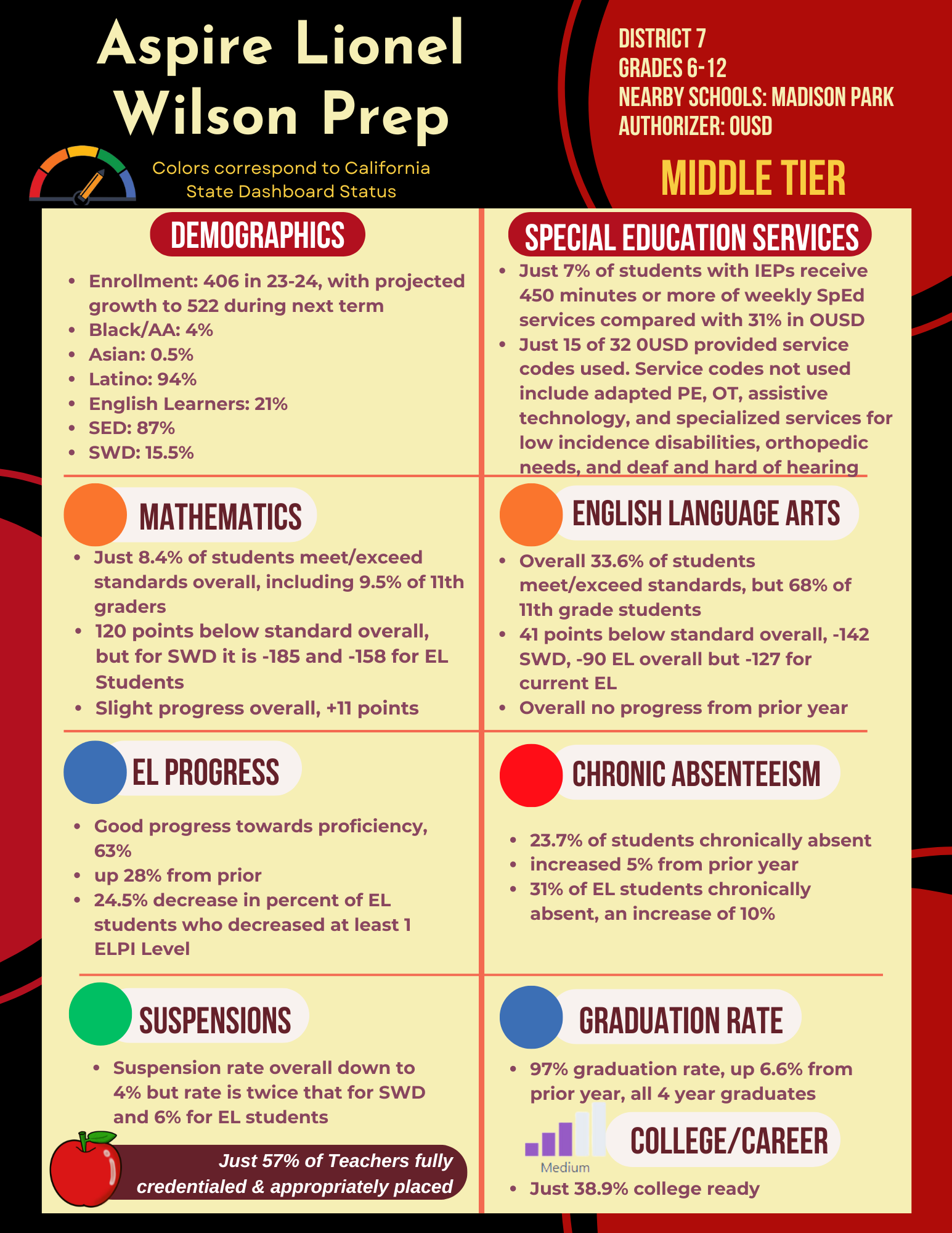
Aspire Lionel Wilson Preparatory Academy (“Aspire LWP”) has suffered a significant loss in enrollment since the beginning of the pandemic from which they have not recovered. Enrollment is down from a high of 525 to 406 in 2023-24 (the most recent official data from the state). While OUSD and most charter school’s enrollment loss slowed down in the last two years, it has continued to accelerate for Aspire LWP, down 15.9% over their last two years alone. In the pandemic years of remote learning, enrollment was down 4% each year. But in the last two years, enrollment fell 6.6% in 2022-23 and 10% in 2023-24, twice the rate of the pandemic enrollment loss.

Given that, it is inherently unreasonable for Aspire LWP to be projecting a nearly 30% growth over the next charter term. It is hard to turn around steep enrollment decline, but it is frankly impossible in a time when enrollment is expected to continue to decline as is projected for California. If OUSD projected a 30% growth and based its multiyear projections on that, the county trustee would reject it as inherently unreasonable. OUSD should do the same here. The fiscal projections are not reasonable, making the programmatic offerings not realistic.

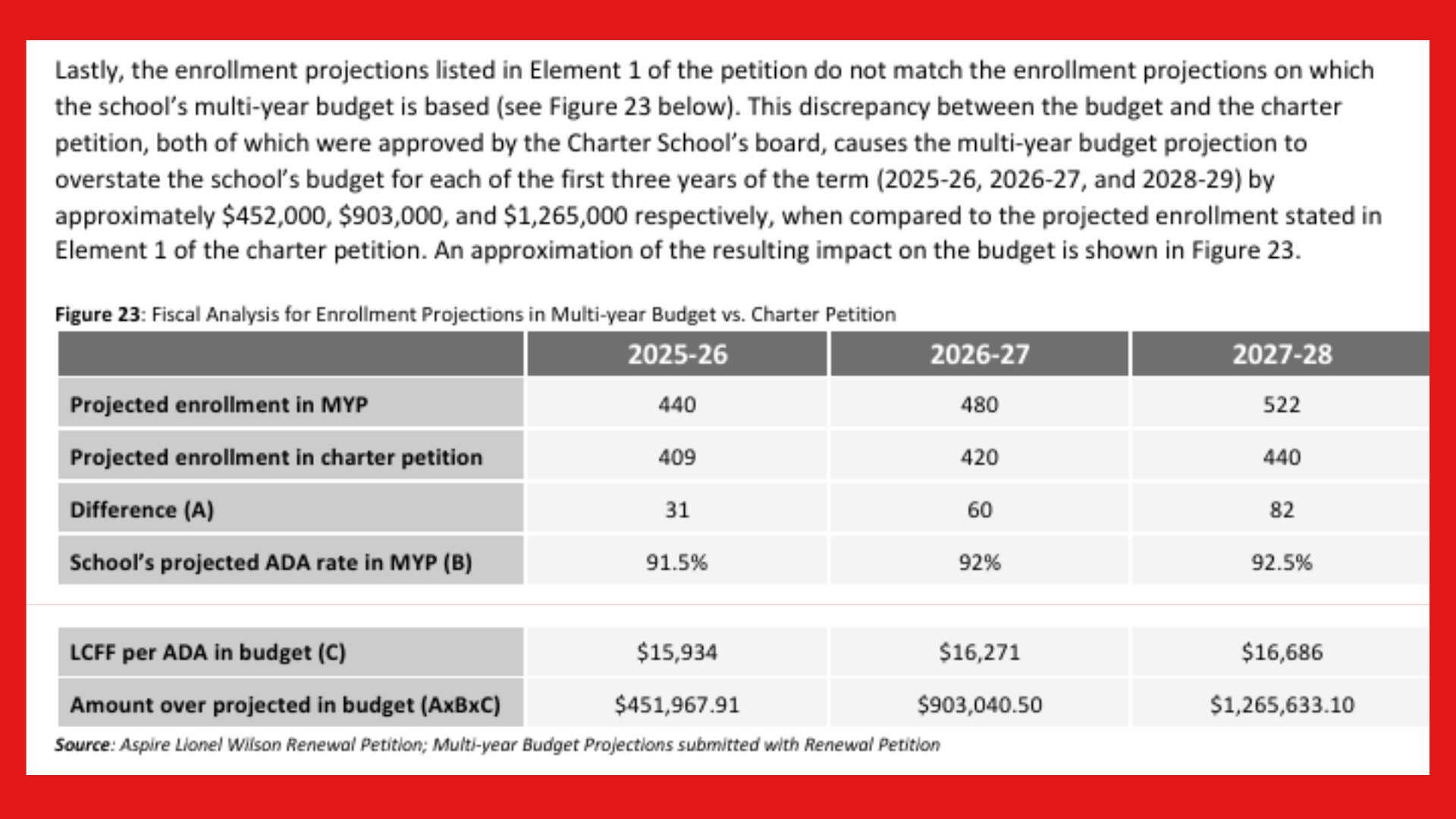
The OUSD staff report for Aspire LWP had a fairly in depth discussion about the unreasonable enrollment projections, stating that the petition “does not accurately project the financial reality for the 2025-26, 2026-27, and 2027-28 school years” and further that the projections as stated in the petition and the assumptions of the Multi-year budget did not match, resulting in an even greater over projection of revenue:

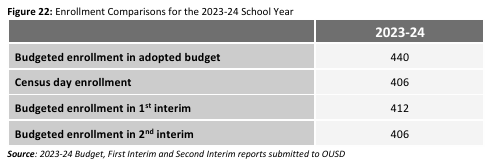
OUSD Charter Staff also stated that “As shown below, the adopted budget for the 2023-24 school year was based on substantially over projected enrollment assumptions, which together with the MYBP submitted in the renewal petition, demonstrates a concerning pattern of the school’s governing board approving budgets that rely on unrealistic enrollment figures” (emphasis added).

Based on all of this, it is clear that even OUSD believes that the enrollment projections are inherently unreasonable. Despite that, OUSD staff recommends approval, which is surprising and irresponsible. This petition contains ample “challenges” that could be used as findings supporting a denial of the Aspire LWP petition, including the unreasonable enrollment assumptions2. The OUSD board must act as a reasonable, rational authorizer and deny the petition based on all of the findings, including this one.

Education for Change Ascend

Education for Change (“EFC”) Ascend had a moderate enrollment decrease over its term, including a 3% loss over the last two years, but because they were at one time 11% above projected, they largely absorbed that decline and as of this year are still ahead of their projections by 21 students.

Nonetheless, EFC Ascend is projecting a 5.2% growth, including a 4.4% growth next year. While not as significant as the growth some of the other charter schools are claiming, it is still a substantial single year growth that may not be achieved, and in fact may decline. OUSD Staff should ask EFC Ascend for its census day enrollment for 2024-25 before the hearing date of October 10th to see whether EFC Ascend’s enrollment has made some recovery (gained students) or if the trend of continued declining enrollment continues, the OUSD Board should look carefully at the financial projections to determine whether this charter school will be demonstrably likely to implement the program with inaccurate financial projections.

Education for Change Learning without Limits

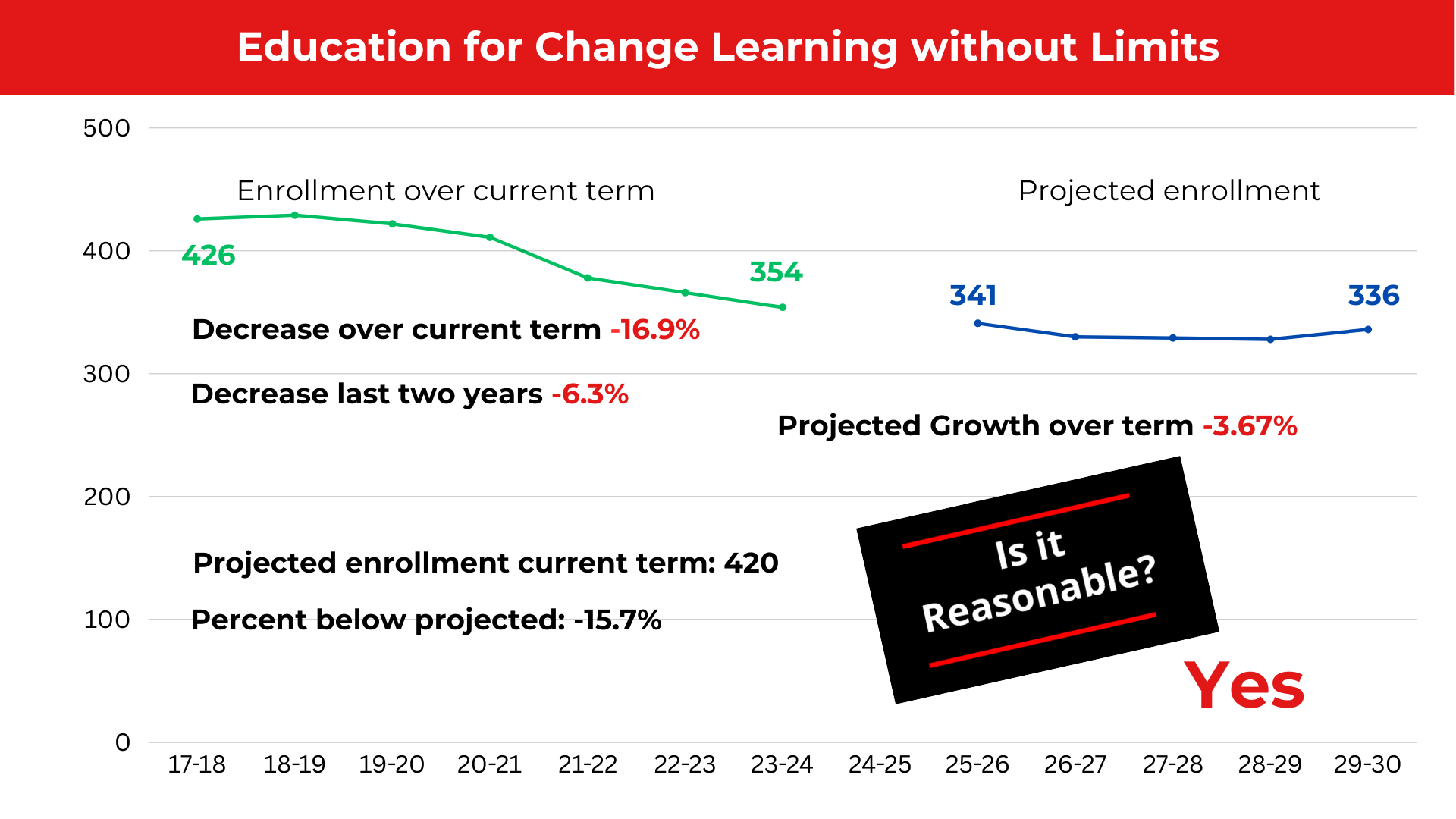
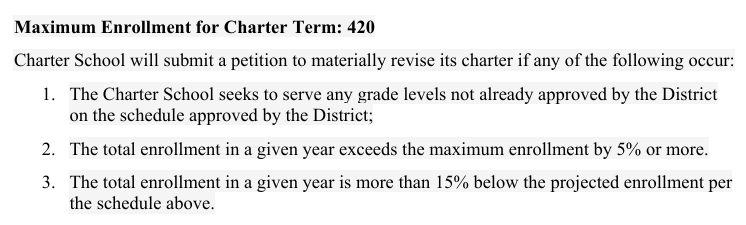
EFC Learning without Limits is projecting a slight decline in enrollment, which is reasonable and consistent with its history. However, the charter school identified the “maximum enrollment” as 420, which is NOT reasonable, and the board should require EFC to change that to the 341 maximum enrollment specified in the contract. This is an attempt by this and two other charter schools (KIPP Bridge and Unity High School) to circumvent the following OUSD oversight language in the charter petition”

By including a maximum enrollment well above their enrollment projections, they will technically fail to trigger a material revision as the required language refers to “maximum enrollment” instead of “projected enrollment” as is required in item 3.3 This is not appropriate and the board should make clear that this must be changed and that OUSD will continue to base the need for a material revision on the projected enrollment and not any artificial “maximum enrollment” stated by the charter school itself.

KIPP Bridge

Of the charter schools with inflated enrollment projections, KIPP Bridge’s numbers are the most egregious. KIPP Bridge is current 42% below their projected enrollment of 835, and enrollment has declined over the past two years alone by 9.5%. But looking at their numbers over the course of their entire current charter term, they never came even close to meeting their projected enrollment, and should have been required to request a material revision long ago.4

For the charter school to be now projecting an increase in enrollment over the next 5 years of more than 17% is unreasonable on its face, and this board should not approve this charter unless those numbers are changed, which at this point requires that KIPP Bridge withdraw their petition and start over. Simply substituting new numbers for old numbers will not fix the problem, the fiscal analysis and program offerings will still be based on the prior, patently unreasonable numbers. If KIPP Bridge insists on pushing forward with this petition5 OUSD must deny the renewal petition.

Unity High School

Oakland Unity High School was unusual for Oakland based charter school in that they initially gained enrollment during the pandemic, gaining 21 students from 2019-20 to 2021-22. Since the return to in person education, Unity High School experienced a sharp decline in enrollment over the last two years of 20%, a significant loss. Despite that, Unity High School is projecting 12% growth over the charter term, including a 4% increase by next year. It is important to look at the 2024-25 census day enrollment to see where Unity High School stands right now, but if enrollment is continuing to decline at or near the rate currently being experienced, Unity High School will be experiencing significant financial difficulties which will make it virtually impossible to run a successful high school program.6

OUSD must be a responsible authorizer and ensure enrollment projections, budgets and academic offerings are reasonable and that the charter school is demonstrably likely to successfully implement the program set forth in the petition.

For too long, OUSD has rubberstamped charter renewals, absent really egregious problems, so much so that charter leaders are objecting to answering reasonable questions from board members. As the authorizer, OUSD has an obligation to ensure that the charter school is demonstrably likely to successfully implement the program, and should use what has happened in the current term as evidence of that, including student progress for all subgroups to state standards and how well the school met its own benchmarks, which includes enrollment and fiscal goals. In this context of declining enrollment statewide, the OUSD board must look closely at the enrollment projections, as enrollment drives revenue which makes a successful program possible.

  1. OUSD should have required these schools to request a material revision pursuant to its own “Material Revision Handbook” which requires it when the charter has “increasing or decreasing enrollment, respectively, above or below the number originally projected in the charter petition” and requires an “An analysis of the proposed change’s impact on staffing, budget, and facilities”. Going forward, OUSD should follow the practice of the Alameda County Board of Education of regularly requiring material revisions for any decreases in enrollment below projections. ↩︎
  2. Other findings could be based on: the failure of middle school grades to meet state standards in both math and ELA post pandemic (while being significantly below OUSD post pandemic); failure of HS to meet state standards (or OUSD average) in Math, resulting in just 9% of students who met or exceeded standards in math; failure to show meaningful differentiation or academic discourse; Enrollment demographics do not reflect the diversity of OUSD schools; and serving only a minimal number of students with moderate/severe disabilities based on service minutes. ↩︎
  3. OUSD should revise this required language to make that change clear. In addition, OUSD should revise item 3 to read 10% as was previously required language used by OUSD (and for some reason was changed without notice) and is also the best practice established by the Alameda County Board of Education. ↩︎
  4. The charter school office has stated that they did not require a material revision due to low enrollment because it was not explicitly contained in all prior petitions, but that does not prevent them from doing their due diligence to review the fiscal sustainability and ability to meet the promises in their charter of a charter school which they authorize, and a charter school that is 25% or more below projections clearly is not functioning as set forth in the charter due to a lack of revenue. ↩︎
  5. Although not covered in this post, KIPP Bridge also has significant issues with the accuracy of its financial data submitted as part of this petition which should require them to withdraw to correct those mistakes anyway. OUSD should make clear that the enrollment projections must be fixed, and also that the “maximum enrollment” must be no more than their projected enrollment as discussed with EFC Learning without Limits, above. ↩︎
  6. Unity High School also has overstated its maximum enrollment and OUSD should require them to adjust it from 450 to the maximum enrollment in the petition. ↩︎

#ousd #charterrenewals

Guest Commentary: How Should OUSD Board Assess Charter Schools Facing Renewal?

This guest commentary is authored by Emily Filloy, Marcia Henry, Jan Malvin, Alison McDonald and Shelly Weintraub, on behalf of Educators for Democratic Schools. 

Among the major decisions facing the Oakland School Board this fall will be votes on the future of nine charter schools. Renewals have backed up because of extensions granted due to the pandemic. In considering whether to continue these schools – all operated with public funds, but governed by private corporate boards and thus not accountable to the public – the OUSD Board should ask some hard questions. Do these nine schools offer their students a truly equitable education? Do they improve the overall quality of public education in Oakland? Do they abide by the requirements of state law? We urge the Board to carefully consider these important questions: 

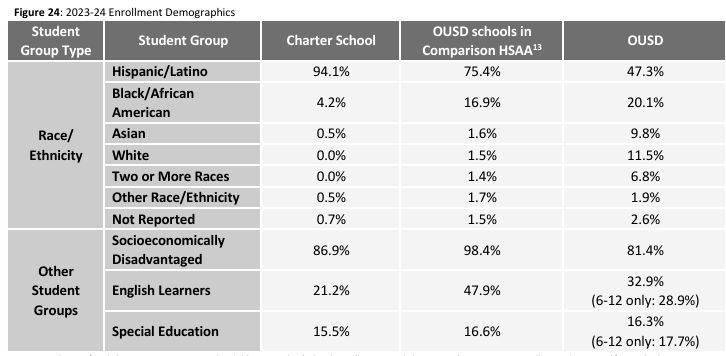
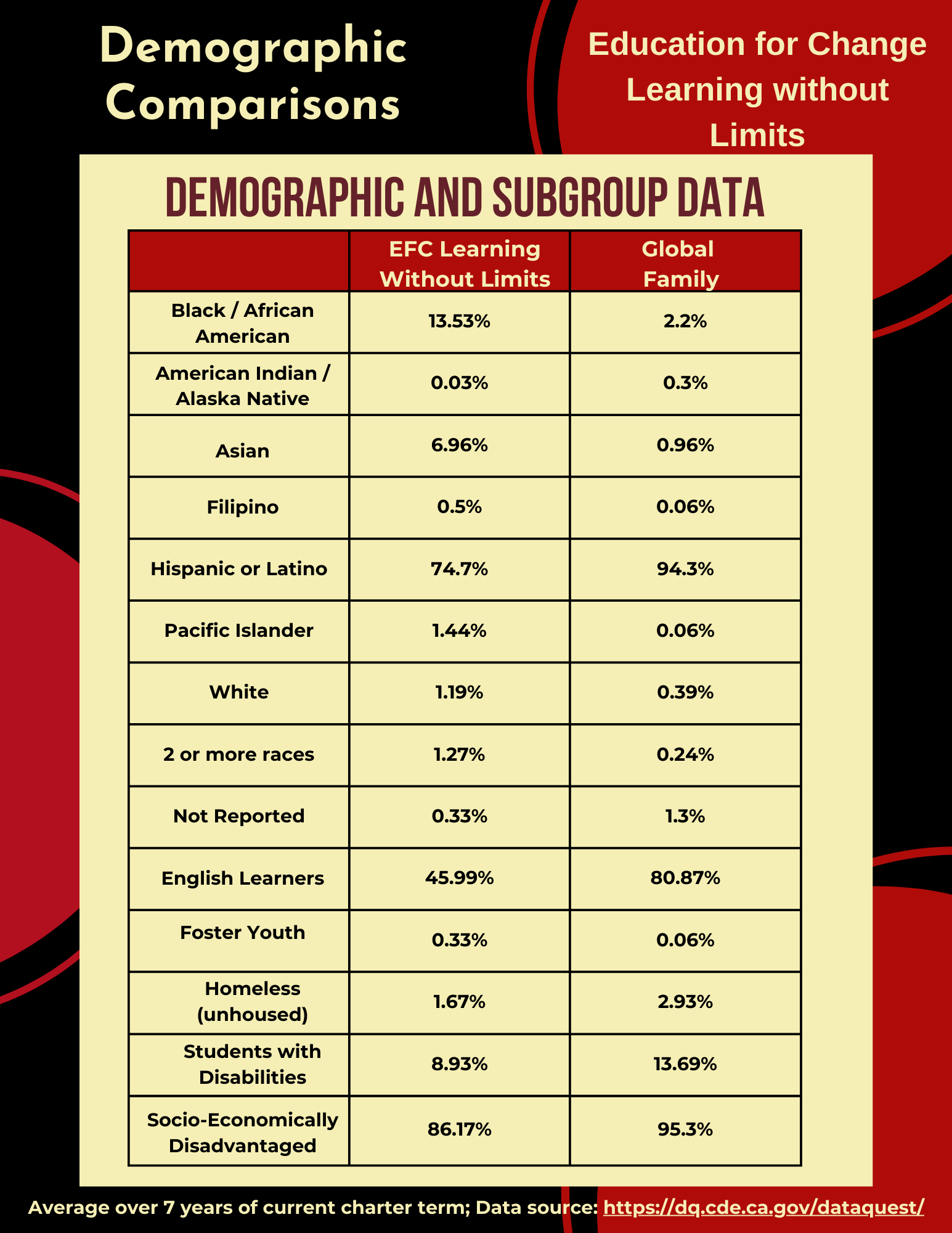
1) Does the charter schools student population reflect the district as a whole, in terms of race/ethnicity, students with disabilities, and English Language Learners, as state law requires?  Charter schools must describe how they will achieve a balance, and yet one charter school facing renewal serves a 97% Latino student body, while 46% of OUSD students are Latino. That same school serves 2% Black students, compared with 21% Black students in OUSD. Three other charter schools facing renewal have student bodies that are more than 90% Latino.

from OUSD staff report, Aspire Lionel Wilson Prep

District schools, which must serve all students, are far more integrated by race and ethnicity than the charter schools. And data shows other forms of segregation as well; charter schools serve fewer foster youth, English Language Learners, and students with disabilities.

2) Are most teachers and administrators well-qualified, as state law requires? Teachers in all publicly-funded schools must have valid state teacher credentials. And yet at one Oakland charter school facing renewal, 70% of current teachers not only lack credentials; they are substitutes. At four other charter schools up for renewal, fewer than half the teachers are credentialed. In OUSD public schools, 80% of the teachers have credentials, comparing favorably with 89% statewide.

3) Is the charter school doing its fair share educating students with special needs, as state law requires? The charter sector serves some students with special needs, but fewer than than OUSD. In OUSD, 16% of students have disabilities; while the average of charter schools up for renewal is 13%.
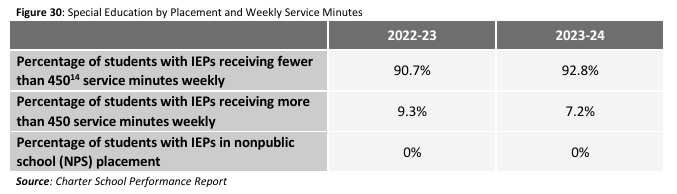
However, there is a huge disparity in serving students with extensive needs. These students (e.g., those with physical disabilities, autism, hearing or visual impairment, or emotional challenges) are dramatically underrepresented in charter schools. Costs of supporting them, including transportation when appropriate, are far greater than the costs to support students who need, for example, speech therapy.

OUSD staff report, Aspire Lionel Wilson Prep

Students with extensive needs may require individual attendants, emotional and behavioral therapy, or adapted physical education. When charter schools do not serve a fair proportion of students with extensive needs, a vastly disproportionate cost falls on the district’s public schools.

These are hard questions, and Oakland needs its School Board members to demand detailed, well-documented answers. AB 1505, passed in 2019, imposed more rigorous oversight of charter school renewals. The OUSD Board must take its oversight obligation seriously and show little tolerance for schools that do not serve all students. If the Board thoroughly scrutinizes the data and adheres faithfully to its obligation to act in Oakland students’ best interest, it likely will refuse renewal for at least some of the nine charters before it.

The resulting closures will disrupt the affected school communities, as closing schools is inevitably traumatic. Even as the Board acts to follow state law, uphold equity, and avoid promoting segregation, OUSD must find a way to welcome charter students, families, and staff back into the public system with open arms.

Educators for Democratic Schools is an organization of mostly retired Oakland educators concerned about privatization of our public schools. We appreciate their partnership in bringing greater transparency to the charter renewal process. For more information, reach out to EDS at edsOakland@gmail.com or follow them on facebook: https://www.facebook.com/EDSOakland/

#charterrenewals #ousd

It’s Time to Talk about Charter School Renewals

In years past, California Charter Schools would submit a renewal petition every five years, but new laws and the pandemic changed all that, and all charter schools were given an extension of time of up to 3 years to seek renewal of their charters. That time is now up, and this fall, 13 Oakland based charter schools need to seek renewal of their charters in order to continue operating after the 2024-25 school year.

Since OUSD regained local governing control in 2009, the Charter School Renewal process has been largely opaque and somewhat perfunctory, with most charter schools being recommended for renewal by our prior Charter Office staff, and the board nearly always agreeing with them. This will be the first time that any of our current board members have faced a renewal petition, and among the first to be decided since the passage of AB 1505, which revised charter law, providing additional tools for holding charter schools accountable for serving the same student populations served by public school districts and evaluating the impact of charter schools on their schools.

Although the charter industry tries to blur the lines between charter schools and public schools, there are some very important differences between them, and one is that charter schools operate under a “charter” – a type of contract – that sets out goals and promises about how the charter school will function. If they fail to meet those promises, they should not be renewed for an additional term. The Charter school is exempt from certain Education Code requirements, gains certain flexibility and independence, and “gives charter schools more room to experiment and to come up with instructional and other innovations.” According to the California Charter Schools Association: “In exchange for operational freedom and flexibility, charter schools are subject to higher levels of accountability than traditional public schools.” Part of that accountability is the renewal process, determining whether the school is making progress towards state standards, and is doing it while serving the same groups of students as served by the territorial jurisdiction in which they operate.

Here’s what you need to know about renewals

So far, two charter schools have had a public hearing in front of the OUSD Board (and one at the County board) and if you saw the petition submitted, you would know they are massive. The Aspire Lionel Wilson Prep petition attached to the agenda was 1,517 pages long. The charter law (California Education Code sections 47605 et seq) is also long and can be difficult to understand. As the OUSD Board of Education prepares to decide whether to renew or not renew the 9 charter schools expected to come before them this fall, we will be running a series of blog posts about the process, starting today. We will provide information about the renewal process, as well as snapshots of each school and the relevant data, so that the Oakland community can make sense of what often feels like an overly technical and not very accessible renewal process.

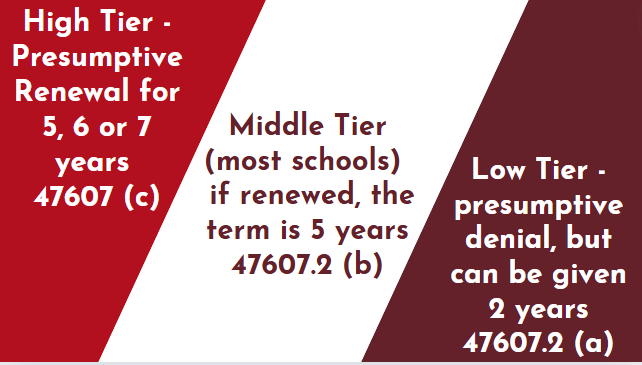
Charter schools up for renewal are placed into one of three categories by the state, and the standards for renewal are different dependent on the assigned renewal “tier”

For our purposes, how the state decides which renewal tier to assign each charter school is not really important, but if you are interested in learning more about this process, the California Department of Education website has more information. A charter school is determined to be “High performing” or “Low performing” through a formulaic assessment by the state, and all other schools are then deemed “Middle tier” by default. Most charter schools up for renewal this year are middle tier schools, and so we will primarily focus on those schools.

The High and Low tier schools are as follows:

  • High tier: American Indian Public Charter School II
  • Low tier: LPS R&D Oakland and Urban Montessori (county authorized)

High tier schools are generally presumed to be eligible for renewal for 5 to 7 years as the board decides (although there are exceptions to that rule which will become important this year). Low tier schools are presumed to be non-renewed, but the board can decide to renew for 2 years if they want to. Middle tier schools can only be renewed for 5 years, and because of the very nature of being neither high nor low performing by state standards, will have data that will suggest renewal and data that will suggest non-renewal, and it is up to the authorizing board (not the district staff) to make the decision as to whether to grant that new five year term.

Charter School Renewal Report Cards – our distillation of the information that OUSD will be considering when deciding whether or not to renew a middle tier school

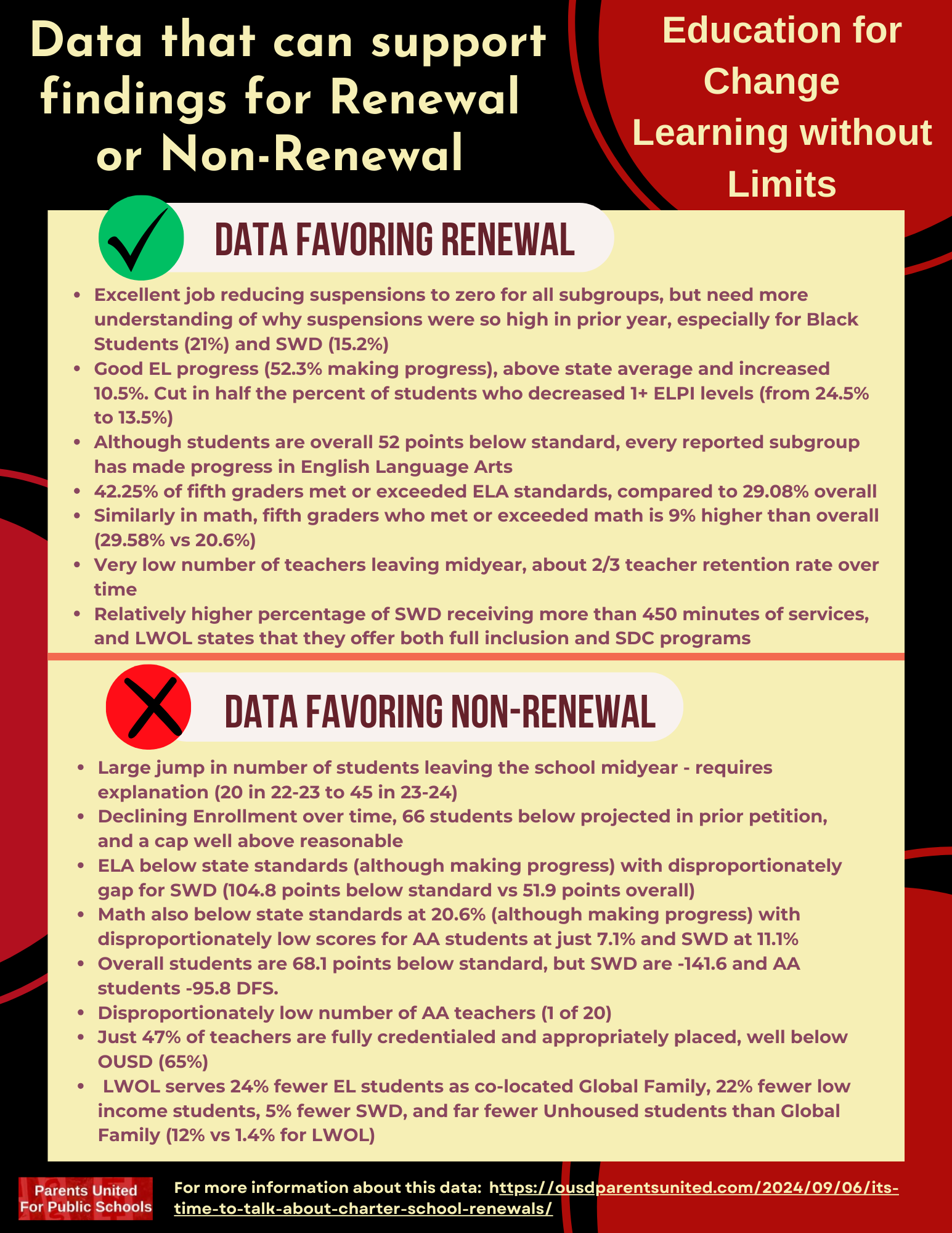
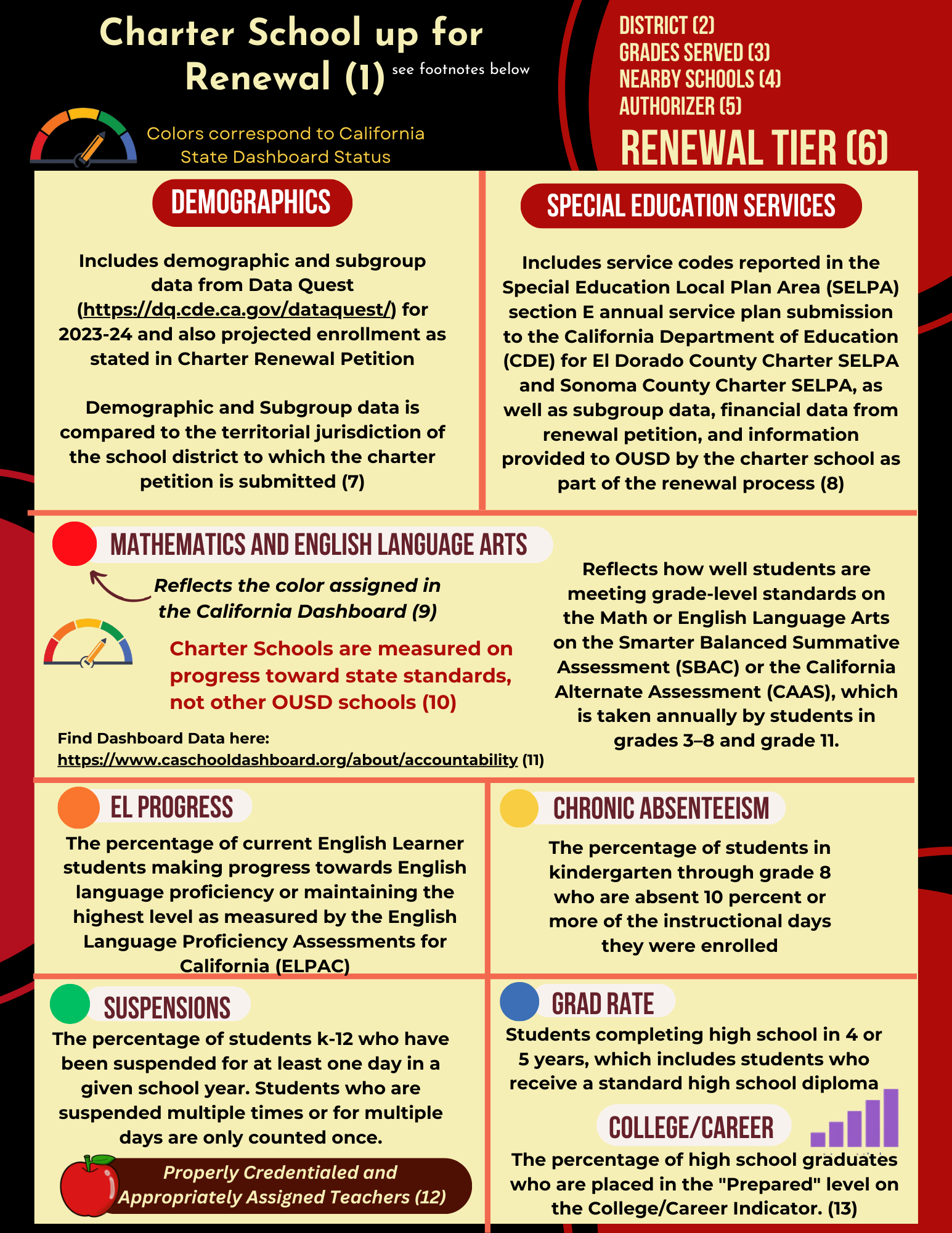
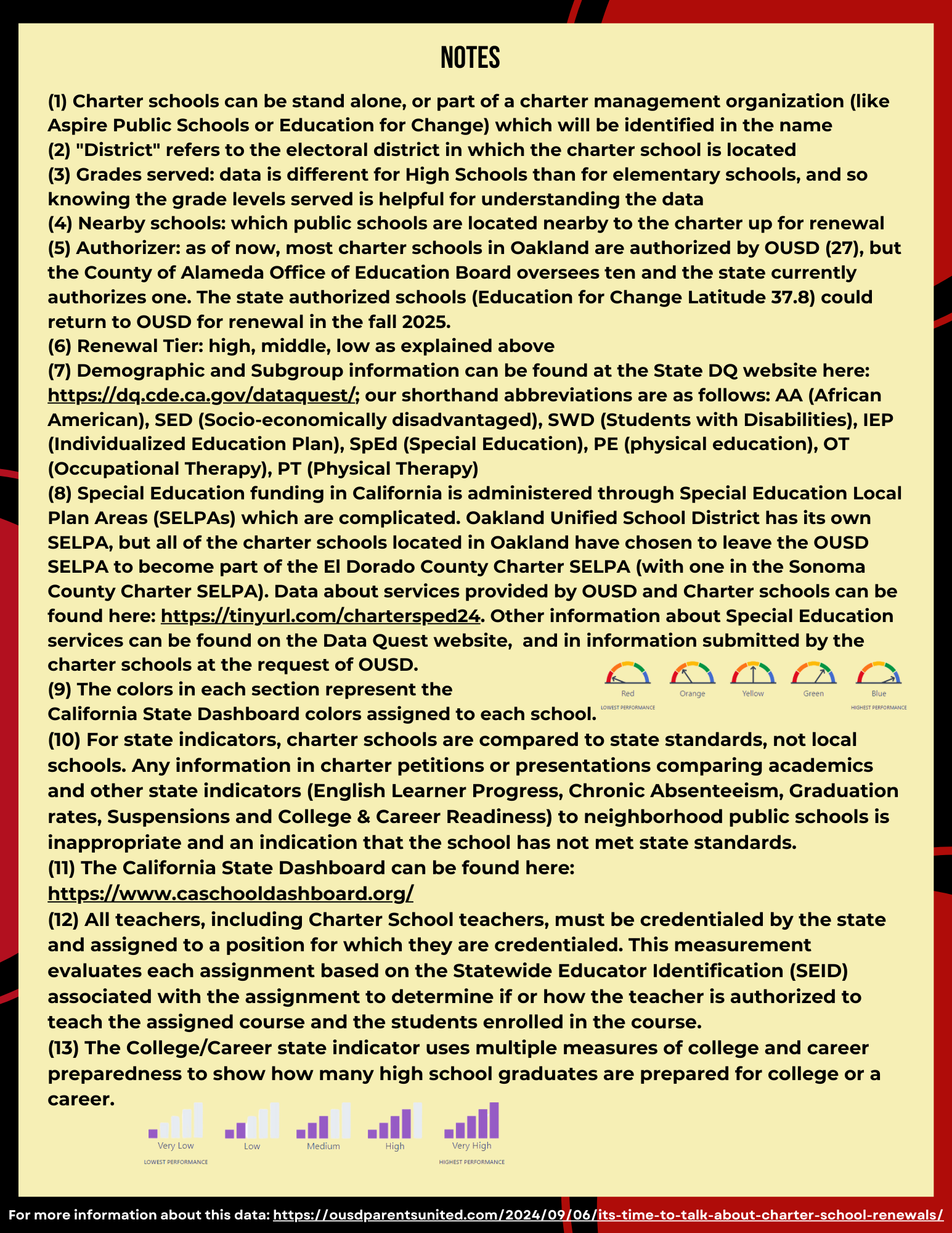
In order to simplify what seems a complicated process, Parents United will be creating Renewal Report Cards for each of the charter schools up for renewal this year. It’s not easy to distill a 1,500 page petition, an academic performance dashboard, disaggregated demographic and subgroup data and charter submitted information into a two-page Renewal Report Card, but we have tried to provide an overview and significant highlights to help Oaklanders understand the Renewal process better. Here is our “explainer” for what that data represents:

Most of the data comes from the California State Dashboard and it is really important to remember that charter schools are not evaluated by how they are performing compared to the local public schools, they must meet the promises in their charter and make progress towards the State standards, and that is the only appropriate comparison. It is only when looking at Local indicators, including whether the charter school serves all students, that we consider local data. When a charter school compares its academic data to neighborhood public schools, they are doing that to distract from the fact that they are not meeting state standards.
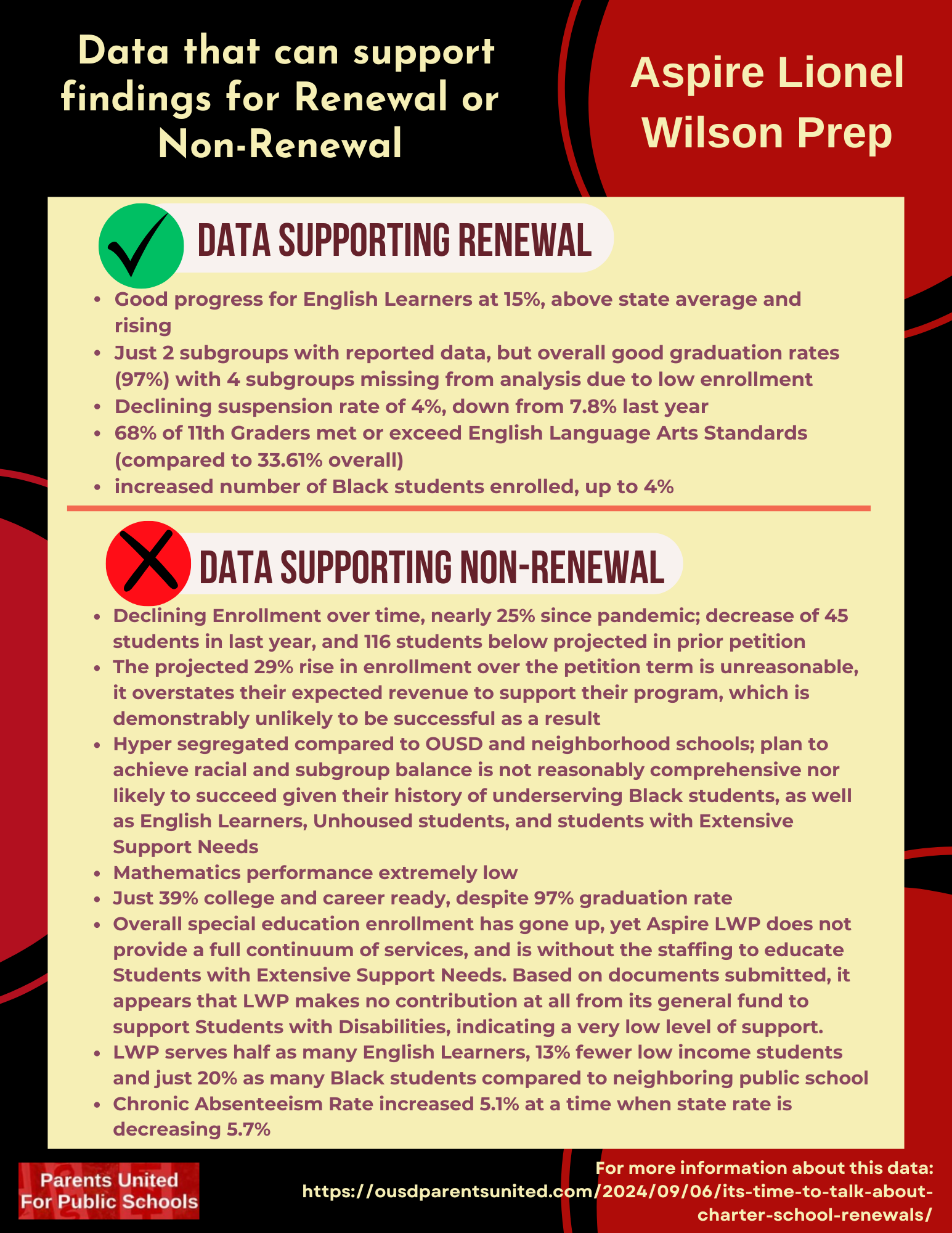
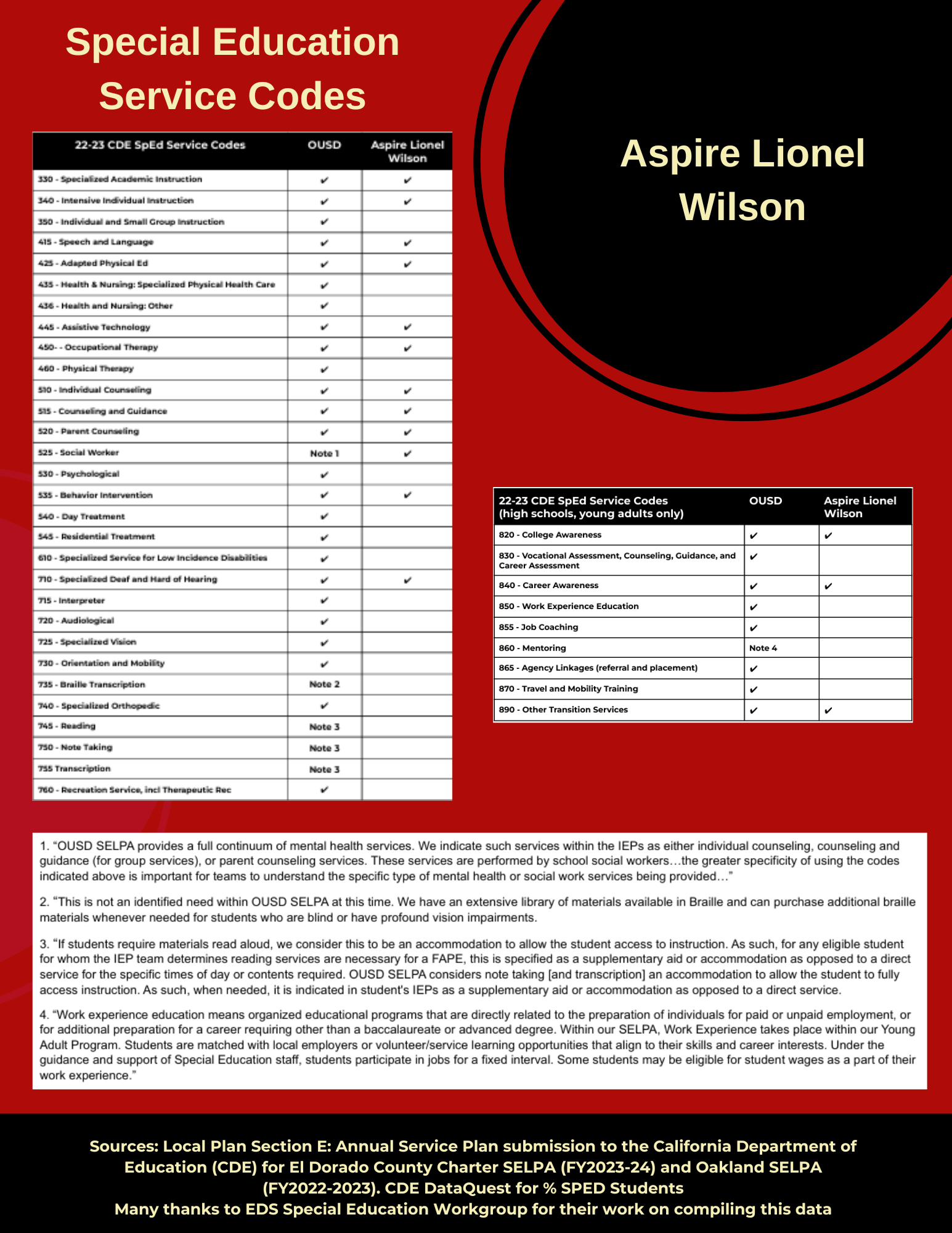
To understand the different pieces of the Renewal Report Card, we have given an explainer and added the below footnotes for additional information. Look for future posts about individual charter school renewal petitions, a deeper dive into the consequences of “failing to serve all students” and the different kinds of analyses used when a charter school has special fiscal or governance issues, or is not serving all students who wish to attend. We will also be digging more deeply into the issues surrounding Special Education, and the impact of the collective failure of charter schools to serve students with the most significant disabilities.
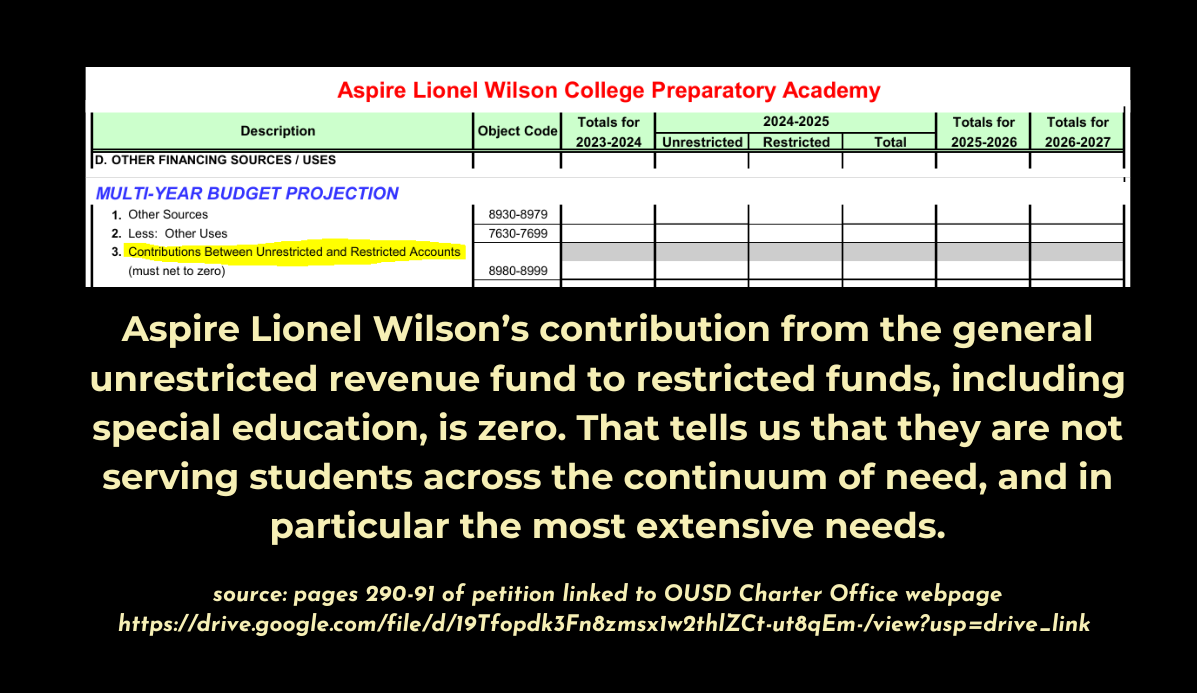
We want to give a special thanks to the Educators for Democratic Schools (“EDS”) Special Education Workgroup for their generous help in gathering and understanding this data. Their collective expertise has been invaluable.

#charterschoolrenewals #ousd #specialeducation