
Outgoing Superintendent Dr. Johnson-Trammell has long argued that Oakland Unified School District (“OUSD”) must close schools in order to be fiscally sustainable, yet the majority of our elected school board has resisted that call, rescinding a decision to close schools in 2023, and rejecting a new plan to close and merge schools last fall. The argument is that we have too many schools for our declining enrollment, and that some schools are “underutilized” and not generating enough revenue (dependent on the Average Daily Attendance or “ADA”) to pay for itself, as if each school is a McDonald’s that needs to show a profit to stay open. We need to balance our budget as a unified system, and we need to offer accessible public education to Oakland’s kids, but we are not willing to have a real conversation about what that looks like.
Much is made about the fact that OUSD has more schools than many other California school districts per ADA. The question is, why does that matter and are we talking about public schools in the right way?

OUSD does have more schools per student than most medium to large school districts, but does that mean we have “too many schools”? Part of how you answer that question may depend on what you see as the purpose of public education and what our constitutional obligation to provide a free public education to all children requires of us. A child who can no longer go to school because her neighborhood public school has closed has no access to public education.
OUSD has argued that elementary students can walk 2 miles to school, but experts agree that is 2 to 4 times more than is reasonable.

It is important to note that OUSD does not provide transportation to most students, no yellow school buses pick kids up and take them to their neighborhood school, which means that if you do not have a car, you must walk to school or take public transit. Especially for elementary age students who most agree cannot take the bus on their own, there is a limit to how far a young child can be reasonably asked to walk to school. So long as Oakland does not provide transportation to all students, closing schools removes access to public education for many students and as such is not acceptable.
OUSD has fewer schools per square mile than most comparable school districts, most of whom provide transportation to school
So long as we are not providing transportation to students, every student needs a neighborhood public school within walking distance. Ideally, that would mean you would have at least 1 elementary school per square mile spread out evenly so that no child would have to walk more than 1/2 mile to get to school. Fontana Unified School District has approximately the same number of students as OUSD on 25 fewer campuses and has been used by OUSD as an example of a district that is “right sized”. Fontana is 52 square miles, which means they have 0.87 schools per square mile. They also provide transportation to all students who live certain distances from their neighborhood school, as shown below.

Oakland is 78 square miles and has 69 active campuses across Oakland. A sampling of ten medium to large school districts with a UPP (Unduplicated Pupil Percentage) greater than 50% (including Fontana) shows that the average number of schools per square mile is 1.06. As you can see, Oakland is at 0.88 schools per square mile which is about 2/10ths of a mile below the average and just about the same as Fontana. For comparison, Piedmont Unified has 371 ADA per school and 3 schools per square mile, fewer students per school and more schools per square mile.

OUSD only provides transportation to certain disabled students. The majority of these other school districts provide transportation beyond that to all students who qualify (usually based on location), and the only two districts that do not have approximately twice the number of schools per square mile as OUSD does. If we think about public education as a common good that must be accessible to all students, the number of schools per square mile, especially when you fail to provide transportation, is a more relevant number than the number of students per school.
So who is pushing OUSD to close schools, anyway?
The people you most often see pushing school closures, in addition to our Superintendent and certain board members (mostly no longer on board) are charter school advocates (because the primary barrier to charter school growth is access to facilities) and mostly white/affluent parents whose children attend “hills” schools, because they believe that their schools will be spared because they are “fully enrolled” and “high performing”. We have seen (with Kaiser and Hillcrest) that those parents will change their tune when their school is targeted.
“Lack of access to affordable school buildings is the single immediate and overwhelming factor containing [charter school] growth.”
So why do charter advocates care about public school closures? The answer is simple: real estate. The Center on Reinventing Public Education (“CRPE”) is a right-wing charter school think tank that understands that without facilities, it is hard to growth the “market share” of charter schools, especially in the Bay Area where real estate is so expensive.

At OUSD board meetings where school closures are on the agenda, the only people speaking in favor of them are those charter school advocates, as pointed out in 2019 by Director Hutchinson.

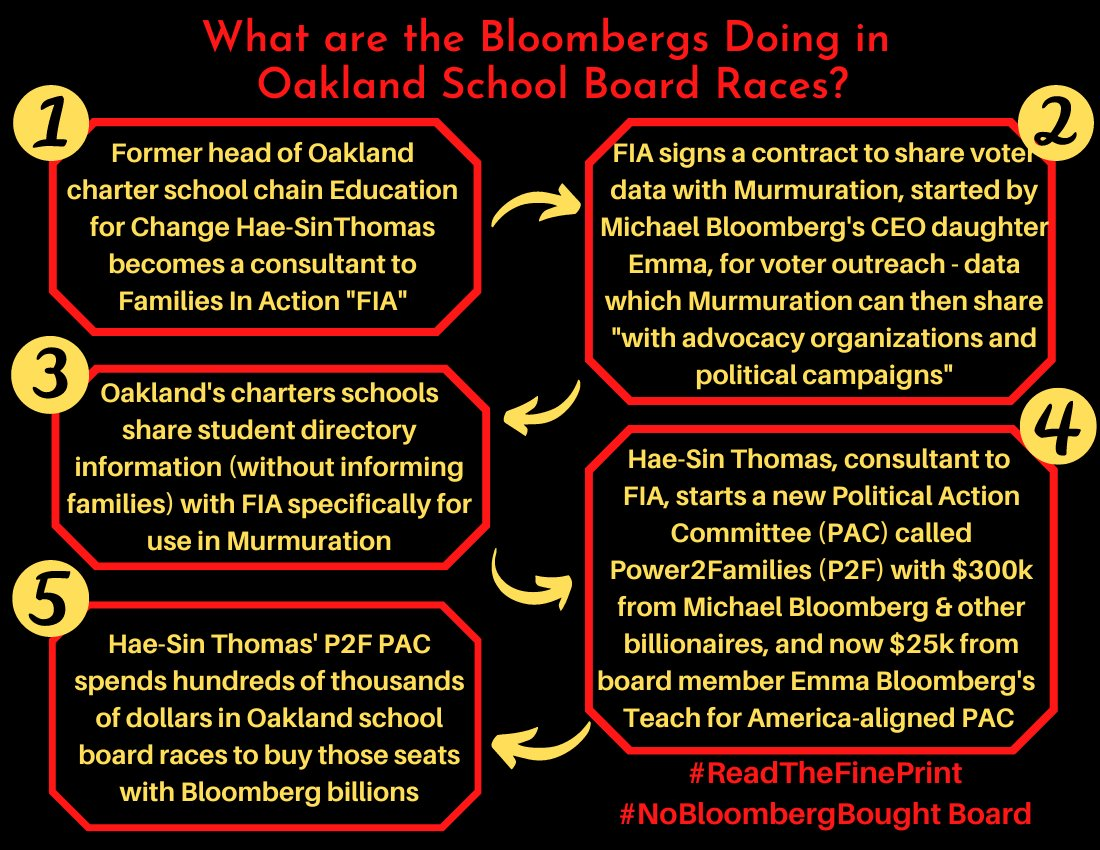
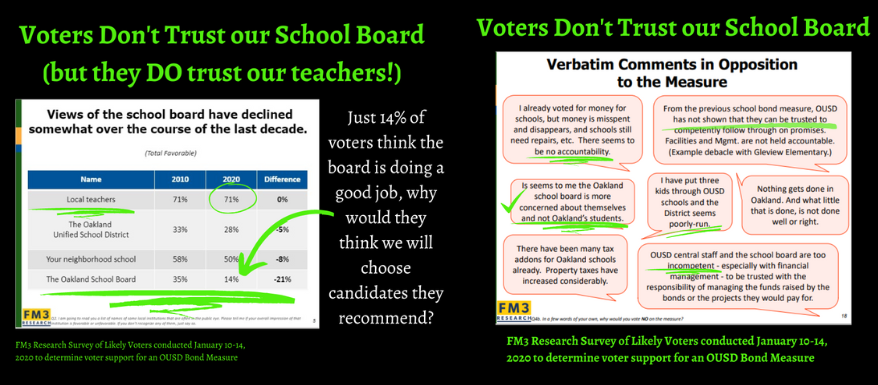
For many years, GO Public Schools (“GO”) flooded school board elections to stack the board with directors who would further privatize OUSD and rubberstamp the growth of charter schools. Groups like Families in Action for Justice (or Education) have taken over GO’s role in school board elections, supporting candidates who support the continued and ongoing privatization of OUSD, including through charter school growth. Interestingly but not coincidentally, the most vocal supporters of the “Bankrupt” narrative being pushed by Director Hutchinson have mostly been Families in Action members, and Director Hutchinson has now taken to endorsing those same school board candidates (Salop, Aikens, Berry and Thompson in the last election) as both Families in Action and the new anti-progressive, anti-union group “Empower Oakland”.

Under Prop 39, closed district campuses must be offered to charter schools
We have posted before about Prop 39, the law that requires school districts to provide space in its schools for charter schools who ask for it in return for a “facilities use fee” that is significantly lower than for publicly owned spaces, usually less than $5 per square foot per year (not per month). Every year, OUSD receives between 5 and 17 requests for space in OUSD schools. Most of our previously closed schools are already spoken for, so charter schools have to “co-locate” with district schools unless there are newly vacant properties through school closures.

OUSD has a long history of closing schools since 2003. From 2004 to 2018 OUSD closed 18 schools, and 14 of them became new homes for charter schools. It is no surprise, then, that charter school advocates urge OUSD to “be bold” and close schools.







































 Parents United for Public Schools