Why does OUSD keep trying to close schools to balance its budget when it clearly doesn’t work? The answer might be that the people pushing that narrative aren’t interested in our budget, they are interested in our buildings.

Outgoing Superintendent Dr. Johnson-Trammell has long argued that Oakland Unified School District (“OUSD”) must close schools in order to be fiscally sustainable, yet the majority of our elected school board has resisted that call, rescinding a decision to close schools in 2023, and rejecting a new plan to close and merge schools last fall. The argument is that we have too many schools for our declining enrollment, and that some schools are “underutilized” and not generating enough revenue (dependent on the Average Daily Attendance or “ADA”) to pay for itself, as if each school is a McDonald’s that needs to show a profit to stay open. We need to balance our budget as a unified system, and we need to offer accessible public education to Oakland’s kids, but we are not willing to have a real conversation about what that looks like. 

Much is made about the fact that OUSD has more schools than many other California school districts per ADA. The question is, why does that matter and are we talking about public schools in the right way?

OUSD does have more schools per student than most medium to large school districts, but does that mean we have “too many schools”? Part of how you answer that question may depend on what you see as the purpose of public education and what our constitutional obligation to provide a free public education to all children requires of us. A child who can no longer go to school because her neighborhood public school has closed has no access to public education.

OUSD has argued that elementary students can walk 2 miles to school, but experts agree that is 2 to 4 times more than is reasonable. 

It is important to note that OUSD does not provide transportation to most students, no yellow school buses pick kids up and take them to their neighborhood school, which means that if you do not have a car, you must walk to school or take public transit. Especially for elementary age students who most agree cannot take the bus on their own, there is a limit to how far a young child can be reasonably asked to walk to school. So long as Oakland does not provide transportation to all students, closing schools removes access to public education for many students and as such is not acceptable.

OUSD has fewer schools per square mile than most comparable school districts, most of whom provide transportation to school

So long as we are not providing transportation to students, every student needs a neighborhood public school within walking distance. Ideally, that would mean you would have at least 1 elementary school per square mile spread out evenly so that no child would have to walk more than 1/2 mile to get to school. Fontana Unified School District has approximately the same number of students as OUSD on 25 fewer campuses and has been used by OUSD as an example of a district that is “right sized”. Fontana is 52 square miles, which means they have 0.87 schools per square mile. They also provide transportation to all students who live certain distances from their neighborhood school, as shown below.

Oakland is 78 square miles and has 69 active campuses across Oakland. A sampling of ten medium to large school districts with a UPP (Unduplicated Pupil Percentage) greater than 50% (including Fontana) shows that the average number of schools per square mile  is 1.06.  As you can see, Oakland is at 0.88 schools per square mile which is about 2/10ths of a mile below the average and just about the same as Fontana. For comparison, Piedmont Unified has 371 ADA per school and 3 schools per square mile, fewer students per school and more schools per square mile.

OUSD only provides transportation to certain disabled students. The majority of these other school districts provide transportation beyond that to all students who qualify (usually based on location), and the only two districts that do not have approximately twice the number of schools per square mile as OUSD does. If we think about public education as a common good that must be accessible to all students, the number of schools per square mile, especially when you fail to provide transportation, is a more relevant number than the number of students per school. 

So who is pushing OUSD to close schools, anyway?

The people you most often see pushing school closures, in addition to our Superintendent and certain board members (mostly no longer on board) are charter school advocates (because the primary barrier to charter school growth is access to facilities) and mostly white/affluent parents whose children attend “hills” schools, because they believe that their schools will be spared because they are “fully enrolled” and “high performing”. We have seen (with Kaiser and Hillcrest) that those parents will change their tune when their school is targeted.

“Lack of access to affordable school buildings is the single immediate and overwhelming factor containing [charter school] growth.”

So why do charter advocates care about public school closures? The answer is simple: real estate. The Center on Reinventing Public Education (“CRPE”) is a right-wing charter school think tank that understands that without facilities, it is hard to growth the “market share” of charter schools, especially in the Bay Area where real estate is so expensive.

At OUSD board meetings where school closures are on the agenda, the only people speaking in favor of them are those charter school advocates, as pointed out in 2019 by Director Hutchinson.

For many years, GO Public Schools (“GO”) flooded school board elections to stack the board with directors who would further privatize OUSD and rubberstamp the growth of charter schools. Groups like Families in Action for Justice (or Education) have taken over GO’s role in school board elections, supporting candidates who support the continued and ongoing privatization of OUSD, including through charter school growth. Interestingly but not coincidentally, the most vocal supporters of the “Bankrupt” narrative being pushed by Director Hutchinson have mostly been Families in Action members, and Director Hutchinson has now taken to endorsing those same school board candidates (Salop, Aikens, Berry and Thompson in the last election) as both Families in Action and the new anti-progressive, anti-union group “Empower Oakland”.

Under Prop 39, closed district campuses must be offered to charter schools

We have posted before about Prop 39, the law that requires school districts to provide space in its schools for charter schools who ask for it in return for a “facilities use fee” that is significantly lower than for publicly owned spaces, usually less than $5 per square foot per year (not per month). Every year, OUSD receives between 5 and 17 requests for space in OUSD schools. Most of our previously closed schools are already spoken for, so charter schools have to “co-locate” with district schools unless there are newly vacant properties through school closures.

OUSD has a long history of closing schools since 2003. From 2004 to 2018 OUSD closed 18 schools, and 14 of them became new homes for charter schools. It is no surprise, then, that charter school advocates urge OUSD to “be bold” and close schools.

News Alert: The Oakland Unified School District just adopted a budget that shows that OUSD “is solvent” as required by law. So why does School Board Director Mike Hutchinson keep insisting that OUSD is “bankrupt” – statements that are both false and harmful to our schools and students.

School Districts in California are required to adopt a balanced budget by June 30th each year, and the Oakland Unified School District (“OUSD”) did so on June 25, 2025. Yet the District 4 School Board Director Mike Hutchinson is insisting on social media and in public remarks that “OUSD is “bankrupt” and is using that narrative in an attempt to turn the public against the school board President and Vice-President in order to force them to resign. Director Hutchinson has claimed (without proof) multiple times that he “forced” former District 6 Director to resign, and he can do it again to these women.

While there are definitely concerns about where the budget stands, OUSD is not bankrupt, as stated by Chief Business Officer (“CBO”) Lisa Grant-Dawson in her presentation and memo, we are “solvent” and have enough cash to pay our bills. Importantly, OUSD improved its position by $44 million overall from what was projected last year, including $82 million in our unrestricted general fund.

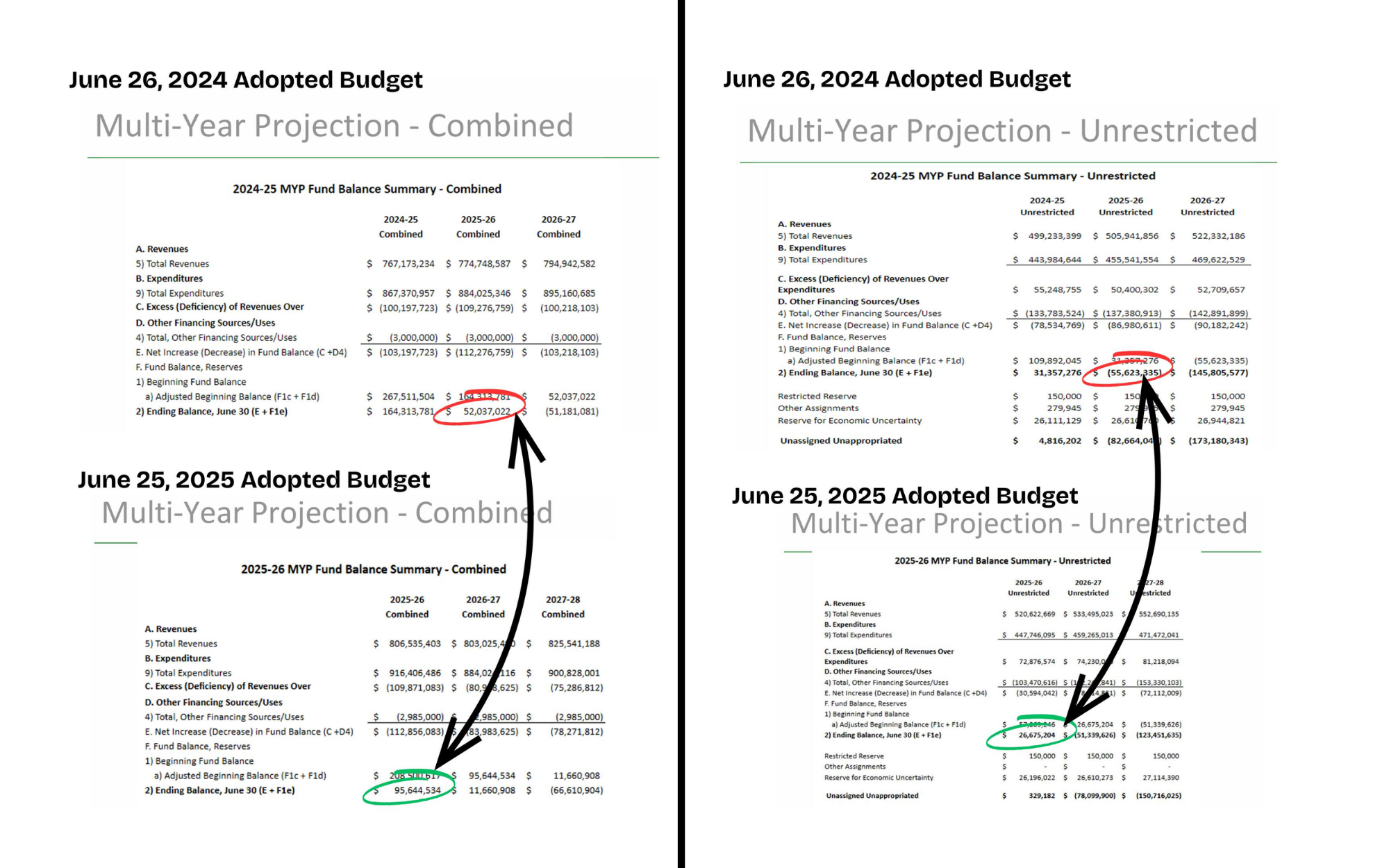
Last year, OUSD was projected to have an ending fund balance (combined) of $52 million; the actual adopted budget shows that our ending fund balance will be $44 million HIGHER than projected ($96 million). Our unrestricted ending fund balance for 2025-26 was projected a year ago to be NEGATIVE $55 million, but according to the adopted budget, that ending fund balance will be +$27 million, which is a positive swing of $82 million.

According to Chief Business Officer Lisa Grant-Dawson in the Memorandum and Resolution Approving District’s Approved Budget which was approved June 25, 2025, “the district is solvent for the fiscal year 2025-26” and OUSD’s “Cash Flow continues to remain strong, though declining from levels in prior
years due to one time funds, with a projected $265M ending cash balance.” The Memo also states that OUSD will be preparing a 45 day revised budget and that we “anticipate some additional upside to the beginning balance for 2025-26.”

That is not to say that there is not serious work ahead to eliminate overspending and balance future budgets so that we can invest more in our students, schools and staff. The adopted budget (which we know will get better but not improve enough to obviate that need) shows a significant deficit in year 2 and year 3 which must be addressed.

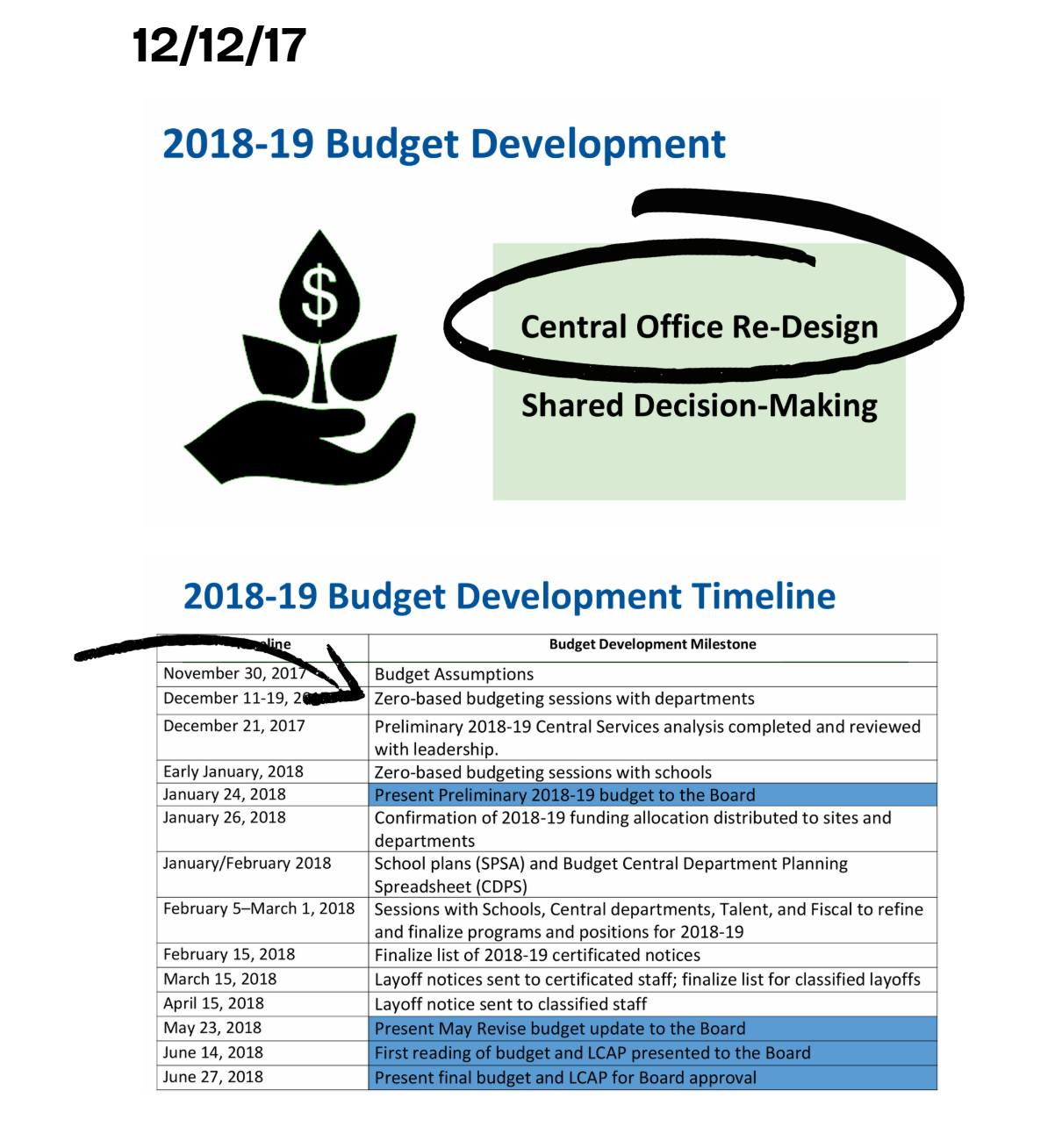
There are many ways to balance the budget, and it comes down to what you value. We have for too many years put too many dollars into senior leadership and central office, contracting out jobs, consultants who tells us how to do whatever it is that they are “experts” at, and every shiny new educational theory that our board or staff learns at the last ed reform conference paid for by one of the billionaire funded “non-profits” that are so prolific in Oakland. When Superintendent Dr. Johnson-Trammell came in as superintendent in 2017 she promised to reorganize our central office and move to zero-based budgeting for central office and school sites. That was one of the reasons that the Superintendent’s selection received broad community support. Eight years later, we don’t have zero based budgeting, and we are still talking about but not actually doing that central office redesign.

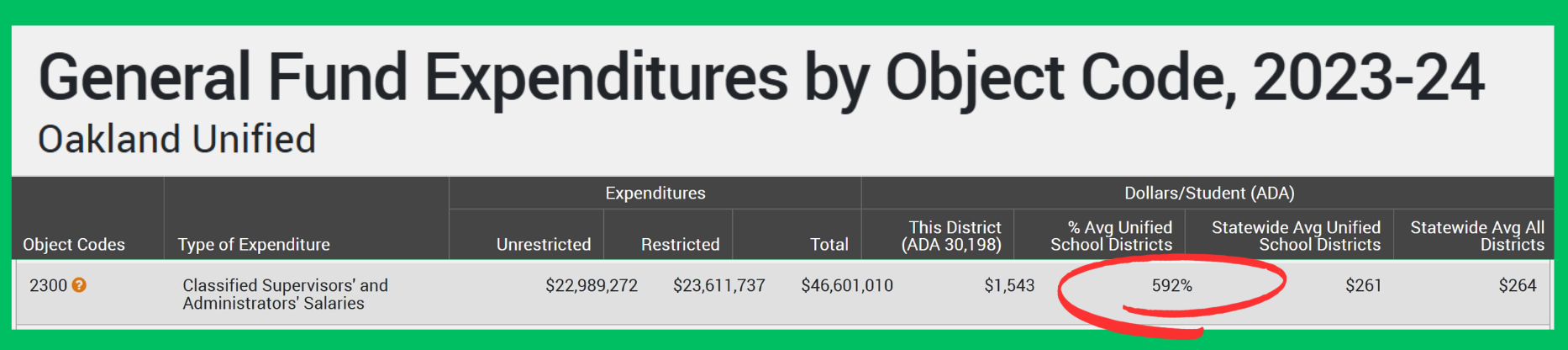
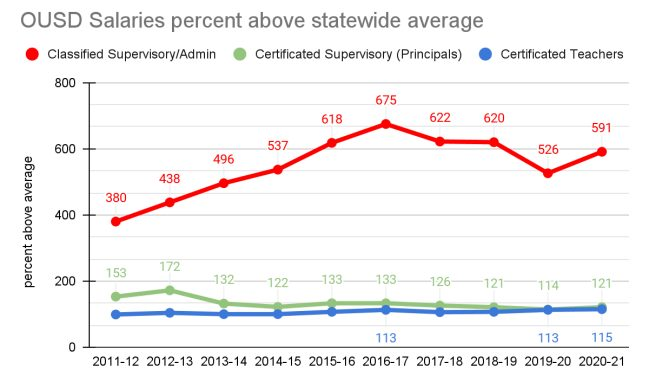
According to state data, OUSD spends almost 6 times as much per student on classified supervisors and administrators (not including principals) as the state average.

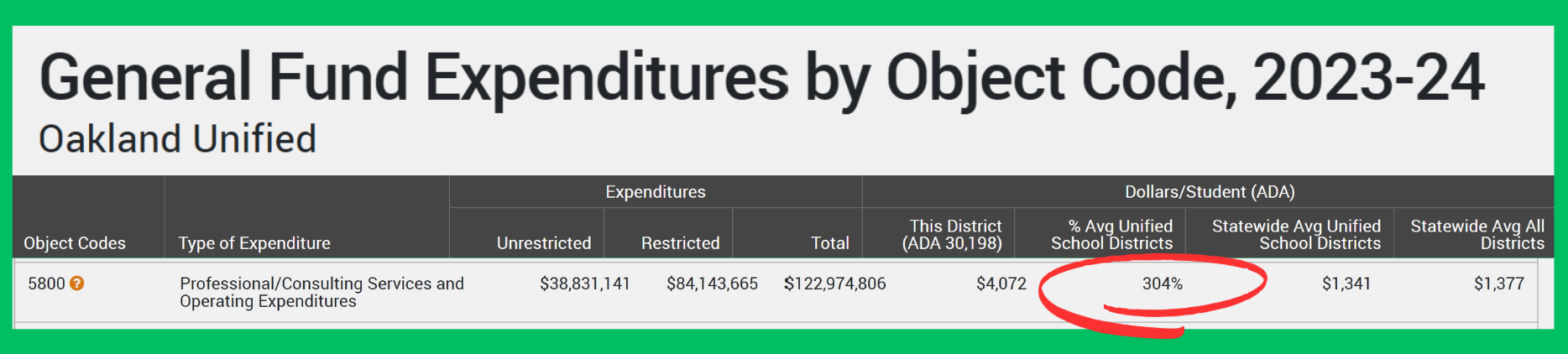
OUSD currently spends more than any other district in California except LA (in gross dollars, not per pupil) on Professional/Consulting Services and Operating Expenditures. In fact 22% of our total spending goes to those Object Code 5800 expenditures, as compared to 8% in San Diego or 18% in Berkeley. That is 300% higher per student than the statewide average.

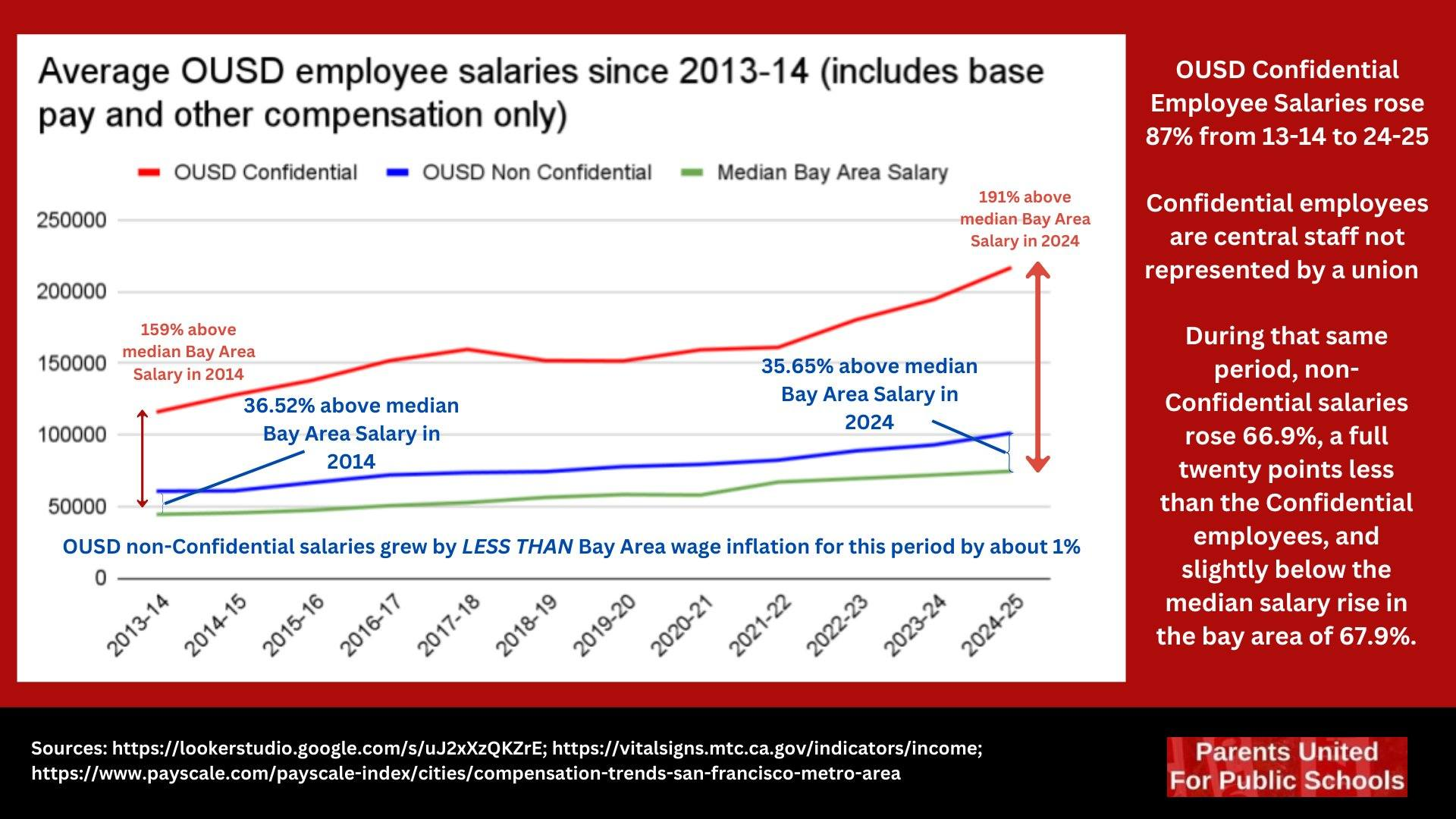
While our teachers and site staff salaries have risen at about the rate of inflation, the highest paid “confidential” employee salaries have risen 87% over time.

Since January, the board majority has been pushing for “alternative budget cuts” to address some of this overspending, which has been resisted by staff and attacked by Director Hutchinson. In pursuing a cap on outside contracts, unrestricted books and supplies, travel, conferences and confidential senior employee spending, the board majority led by the President and Vice President were beginning to take the steps necessary to redirect spending to ensure we are fully funding our school sites. Although those alternative cuts have been delayed to next year, they are important first steps in addressing necessary changes to our district to ensure that we have a balanced budget that supports students.

The business model of public education that is favored by billionaire funded groups like Chiefs for Change, which our Superintendent joined in about 2020, sets up the top heavy too many administrator model, and pays those administrators like corporate executives while we have full time employees who are unhoused in Oakland.

Chiefs for Change was started by Jeb Bush and Betsy DeVos, as Director Hutchinson pointed out in this post from his advocacy group “Oakland Public Education Network” from 2020 and is anti-union and anti-public school.

There is not a single board member who wants to have an unbalanced budget. The question is: how can we restructure all of our spending to maximize dollars to schools and to students. The Board must work together to find student-centered and fiscally responsible changes to the way OUSD spends its way too little revenue. Irresponsibly throwing around terms like “bankrupt” and “fiscal crisis” do nothing to solve OUSD’s challenges and in fact are likely to create more challenges as prospective families read this “doom loop” narrative about Oakland Unified School District. We urge Director Hutchinson to join other board members in working with new Interim Superintendent Dr. Denise Saddler and CBO Grant-Dawson in a responsible and positive budget development process instead of making inflammatory, self-aggrandizing and false statements intended to gain personal notoriety.


OUSD is planning “across the board” school site budget cuts that disproportionately harm Black and Brown schools while also using Learning Loss funds to give most of our affluent, whiter elementary schools extra staffing that other schools have to pay for out of their limited (and reduced) site budgets. That is NOT #BudgetEquity!

School budgeting is complicated. Right now, site principals are trying to create budgets for their schools from a “one pager” – the budget document created every January for each school showing how much money and staff that they will receive in the following year1. We know, because the board approved budget “adjustments” for 2024-25 as part of last year’s long-term budget planning2, that school sites will lose $10 – 20 per student (dependent on grade level) in “base” funds, and also $110 per student in “Supplemental” funds received based on their Unduplicated Pupil Percentage (“UPP”)3. UPP is measured by counting the number of low-income students, English learners and Foster Youth in a school community and converting that to a percentage4. It is easy to understand how cutting the Supplemental funds across the board disproportionately harms the primarily Black and Brown students who generate the Supplemental funds in the first place – the more wealth in a school community, the smaller the cut.

But it is also true that “across the board” cuts in Base (per pupil) funding disproportionately impacts lower income communities who do not have other means to make up the difference.

see citation below

In 2017 when faced with drastic budget cuts, some board members asked for a more “equitable” process than the “across the board” strategy, and staff responded that it was just too difficult:

“Sondra Aguilera, deputy chief of student services for OUSD, told board members Wednesday that this is the “best option.” She said a more tailored approach for cutting the budget at each school would be difficult, in part because some parent-teacher associations raise their own grants but are not required to report those funds to the district. “We began to see this rabbit hole that we were going to go down mapping all the different sources,” Aguilera said. “You can’t possibly map all the different sources that school sites receive.””

https://www.kqed.org/news/11635537/oakland-unified-proposing-9-million-in-midyear-budget-cuts-to-schools

OUSD is willing to implement “across the board” budget cuts which they know disproportionately impact low-income Black and Brown families because it’s harder to figure out how much money PTAs pull in for their schools.5 That is NOT #BudgetEquity.

Given that OUSD understands that “across the board cuts” disproportionately harm Black and Brown schools, why is OUSD giving even MORE of our students’ precious resources to higher income, whiter schools?

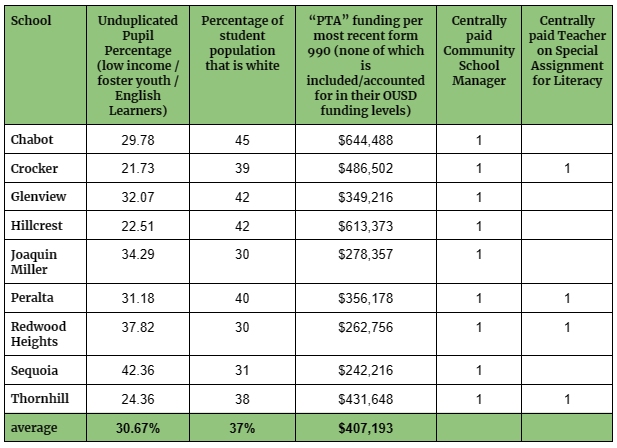
According to the OUSD School Site Funding Profile (“Proposed Budget”) the following wealthy, primarily white elementary schools are receiving “additional centrally provided” Community School Managers (“CSM”) (and a few are also receiving additional centrally provided Literacy Teachers on Special Assignment “TSAs”):

These schools are getting “free to them” Community School Managers despite the fact that they are not community schools6, and do not qualify as community schools per the California Community School Partnership Program (“CCSPP”) grant because their UPP is below the 50% threshold7. In fact, most of the schools on this list fall far short of that UPP and represent 9 of the 10 schools with the highest percentage of white students in OUSD.8 These schools collectively reported nearly $3.7 million in PTA revenue in their most recent disclosures.9

Some OUSD Community Schools receive partial funding for their CSM (about half of the cost) as part of their “enrollment based” staffing, but 10 schools receive no CSM allocation, and so must pay for their CSM out of their discretionary funds – thereby decreasing the amount left for important student services. It is hard to understand why OUSD, when considering which schools to “centrally provide additional” staff to in the most equitable way – a value which OUSD claims to hold at the center of everything they do – decided to provide “free to them” Community School Managers to elementary schools which are not Community Schools (and cannot qualify under CCSPP) instead of providing them to the 10 elementary schools which received NO allocation (not even partial) for their CSM. Given the history of anti-Blackness in OUSD, it is not surprising that 7 of the 10 elementary schools which received no CSM allocation are 7 of the Blackest elementary schools in OUSD10.

OUSD must redo the one pagers to reflect #BudgetEquity by eliminating “across the board” cuts and reallocating “centrally provided staffing” from affluent, white elementary schools to the primarily Black elementary schools which have NO allocation for Community School Managers.

Equity is not just a buzzword, it is enshrined in OUSD Board Policy 503211 which states: “we hold the powerful belief that equity is providing students with what they need to achieve at the highest possible level” and “to interrupt patterns of institutional bias at all levels of the organization”. Continuing to offer disparate and inequitable funding levels to majority Black schools is not interrupting that pattern. The OUSD board must direct staff to revise these and other areas of inequity in the budget to make the changes that are necessary to create #BudgetEquity.

  1. There are three general categories included in the One Pagers: (1) dollar allocations which schools can decide how they want to spend; (2) staff allocations based on enrollment and student population; and (3) centrally provided additional staff placed at the discretion of OUSD staff (which are “free” to the school and in addition to the staffing generally provided to other schools). ↩︎
  2. From a staff presentation to the Budget and Finance Committee on October 12, 2023. https://ousd.legistar.com/View.ashx?M=F&ID=12354388&GUID=E0330B30-D391-4BA3-BB28-C142E0CD19A5 ↩︎
  3. This is part of the “Local Control Funding Formula” (“LCFF”) adopted by California in order to provide more funding to school districts with higher proportions of higher need students. Beginning in 2013-14, school districts would receive equal “Base” funding per pupil, but also would receive “Supplemental” funding for higher need students, and “Concentration” dollars for the highest need students. OUSD, which has a UPP of 77.96% according to 2023-24 adopted budget, receives significant additional Supplemental and Concentration funding generated by its high need populations. For information about LCFF see https://publicadvocates.org/our-work/education/public-school-funding/lcff/ ↩︎
  4. The count is “unduplicated” because each student is only counted once, even if they fall into multiple categories. So if a student is a Foster Youth AND an English Learner, they are only counted one time. ↩︎
  5. That is not quite true. PTAs and similar “tax exempt” parent organizations are required to file federal forms called 990s that identify how much revenue is raised, and how that money is spent. You can find them on public websites like ProPublica: https://projects.propublica.org/nonprofits/ ↩︎
  6. There are two other Elementary schools which received this centrally provided additional staff member, Cleveland Elementary and Piedmont Avenue. Each of those schools meets the CCSPP threshold and are not included in this analysis as a result. ↩︎
  7. 50% is the base threshold, but the competitive grant threshold (in practice) was 80% UPP (https://cslx.org/assets/g-files/CCSPP-Grant-QA-V1.pdf). ↩︎
  8. The only affluent, white elementary school not on this list is Montclair Elementary which is 34% white and has an UPP of 29.49%. We are not clear on why only this “Hills” school was not included. ↩︎
  9. See the ProPublica website, ibid. ↩︎
  10. The elementary schools which did not receive a CSM allocation are, including percentage of African-American (AA) or Black students: Burckhalter (50%), Grass Valley (53%), Laurel (31%), Lincoln (9%), Montclair (12%), Carl Munck (43%), OAK (formerly Howard) (44%), Manzanita SEED (11%), Prescott (51%) and Sankofa (36%) ↩︎
  11. https://boepublic.ousd.org/Policies.aspx↩︎

Josh Daniels is leaving – it is time to “reimagine” OUSD’s legal needs

Chief Governance Officer Joshua Daniels is leaving OUSD in August, 2023, and OUSD is “planning” to do a central office reorganization this year as well. OUSD should use this opportunity to eliminate the Chief Governance Officer position and reimagine our legal strategy as a District to ensure we are using our student dollars efficiently and in alignment with their needs.

OUSD needs to eliminate the “Chief Governance Officer” position

Oakland Unified School District is the only California school district that has a “Chief Governance Officer” (or anything like it)1. The Board created the position for Josh Daniels in 2021 and extended his contract with a 17% raise in 2022. This Chief Governance Officer position puts Mr Daniels at the center of all policy making and district/board operations, and then uses the “attorney-client privilege” to shield it all from public view.  The first thing that the OUSD board needs to do is eliminate this position. 

The Board will be voting on an “interim general counsel” contract this week at the final board meeting of the academic year, and they are offering the position to OUSD Executive Director of Labor Relations & Alternative Dispute Resolution Jenine Lindsey, who was OUSD’s chief negotiator during BOTH of the recent OUSD teachers’ strikes. Ms Lindsey has been in the OUSD Labor Relations department since 2013, became the Executive Director in 2018 but was admitted to the California State Bar (i.e. became an attorney) in September 2022, just nine months ago. The salary plus benefits for the agreement total $294,686.

Most California School Districts do not have an in-house General Counsel

A few months ago as part of our review of Central Office Salaries, we discovered that most California School Districts do not have a General Counsel at all, instead relying on outside legal counsel on contract. 

Of the 939 k-12 school districts in California,2 we could only find 13 (or 1.38%) that had a “General Counsel” or “Legal Counsel” on staff3. The two largest school districts have a legal department, as does San Francisco Unified, but the vast majority of other districts, including every district in Alameda County, chooses not to use an in house general/legal counsel.

These in-house General Counsel are responsible for the wide variety of legal issues that confront a school district, from contracts and policy, government and ed code, construction, facilities, special Education, safety and of course Labor relations. As a result, General Counsel are generally, and in fact must be, seasoned attorneys with a broad expertise and understanding of the complicated legal issues they must address. Of those 13 districts with in house legal counsel, the lead attorney has between 10 and 41 years of legal experience4

While Ms Lindsey clearly has experience in the Labor Relations department, as an attorney of less than a year, she has not had the time needed to gain the broad expertise that the General Counsel position requires to do their job. Ms Lindsey is not the right person for this role at this time.

Instead of hiring a new general counsel right now, OUSD should take the time to do a deep dive into how we manage the legal needs of OUSD. Right now, we have about 5 attorneys in our legal office5 and we also have retention agreements with 28 different law firms at an astonishing “not to exceed” amount of $5,088,500 in possible legal costs for this year alone6.

OUSD needs to use this opportunity to examine exactly how much we are spending in legal costs, and whether our current “General Counsel along with large outside counsel contracts” model is the best way to serve our students, families and staff. In the meantime, we can use some of those outside counsel to provide legal advice as needed. Ask the board to vote “NO” to the interim general counsel contract and instead push for an in depth assessment of alternatives that serve students and staff while efficiently using the tax dollars generated by our students.

“Chop from the Top” is not a meaningless catch phrase, and here’s why.

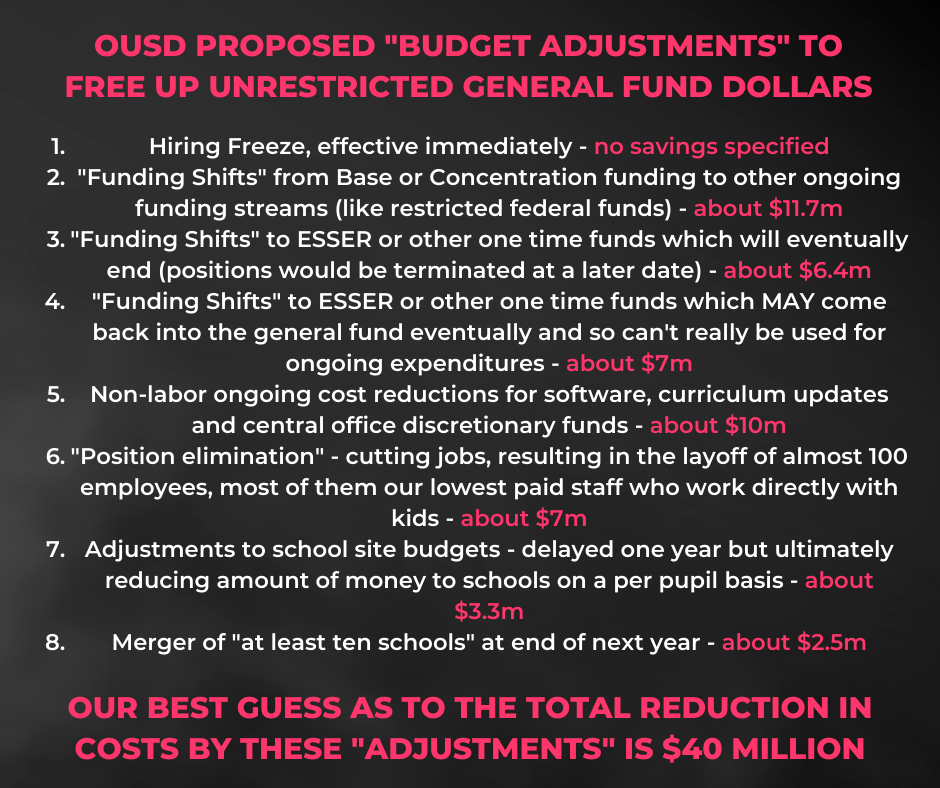
The Oakland Unified School District (“OUSD”) Superintendent and Board of Education President introduced a series of “Budget Adjustments” in a joint letter on 2/27/2023 that they claim are needed to fund badly needed compensation increases for our educators and other union staff. The Attachment A list of “Adjustments” includes (as best as we could make sense of it) the following categories of adjustments:

While the OUSD Board had been talking about reprioritizing the budget since the beginning of the year, it was the first time that the public and perhaps some members of the board had seen some of the “Budget Adjustments” including the plan to lay off nearly a hundred of our lowest paid employees, most of whom work directly with students as special education paraprofessionals, restorative justice facilitators, case managers, early literacy tutors and a safety position created during the implementation of the George Floyd Resolution. Also a huge surprise (given the board’s decision just a month before to overturn planned school closures and mergers) was the plan to merge “at least ten schools” to save $2.5 million. Directors VanCedric Williams, Valarie Bachelor and Jennifer Brouhard have been clear during their campaigns and since that they will not balance the budget by laying off our lowest paid union workers or by closing or merging schools, especially without any prior community agreement. So it was no surprise that these three board members did not support the package of cuts and voted no. For more on that vote check out our blog post from earlier this week.

OUSD has a historic opportunity to fundamentally transform our district in service of students by “chopping from the top”

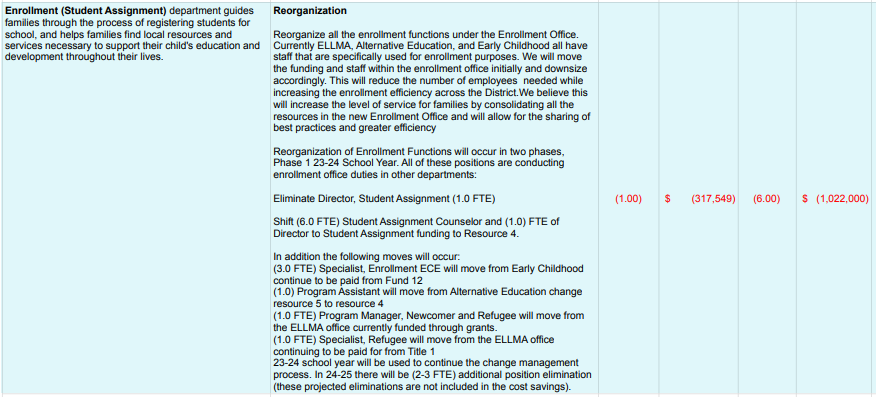
“Chop from the top” doesn’t mean letting a few folks go, it means reorganizing departments (fewer people) and restructuring senior central office salaries to bring us in line with neighboring districts, and now is the time to get started. We have historic reserves and one time Covid dollars that can be used to free up funds to give teachers and other union workers raises (because they are vastly underpaid) while we work on restructuring the central office to run more efficiently with fewer dollars. We are very pleased to have read in the presentation that some of that work has begun. For instance, the enrollment department is reorganizing both the way it is funded and help it deliver services more efficiently:

OUSD Budget Adjustments Attachment A page 7

According to the presentation, OUSD is also planning to eliminate the entire Chief of Staff office at the end of the 2024-25 school year, and to collapse the Business and Operations offices together (which is how we have functioned in the past) over the next few years. While we applaud these changes, and we are looking forward to full implementation, the Chief of Staff’s office is not paid with General Fund revenues (and is therefore those funds are not available to push to school sites), nor is the Chief Business Officer (who is paid from AB1840 funds), so we need to do more.

OUSD has too many supervisors who are paid too much

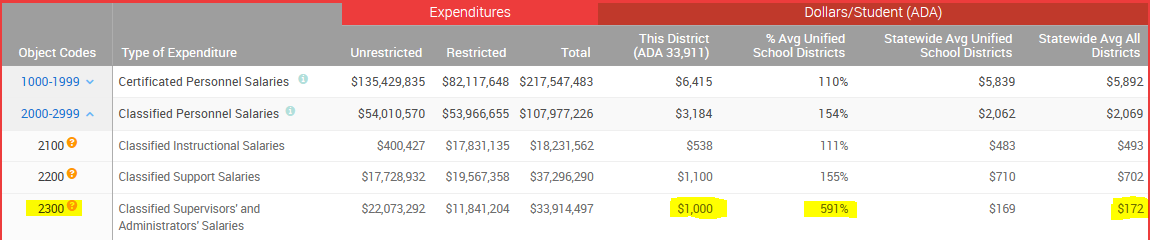
Every district in California reports data to the state, and for expenditures, every district reports them in the same way – by using “Object Codes” to identify the type of expenditure. That data is all publicly available on the http://www.ed-data.org/ website, and much of the data we use comes from that site. Object Code 2300 is defined as “Classified Supervisors’ and Administrators’ Salaries – Full-time, part-time, and prorated portions of salaries of supervisory personnel who are business managers, controllers, directors, chief accountants, accounting supervisors, purchasing agents, site administrators, assistant superintendents, and superintendents. Include stipends for governing board members and personnel commission members.” This does not include Principals (who are “certificated”) but can include Community School Managers. For the most part, however, it represents central supervisory staff.

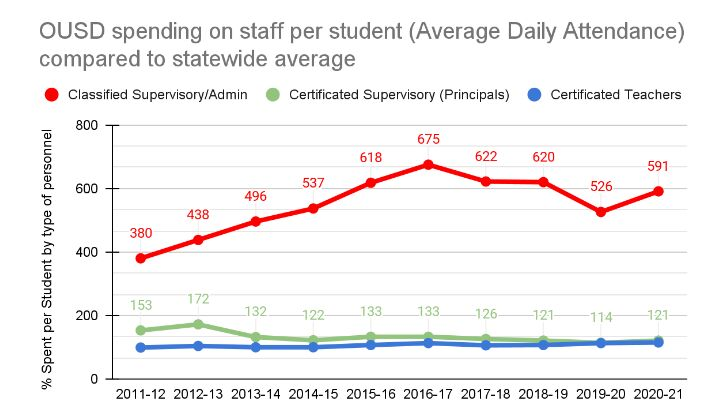
The statewide average for the cost to a district for Object Code 2300 Supervisory staff is $172 per Average Daily Attendance (“ADA”) which is the number of students attending on a given day (so essentially $172 per regularly attending student). For OUSD, that cost is $1000 per student, or 591% above average of all districts.

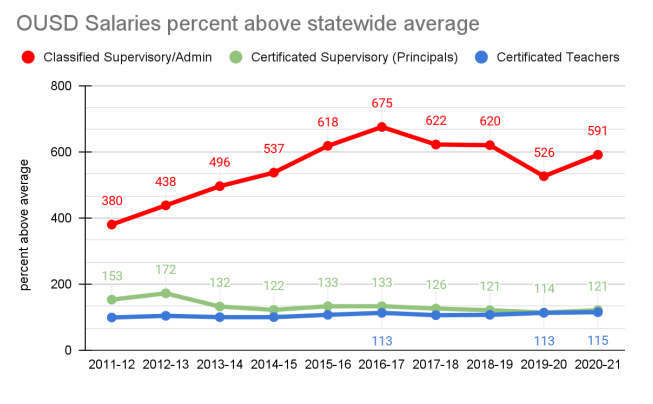
This 591% number is not an anomaly, although it is down slightly from our high of 675% in 2016-17 under previous Superintendent Antwan Wilson. It reflects both the NUMBER of employees (high) and the COST of those employees’ salary and benefits (also high).

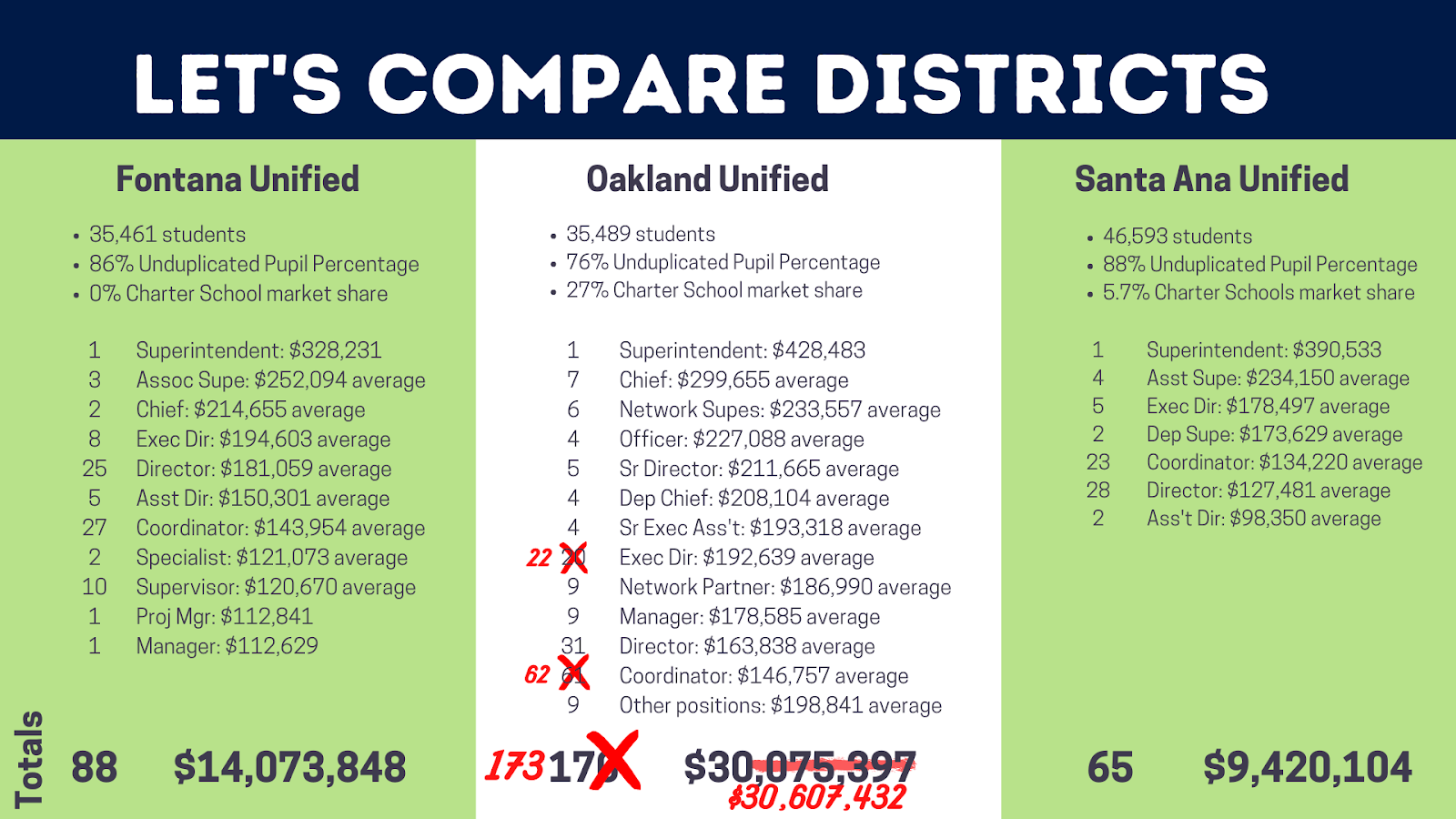
What do some other districts look like in terms of both the number of upper admin and their salaries? We compared West Contra Costa Unified (Richmond area) and Santa Ana Unified in Southern California that OUSD has used for the “number of schools” comparison) to see what it looks like and found that if we staffed similar to those districts, with fewer employees making less money, we could save $20 million per year.

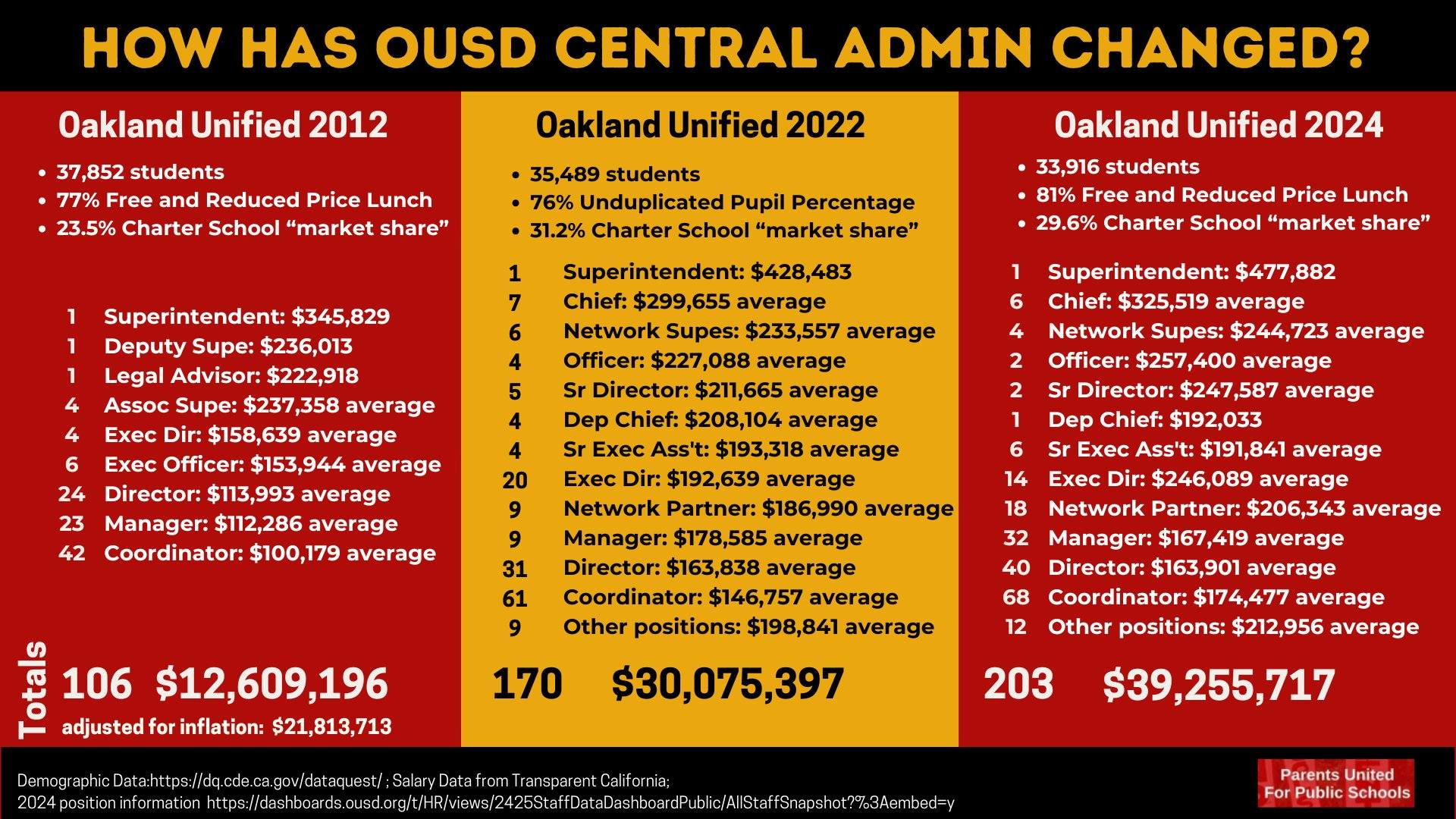
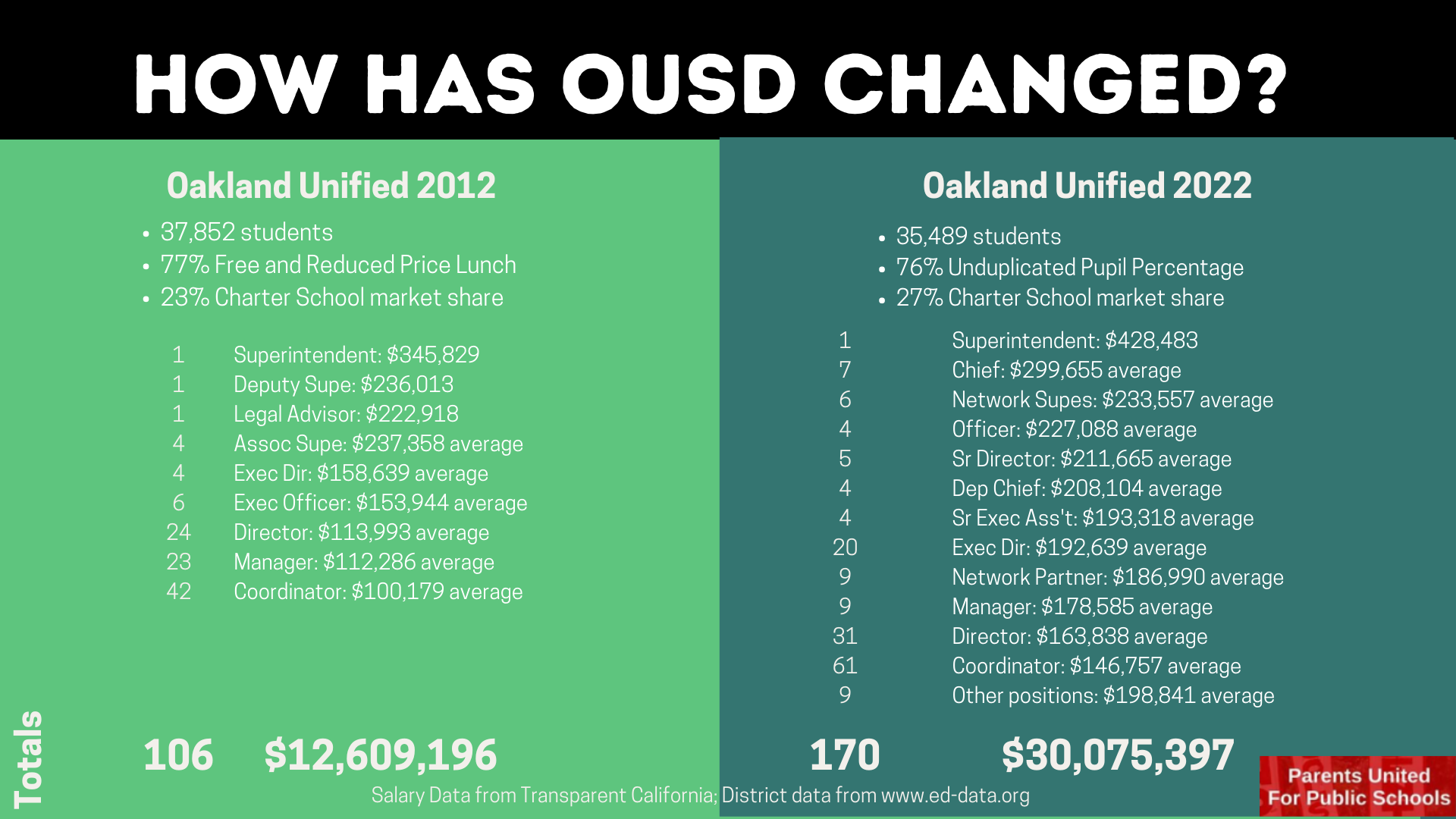
But what about OUSD itself over time. We know that the percentage of statewide average was always high (438% in 2012) but what has changed to cause our growth to jump to 591%? The cost of OUSD’s central staffing in 2012 was $12,609,196 (which is $16,683,075.46 if you adjust for inflation), whereas today it is more than $30 million (twice as much) while the number of staffers has grown 60%. So the number of people we employ in central office supervisory positions has grown by 60% while the amount that we pay them has grown by 100%.

It’s expensive in the Bay Area, so let’s look at our neighbor’s spending on Object Code 2300.

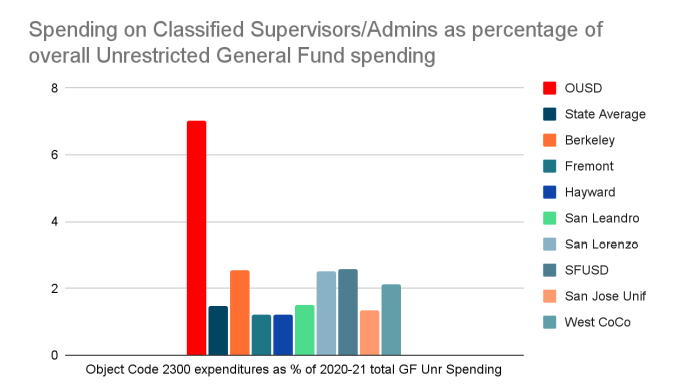
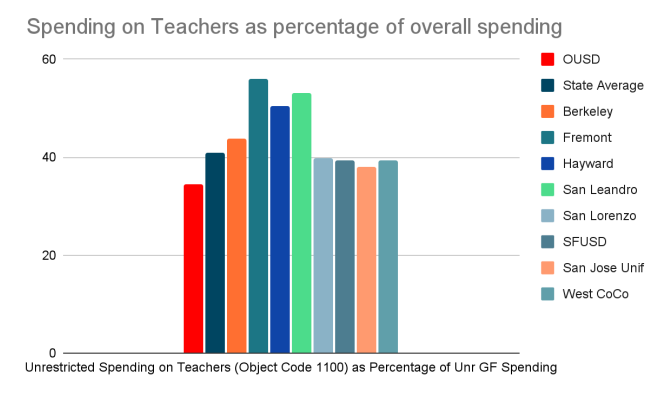
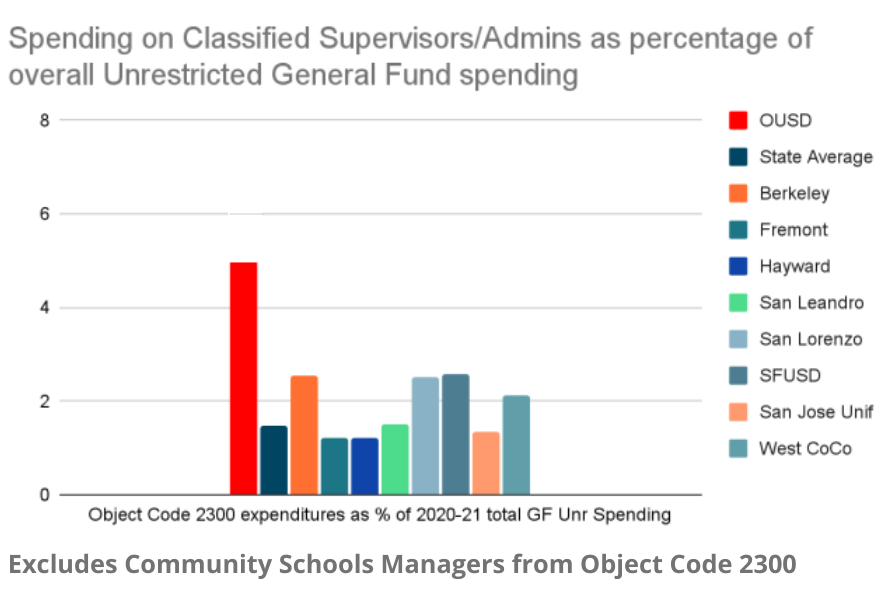
We spend more than twice as much of our Unrestricted General Fund on Object Code 2300 (Supervisory Classified) as neighboring districts (and four times the state average). And what about our spending on teachers?

We pay significantly less of our budget to teachers than other districts do, and according to the Oakland Education Association (“OEA”) Oakland teacher salaries are almost 23% below the median in Alameda County.

The “We have more central administrators than other districts because we operate more schools” excuse doesn’t work

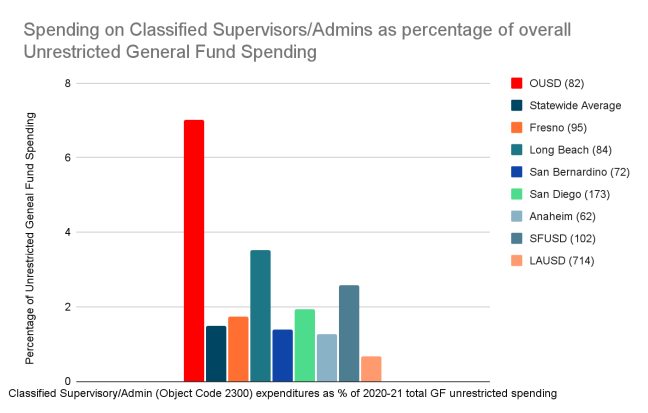
Board members and staff often say that we have more schools per ADA than other school districts and that is why we have so many central supervisors. So we looked at districts with similar numbers or more of schools, and we still have far more administrative costs than those districts which serve more students than we do.

While operating more schools can result in some additional expenses, it is clearly not what is driving this huge overspend gap. .

OUSD staff and board members also use the excuse of Community Schools to explain the disparities in Object Code 2300, saying we spend so much more because we have 50 some community school managers in Object Code 2300, and it is true that if we did not have Community School Managers we would reduce our overall spending in this category. The bad news is that we still would be at three times the state average of spending, and we would still be spending a minimum of twice as much as our neighbors on this object code. And now, other districts will be adding their own community school managers since the state is making additional money available for them (and for ours).

All of this data leads to one conclusion that we have known for some time: we are top heavy, and compared to other districts we short change our students by investing too much in central office and not enough in the classroom. OUSD is the only district we could find that spend more on Central Office supervisors (2300) than on school administrators (1300). That needs to change.

Tell the Board to adopt “Budget Adjustments” that prioritize our classrooms. No Cuts to Schools. No Layoffs of Staff at Sites. And no surprise mergers.

It’s time to stop making excuses for why we are so top heavy and do something about it. Tell your OUSD Board Directors to “Chop from the Top” by reorganizing and restructuring departments and salaries to downsize both the number of people and their overall cost to our kids. It’s time to get real about bringing compensation for our educators and other represented staff up to at least the county average so we can recruit and retain great teachers and site staff who can afford to live in Oakland. And tell them we are not going to fund raises on the backs of our lowest paid workers or our kids.

Contact the board via email:

  • Sam.Davis@ousd.org
  • Jennifer.Brouhard@ousd.org
  • VanCedric.Williams@ousd.org
  • Mike.Hutchinson@ousd.org
  • Valarie.Bachelor@ousd.org
  • Clifford.Thompson@ousd.org
  • linh.le@ousd.org
  • natalie.gallegoschavez@ousd.org

Voting with your values: Thank you OUSD Board Directors Williams, Brouhard and Bachelor for standing firm and voting against school mergers and layoffs of our classified staff that support our most vulnerable students

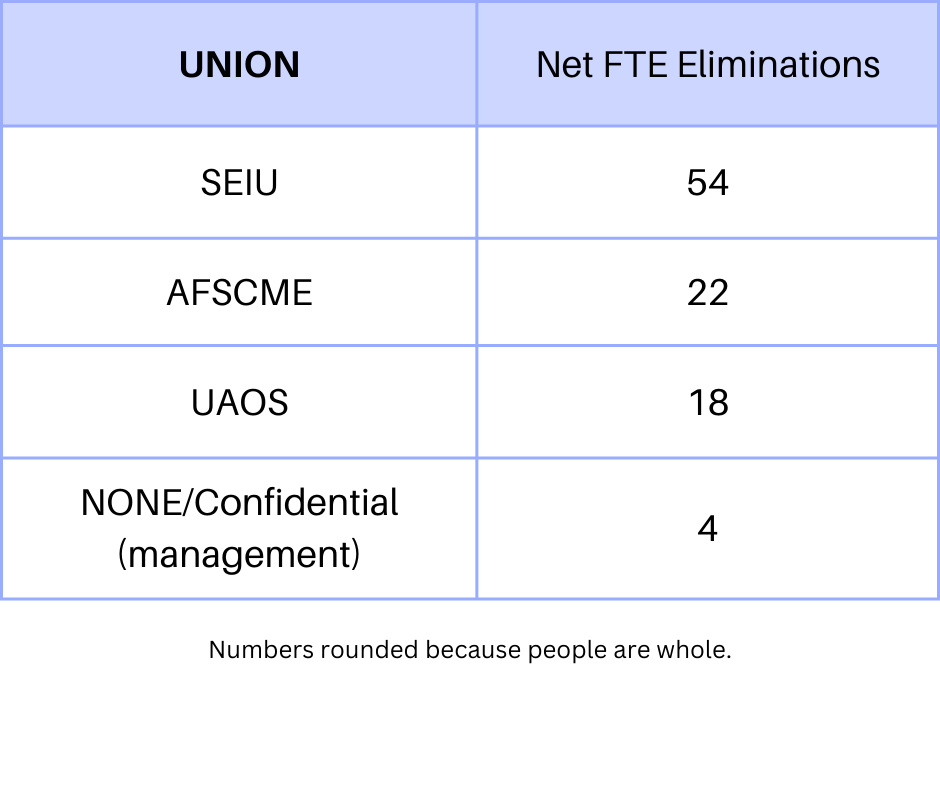
Last night at a special board meeting, the Oakland Unified School District (“OUSD”) Board of Education considered a series of “budget adjustments” that Board President Mike Hutchinson and Superintendent Kyla Johnson-Trammell stated in a letter were necessary to fund ongoing investments in alignment with district priorities. We learned for the first time that President Hutchinson and Superintendent Johnson-Trammell intended to “merge at least ten schools” in order to achieve a purported $2.5 million in staffing costs (by eliminating 5 principals, 1 teachers and about 11 site staff.) In addition, the plan included laying off a net 98.88 “FTE” (full time employee equivalents), nearly all of them our lowest paid workers who work directly with students, such as case managers, literacy tutors, restorative justice facilitators and special education staff. Just 4 employees are “confidential” or unrepresented employees who generally cost far more in wages and benefits to the district and usually are not directly interacting with students. You can see the entire presentation on OUSD’s website.

Although OUSD did not assign numbers to the staff layoffs it appears to be somewhere in the $8 million range and includes the School Security Coordinator that was added by the George Floyd Resolution implementation. The total reductions total about $21 million (including $2.5 million achieved by merging schools) plus “funding shifts” to either restricted funds ($15 million) or one-time funds ($11 million – which will eventually go away and so cannot be used to pay ongoing expenses like key salaries) for a total of about $39 million in proposed general fund savings. There were some small changes to central staffing, but absolutely not the kind of systemic reform needed.

Directors Brouhard, Bachelor and Williams stood firmly with the community and our critical classified staff who support students every day.

The two new board directors Jennifer Brouhard (district 2) and Valarie Bachelor (district 6) were elected because they promised to stand with students, educators and community against school closures and with our most vulnerable children, teachers and staff. Director Williams (district 3) was elected in 2020 on that same platform, as was now Board President Mike Hutchinson (district 5). So it should not have been a surprise to district staff that this Board would demand a different kind of budget balancing, one that looked for creative ways to restructure spending, especially at central office, to keep any adjustments as far from children and the people that work with them every day as possible. After overturning school mergers and closures in January, it should have been crystal clear that unexpected school mergers or closures of “at least” ten schools would not fly. Yet the budget adjustments that Superintendent Johnson-Trammell and Board President Hutchinson co-sponsored (according to the joint letter issued 24 hours before the vote was scheduled) were from the same draconian cuts and closure playbook that has been used over and over again in OUSD and has resulted in a district that values high paid administrators and outsourcing to consultants over classrooms and kids. The Board did not pass the “reduction” package presented, with President Hutchinson and Vice President Thompson voting in favor of the cuts and unidentified school mergers, Director Davis abstaining and Directors Brouhard, Bachelor and Williams voting no.

Just last year, President Hutchinson voted against a similar budget reduction scenario that involved school closures and mergers, plus more than 100 classified staff reductions.

We all know that OUSD must balance its budget and also that OUSD cannot use one time money to fund ongoing raises for its staff. But as this video from March 9th, 2022 shows, there are many ways to balance a budget in accordance with your values, and President Hutchinson was clear on those values just a year ago. At that time, faced with “budget reductions” that included school closures and the elimination of classified staff, then Director Hutchinson pulled the same “budget and staff reduction” item last year as they did last night, and made clear that he stood AGAINST school closures and voting to cut employees and staff:

“I expect everyone who’s watching in the community to know, to pay attention and to remember, because people aren’t allowed to say they’re friends of … labor [while cutting staff]. We’re sitting school board directors, all that matters is our votes. And you won’t ever be able to escape your voting record. Nobody is going to forget these votes … to close our schools, to cut employees, at a time when we see we’re running a budget surplus.”

See Director Hutchinson’s comments here:

//ousd.granicus.com/player/clip/2079?view_id=4&redirect=true&h=f32620b03e4695551650b1fde5b5945a&entrytime=24628&stoptime=24702&autostart=1&embed=1

We know that President Hutchinson has a great deal of responsibility as the President of the Board, but he must exercise his power in accordance with the values he has always espoused, and upon which he was elected. We therefore ask President Hutchinson to work with Directors Williams, Brouhard and Bachelor to find the funds necessary to meet our District priorities, including providing raises to all represented staff, in alignment with the values that we know that they all have in common, without closing or merging schools (especially without deep community participation beforehand) and without eliminating key health, safety, special Education and other positions that serve our students directly and are among the lowest paid employees in this district. We are counting on you all working together to revamp and reorganize our district to align with our shared student centered vision.

The entire discussion and vote from March 9, 2022 can be found at the link below.

//ousd.granicus.com/player/clip/2079?view_id=4&redirect=true&h=f32620b03e4695551650b1fde5b5945a&entrytime=24480&stoptime=25027&autostart=0&embed=1

Our newly elected, progressive OUSD Board majority just reversed school closures. Now it’s time to get to work to realize our vision of a community led, anti-racist, people-over-profit centered school district.

.

Brookfield students showed up for the vote to keep their school open! Photo credit to Corrin Haskell

On Wednesday night, in the first official act of the new progressive majority, the Oakland Unified School District (“OUSD”) Board of Directors voted to rescind planned closures of 5 elementary schools and 1 middle school program at the end of this school year. Students, parents, educators and community were on hand to witness newly elected board members Jennifer Brouhard and Valarie Bachelor join with sitting directors VanCedric Williams and Mike Hutchinson to fulfill the mandate of the 67% of voters who supported their platform of ending school closures which target schools in Black and Brown neighborhoods and destroy communities while fueling the gentrification of Oakland. 

The fight is not over. No sooner was the vote complete than the Alameda County trustee Luz Cazares, appointed to oversee OUSD’s finances, informed OUSD that they reserved the right to stay and rescind the board’s action to end school closures, because OUSD did not provide a Fiscal Impact Analysis as required by its own board bylaws prior to the vote.

District staff should have prepared that Analysis as soon as the matter was introduced by Director (now President) Hutchinson on November 30th, but failed to do so, and it appears that both Director Sam Davis and Director Hutchinson, who had each declared their intention to become board President, allowed staff to delay the Fiscal Impact Analysis until January 25th. This was done despite the urgency of needing to fix the enrollment system immediately to include the targeted schools and begin the budget development for school sites. That willingness to delay and worsen the harm to students led to Director Williams being elected president and immediately calling a special meeting for Wednesday, January 11th for a vote on the rescission resolution, which passed. President Williams’ decision to act immediately to help the targeted school communities jump start planning their futures was also a rebuke against the deliberate slow rolling by staff and politicking by board members. We are grateful for his leadership and for putting students first.

It is now up to District staff to prepare the necessary analysis so that we can avoid action by the County trustee and move on with the planning for how we support the targeted schools to repair the harm done by years of uncertainty and underinvestment. We must also rethink our solvency strategies to ensure we are no longer balancing our budget on the backs of our most vulnerable students. We must restructure our district from a top heavy, consultant-dependent “business model” to a district built from the bottom up, where we prioritize students and classrooms in true Community Schools. We must push our city, county and state leaders to support us in creating a district that serves the whole child, addressing community needs so that students are prepared to learn and excel in life. It is possible to educate students in equitably funded neighborhood public schools with staff who are valued and paid a living wage. 
OUSD receives more money per student than almost any other large school district. It is time we invested those funds in the classrooms where they belong. Let’s get to work.

Why did Alameda County Superintendent Monroe reward managers with huge Covid stipends?

Alameda County Superintendent of Schools Karen Monroe paid up to $22,500 each in Covid related stipends to some of her highest paid managers and political contributors. That’s a problem.

In a fascinating series of meetings by the Alameda County Board of Education (ACBOE), we have learned that Alameda County Superintendent of Schools (Superintendent) L. K. Monroe’s office quietly, and without informing the ACBOE as required by law, paid $527,800 in Covid related stipends to employees, more than half of which went to 16 managers in amounts ranging from $15,000 to $22,500. Further, we learned that the Superintendent’s office has resisted publicly accounting for these expenditures, which the Superintendent now says were a “mistake,” to the ACBOE as required by Ed Code section 1302. That is very troubling, and we should be very concerned about this misuse of taxpayer dollars and hold Superintendent Monroe accountable for this failure by voting in the upcoming June election and NOT rewarding her with another term in office. 

The County Superintendent position is an elected office, unlike what we have in Oakland Unified School District (OUSD) where our elected school board hires (and can fire) the superintendent. Superintendent Monroe is currently running for re-election in Alameda County on the June ballot, and unlike her last re-election campaign where she ran unopposed, she is now forced to actively campaign against a very strong challenger, Alysse Castro. This all comes at a very bad time for Superintendent Monroe, which may explain why these payments were not brought before the ACBOE in the first place, and why  it has been so difficult for the ACBOE to get the answers needed to understand who decided to make these exorbitant payments to upper managers instead of those educators and staff who work with students directly. 

Now that Superintendent Monroe finally provided the list of staffers who received these exorbitant payments and the amounts, we can dig a little deeper and when we did, we discovered that at least half of these staffers who received large Covid stipends ALSO contributed to Monroe’s re-election campaign. In all, 11 ACOE employees made political contributions to Monroe’s campaign, and she awarded 9 of them this enormous discretionary stipend. That is simply shocking. 

Superintendent Monroe also oversees OUSD’s budget, demanding OUSD close schools instead of rightsizing its own bloated administration. That’s also a problem.

The Alameda County Office of Education also oversees the Oakland Unified’s budget and has required OUSD to move forward with school closures that disproportionately harm Black students in a process that is flawed, discriminatory and possibly illegal. Superintendent Monroe threatened to withhold approval of OUSD’s budget and block access to additional state funds if OUSD didn’t execute this plan, claiming she is all about fiscal transparency and accountability. We now know that is not what she is all about. 

In fact, Superintendent Monroe has been approving OUSD’s budgets since she was first elected in 2014, during a time when OUSD’s administrative office grew by 550%; when OUSD paid a consultant $30,000 a month to oversee his own contract; and when OUSD mismanaged funds, covered it up and faced criticism and more from the Fiscal Crisis Management Assistance Team (FCMAT) and the Alameda County Grand Jury. Superintendent Monroe continued to approve OUSD budgets during all of those times, yet threatened to withhold approval if OUSD didn’t continue its racially discriminatory plan to close schools in Black and Brown neighborhoods. Superintendent Monroe should be held to account for that as well.

OUSD continues to overspend on central administrators as compared to districts locally and statewide. In fact, if OUSD “rightsized” its administration the way that Karen Monroe demands that it rightsize the number of schools, OUSD could save in excess of $15 million per year. Yet Superintendent Monroe doesn’t demand that from OUSD. And now we know why – Superintendent Monroe suffers from the same philosophy as OUSD in imagining that central managers deserve more than the educators and staff who work directly with students. 

It is time to hold Superintendent Monroe accountable for the misspending of Covid relief funds and the harm she has done while “overseeing” OUSD’s budget. Vote on (or by) June 7th.

#ACOE #OUSD #Budget #Covid #Transparency #Accountability #Vote