
Charter Schools must serve all students in a way that is reflective of the population of the district as a whole
Under California law1 charter schools must serve a representative population of students, and the plan to do that is a required element of its charter petition as described here: “The means by which the charter school will achieve a balance of racial and ethnic pupils, special education pupils, and English learner pupils, including redesignated fluent English proficient pupils, as defined by the evaluation rubrics in Section 52064.5, that is reflective of the general population residing within the territorial jurisdiction of the school district to which the charter petition is submitted.”2. Although OUSD has not historically used this as a ground for denying a charter renewal or material revision, former Executive Director of the OUSD Charter Office Sonali Murarka made clear in June, 20203 that OUSD would expect charter schools to fulfill that promise moving forward, and that the failure to increase enrollment of identified groups could in fact result in the denial of renewal petitions, and by extension, material revisions, based on the fact that the plan identified in the charter hasn’t resulted in a balance of students and that therefore “the plan is not reasonably comprehensive” under Ed Code section 47605(c)(5). A charter school that is subject to denial on this basis is also subject to denial under section 47605(c)(2) because the charter school is “demonstrably unlikely to successfully implement the program set forth in the petition” given that the plan to balance student groups is a required element of the charter petition. If the plan is not reasonably comprehensive, the required element is not met. Each of these sections could therefore be the basis of the denial of a renewal petition or material revision.
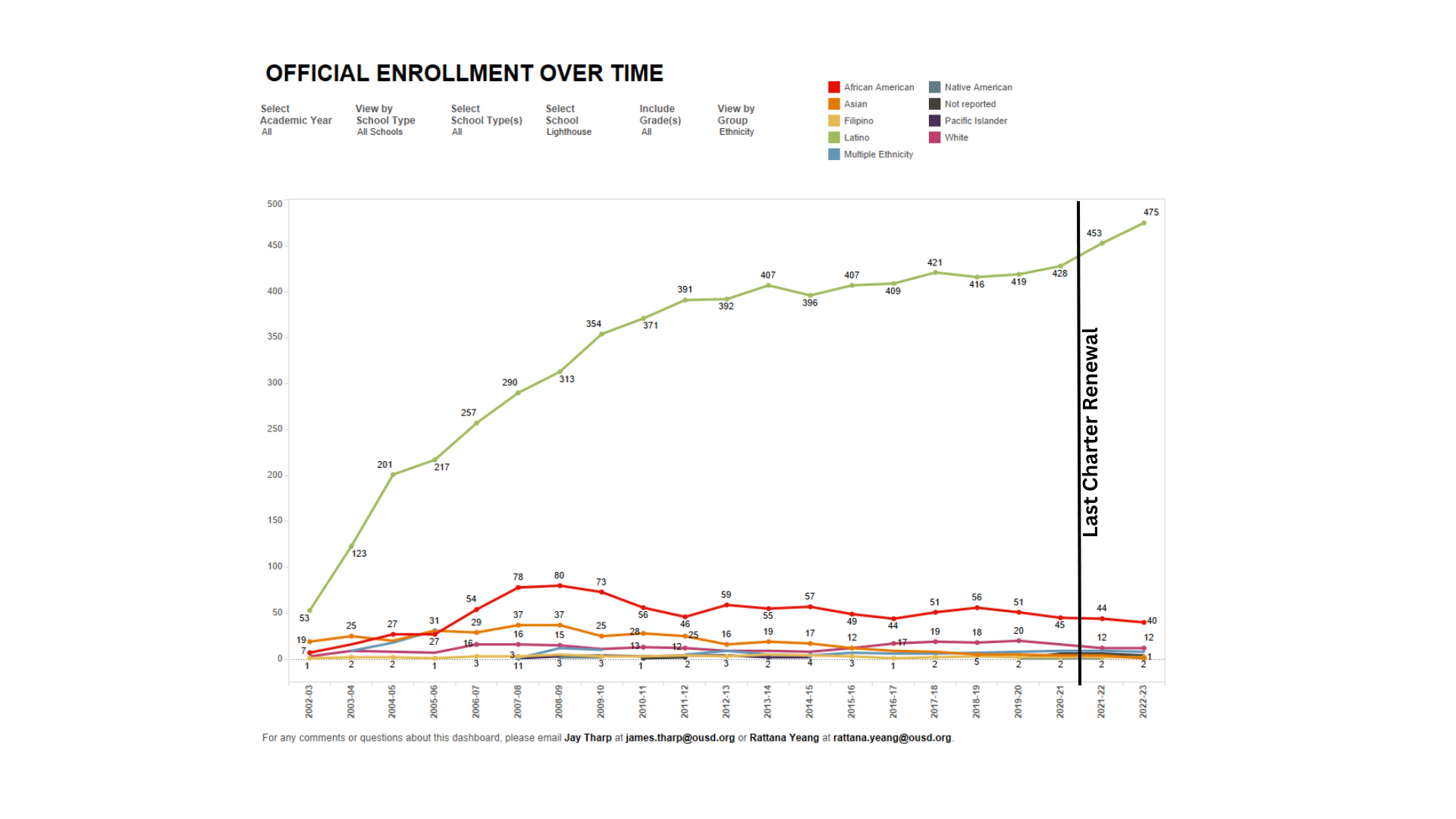
Lighthouse Charter School has consistently failed to enroll Black students over the last several charter terms. That finding is sufficient to deny the material revision sought here
According to the OUSD Staff presentation on the board’s agenda tomorrow night, Lighthouse Charter School K-8 (“Lighthouse”) serves the following student populations:

Shockingly, although OUSD as a whole serves nearly 3 times more Black students (as a percentage of overall enrollment) than Lighthouse, OUSD staff did not even note this discrepancy in its findings, focusing instead on low-income students, English Learners and students with disabilities:
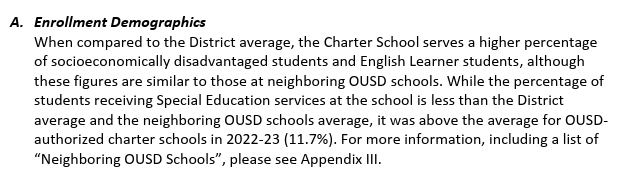
This failure to even mention Lighthouse’s underenrollment of Black students is particularly problematic given the acknowledgment in 2020 by Lighthouse staff that OUSD had pushed them “to increase their enrollment of Black students” over the last several charter terms and asserted that their new enrollment priorities would address this disparity. Lighthouse staff stated that they were “certain” that their plan to achieve that balance would result in an increase in Black student enrollment during their charter term.4 That has not happened. In fact, enrollment of Black students, who have been consistently underrepresented at Lighthouse, has continue to decrease since the last renewal. The plan that Lighthouse identified in its renewal charter has not resulted in the required balance of students, and therefore the plan is not reasonably comprehensive under the charter law. That finding alone is sufficient for OUSD to deny the material revision.

OUSD should not reward Lighthouse with additional opportunities to NOT enroll Black students
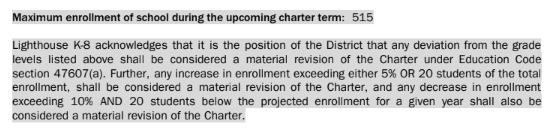
There has been much discussion about whether Lighthouse needs to seek this material revision to add Transitional kindergarten (“TK”) classes, but that is not relevant. TK is not a separate grade level from kindergarten, and so Lighthouse does not need a material revision to add TK classes. Lighthouse must seek a material revision because they are seeking to increase enrollment by 65 students over the maximum enrollment set forth in their charter petition. Language in that petition makes clear that any enrollment exceeding either 5% or 20 students above the maximum enrollment requires this action:
OUSD previously denied a Material Revision to add enrollment filed by Aspire ERES in 2021, choosing there to use Ed Code sections 47605(c)(7) and (c)(8)5, but for some reason the OUSD staff failed to do this analysis here. It should have, and staff should explain why they failed to use those sections of the charter law in considering this material revision.6 But the OUSD board can still deny this material revision based on sections 47605(c)(2) and 47605(c)(5)(G) as set forth above.
Lighthouse, by its own admission, is not serving Black students in a way that is reflective of the community as a whole. OUSD has made a commitment to ensure that OUSD authorized charter schools serve all student groups in the community. If OUSD were to grant this increase in enrollment for Lighthouse, with the same inadequate plan to balance student groups in place, we can expect more of the inequitable exclusion by Lighthouse of Black students. The OUSD board must not reward Lighthouse for bad enrollment behavior by giving them the opportunity to further fail to enroll Black students. The OUSD board must be consistent in its commitment to ensuring that charter schools are serving a representative population of Oakland. We call on the OUSD board to deny the Lighthouse Material Revision and require that Lighthouse return to its maximum enrollment of 515 in the fall.
- California Education Code section 47605 et seq ↩︎
- Ed Code section 47605(c)(5)(G) ↩︎
- See presentation and video of that discussion here: https://ousd.legistar.com/LegislationDetail.aspx?ID=4650883&GUID=4A0928BE-69F2-4295-926C-92377C356E76&Options=ID|Text|&Search=1505 ↩︎
- https://ousd.granicus.com/player/clip/1779?meta_id=631170 ↩︎
- These two sections were added in 2020 as part of newly passed AB 1505 and provide additional reasons to deny new petitions and material revisions (but not charter renewals). 47605(c)(7) would be a finding that the “charter school is demonstrably unlikely to serve the interests of the entire community in which the school is proposing to locate” and 47605(c)(8) relates to the fiscal impact on OUSD: “The school district is not positioned to absorb the fiscal impact of the proposed charter school.” ↩︎
- There has been some discussion that OUSD has been threatened with a lawsuit by the charter industry if OUSD denies this material revision on this basis. We should not be blackmailed into approvals, and it is unlikely that the threat would be carried out. Aspire is a large charter chain, and they chose not to sue OUSD when OUSD used C7 and C8 to deny in 2021. It is highly unlikely that if OUSD denies this material revision based on the failure of Lighthouse to serve Black students as required by their charter and the law that any entity would argue that they should not be held accountable for that discriminatory action. ↩︎


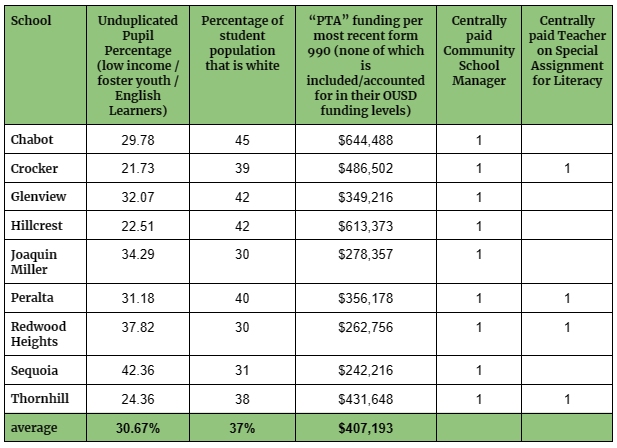
































 Parents United for Public Schools