Parents United was founded in 2014 as a network of Oakland Unified parents who believe deeply in strong, equitable public schools supported by excellent teachers and staff who are paid what they deserve and who can collectively organize to ensure our schools support ALL of our students, not just those who attend schools with PTA funds to spare. We have worked with thousands of parents over the years in schools in North, East and West Oakland, supporting their fight for equitable resourcing and against threatened closures and co-locations that have decimated neighborhoods and harmed our most vulnerable students. Since 2016, we have exposed the Billionaires backing pro-privatization candidates with their millions of dollars poured into misleadingly named PACs, and that is true to today where “Parents” and “Empower” provide cover for anti-union billionaire influence.
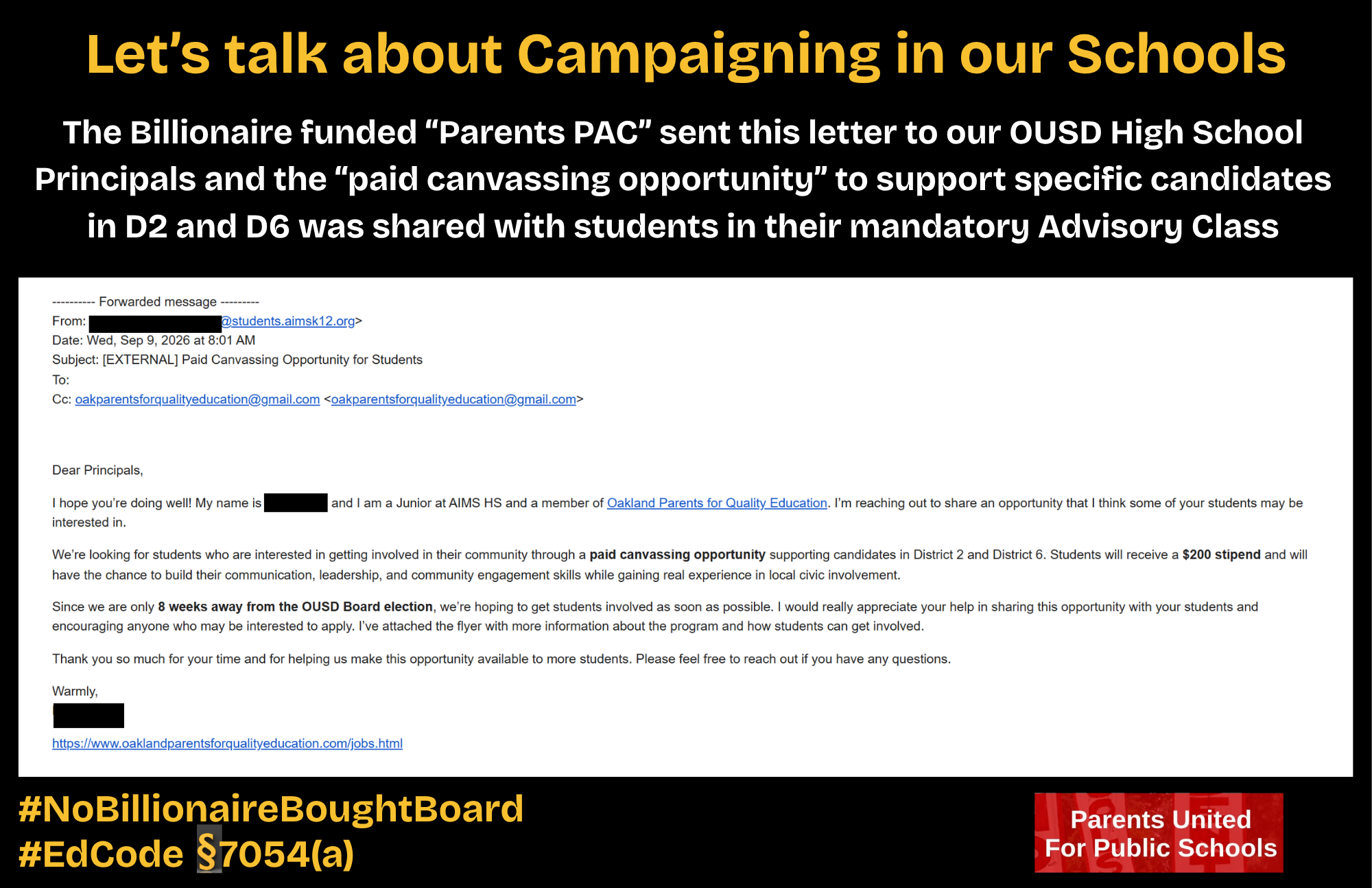
The “Oakland Parents for Quality Education” and “EmpowerOak” PACS are related, billionaire funded entities that want to close schools and cause further harm to the students and families we work with. They are not “grassroots” and they don’t represent the majority of Oakland parents. When the Parents PAC enlisted a charter school student to send emails to OUSD principals to ask them to help their campaign to elect anti-union, billionaire-backed candidates, they violated Ed Code and OUSD policy and should be condemned.
In a district where 82% of students live in poverty, the much needed extra money offered may buy canvassers’ time, and votes, but does not respect the independence and integrity of our students and public schools. This is not just about sharing information; this is a direct attempt to buy influence and votes using our young people who are themselves newly eligible voters.The damage is done, but you can do your part to mitigate the harm by NOT voting for the Parent PAC/EmpowerOak PAC backed candidates in Districts 2, 4 and 6.
In community, Kim Davis, founder, Parents United for Public Schools (estab 2014)
District 2: No on Arielle Fleisher
District 4: No on Mike Hutchinson and Kathryn Camp
District 6: No on Alexandra Williams and LeAna Powell
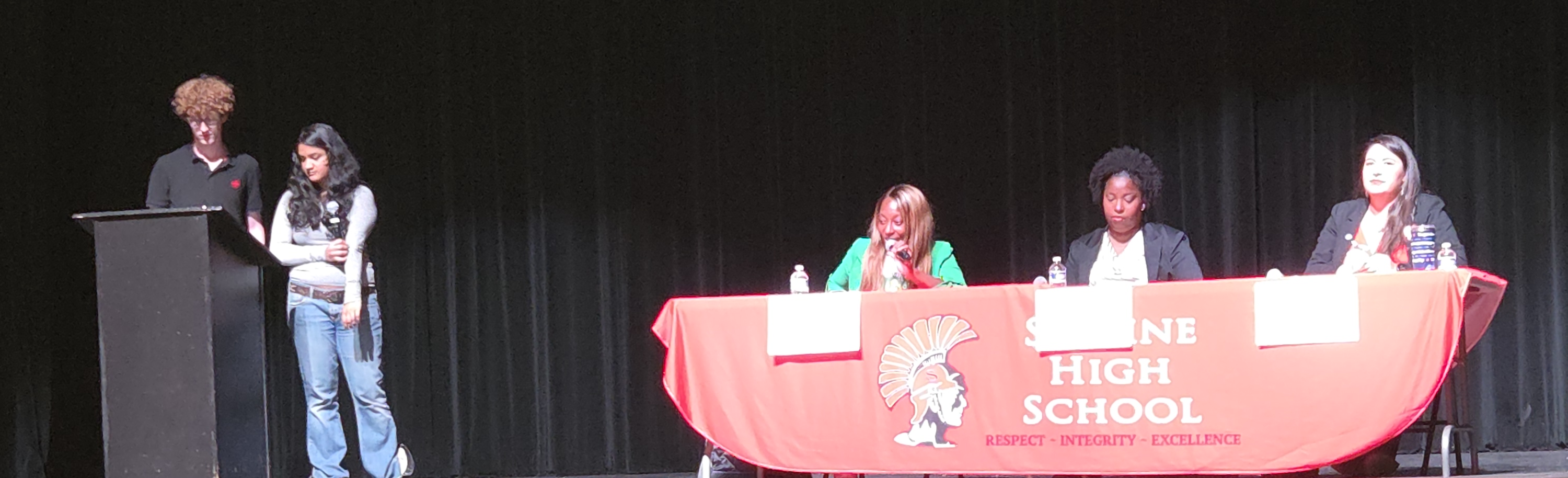
Last week, Skyline HS Students hosted a candidate forum for District 6, and it was amazing. The students were excellent moderators, asked a variety of important questions and managed the whole evening very professionally, well-done Titans!
Skyline High School students moderate candidate forum September 22, 2026
One of the questions for the panel was about school closures, which has been a hot topic in this election cycle. Some candidates and Political Action Committees have renewed calls to close schools to solve the budget crisis (despite no real evidence that it will do so1). Let’s look back at the history of school closures in Oakland for context, to better understand the legal implications of continuing to close “underenrolled” schools in Oakland Unified.
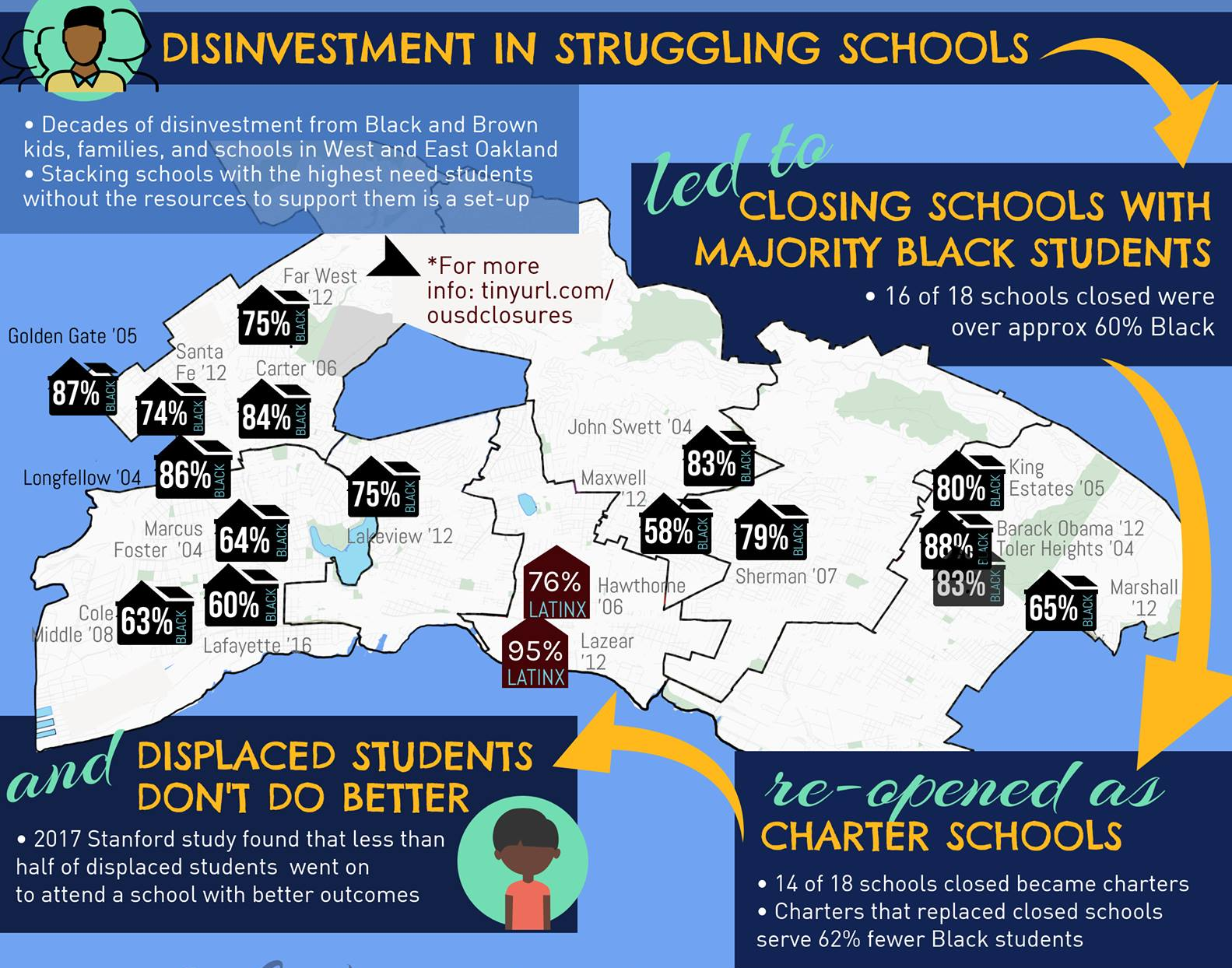
Since 2003 when the state took control of our school district, OUSD has closed 23 school campuses2 (not including creating and closing small schools but leaving the campus open). Of those, 6 are currently vacant and 6 house charter schools3. The remainder have been repurposed for a different OUSD use (admin, preschool, special education, new schools, etc). The vast majority of schools closed have been predominantly Black and have decimated neighborhoods and fueled the gentrification of East and West Oakland. According to a study by Dr Francis Pearman of Stanford “school closures, … are emblematic of a larger spatial and racial reimagining of U.S. cities…, fueled through gentrification and related shifts in local governance, that dispossess and displaces Black neighborhoods.4“
2019 Infographic from Justice for Oakland Students, does not include closures in 2020 and 2022
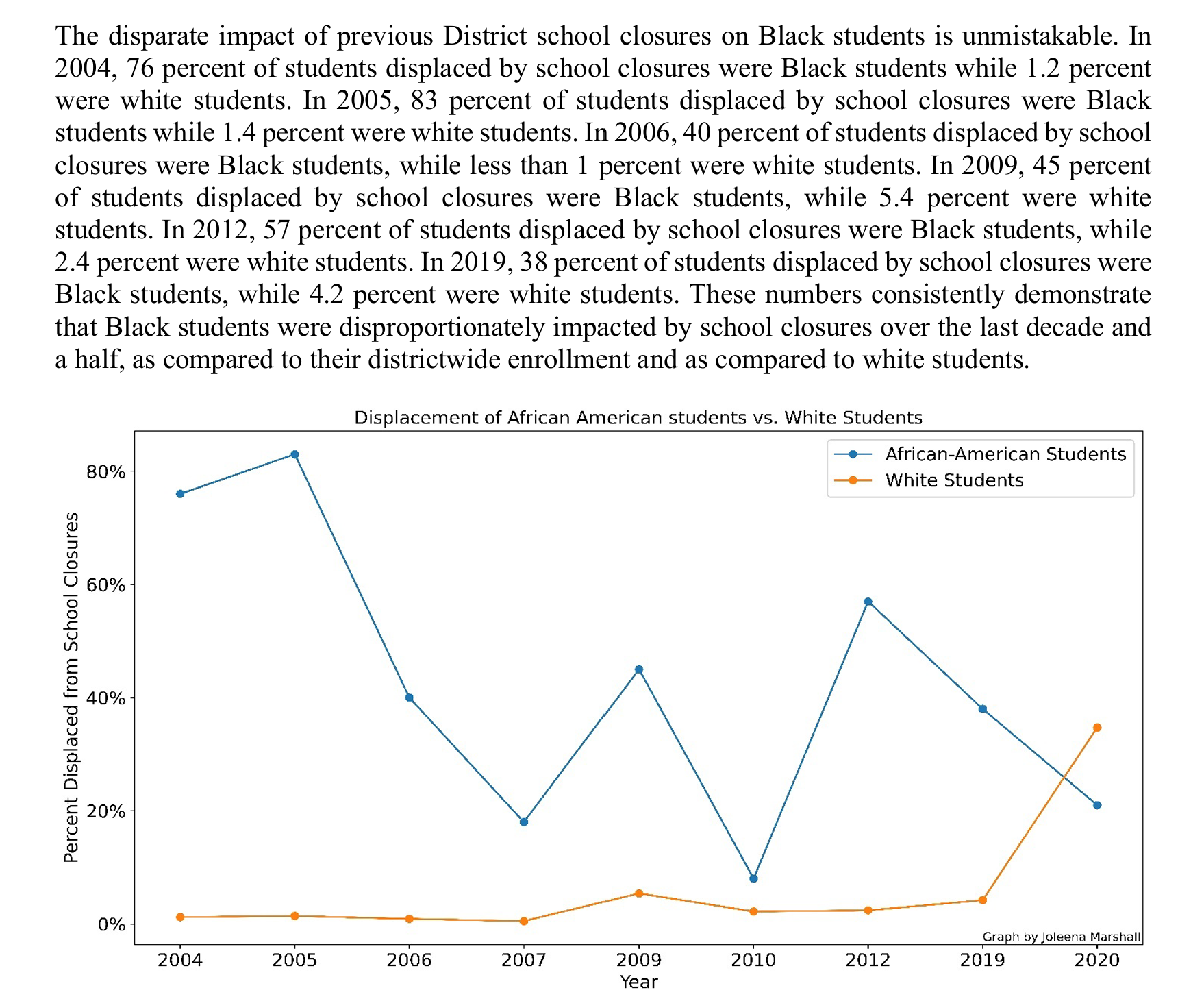
When OUSD voted in a rushed process to close schools in 20225, the Justice for Oakland Students Coalition, of which Parents United is a member, filed a complaint with the California Attorney General’s Bureau of Children’s Justice arguing that as it had historically done, once again OUSD was discriminating against Black students with its school closures plan. The Attorney General agreed6, as did the legislature with the passage of AB 1912 which requires a year long time frame for making any school closure decision and an equity impact analysis to be performed before the decision is made.7
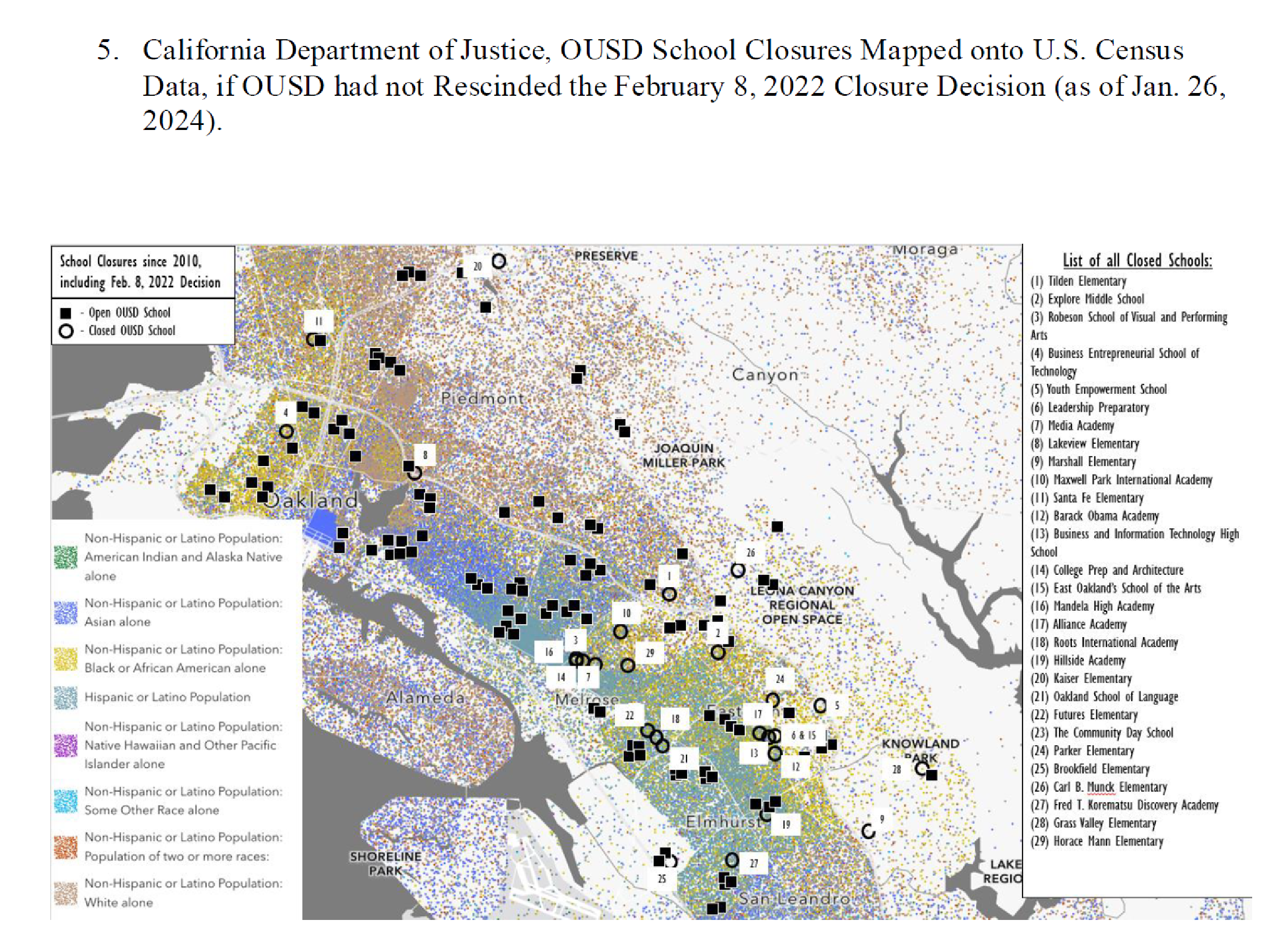
In its letter to the OUSD Board of Education, the Attorney General stated that the “Department’s analysis of public data showed that OUSD’s February 8, 2022 Closure Decision would have disproportionately impacted Black and low-income elementary school students and also high-needs students with disabilities in special day classes, if the decision had not been rescinded.8” In short, any future school closures must look very different from those in the past and not repeat the historic patterns of government sanctioned neighborhood racial segregation. The Attorney General concluded that “(e)ven if the process is conducted in accordance with AB 1912, OUSD must also ensure that the results do not violate California’s Equal Protection Clause or anti-discrimination mandates.”
The patterns of discrimination were mapped out by the AG’s office in its January 2024 letter
Fast forward to 2026, what could school closures look like?
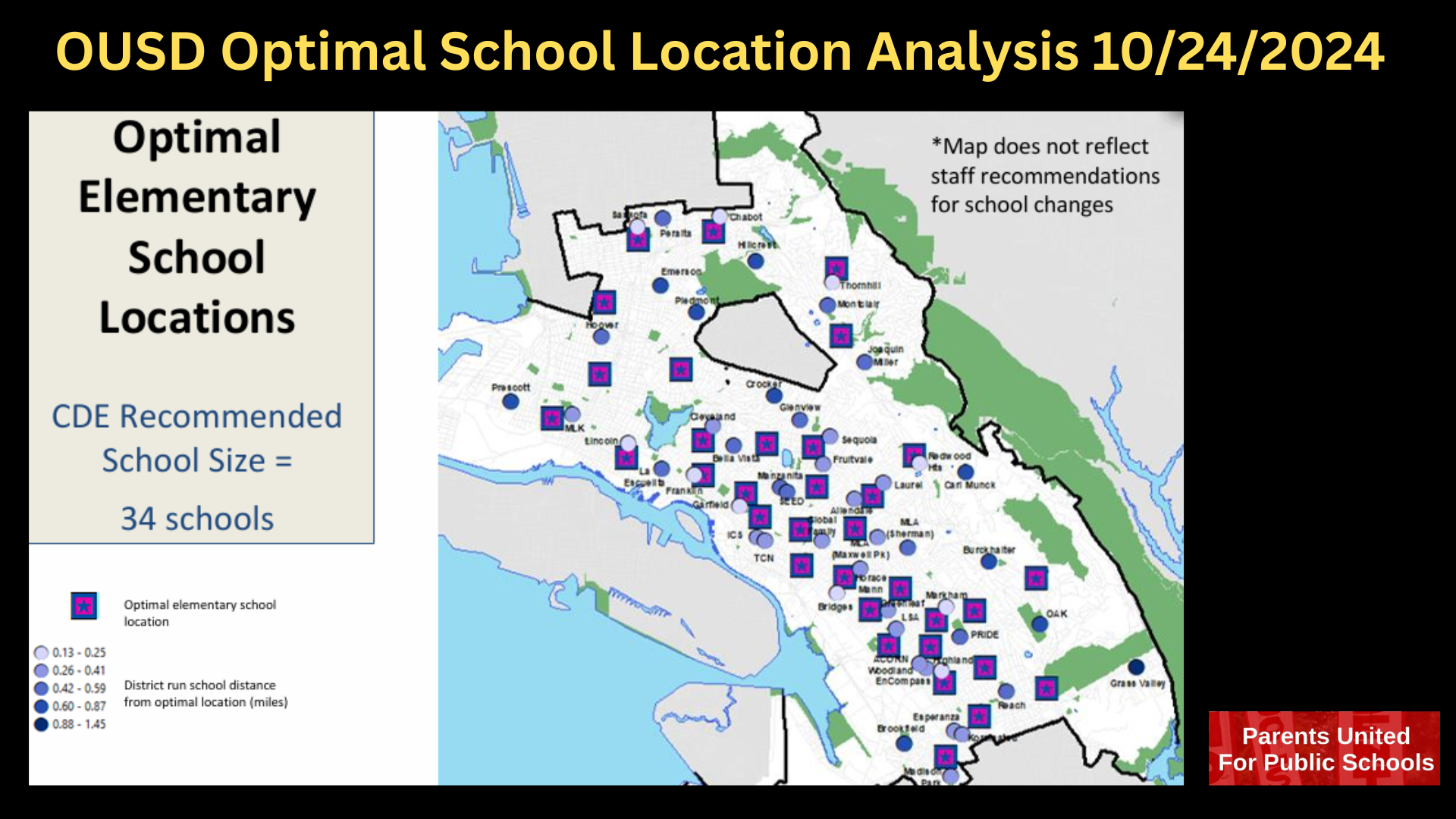
During the Skyline student-led forum candidates were asked a question about school closures to which candidate Alexandra Williams responded that OUSD already had a map ready to go and it just needed to be carried out – a reference to a presentation by staff to the Board in October 20249. It feels like a good time to dig out that set of maps to see just what OUSD was proposing post-AB1912 for how a “right-sized” district would look. Spoiler alert – school closures are not just for Black, Brown and Disabled students anymore.
Graph showing historically disproportionate displacement of African American students in past OUSD school closure decisions, from the ACLU/J4OS complaint, page 12
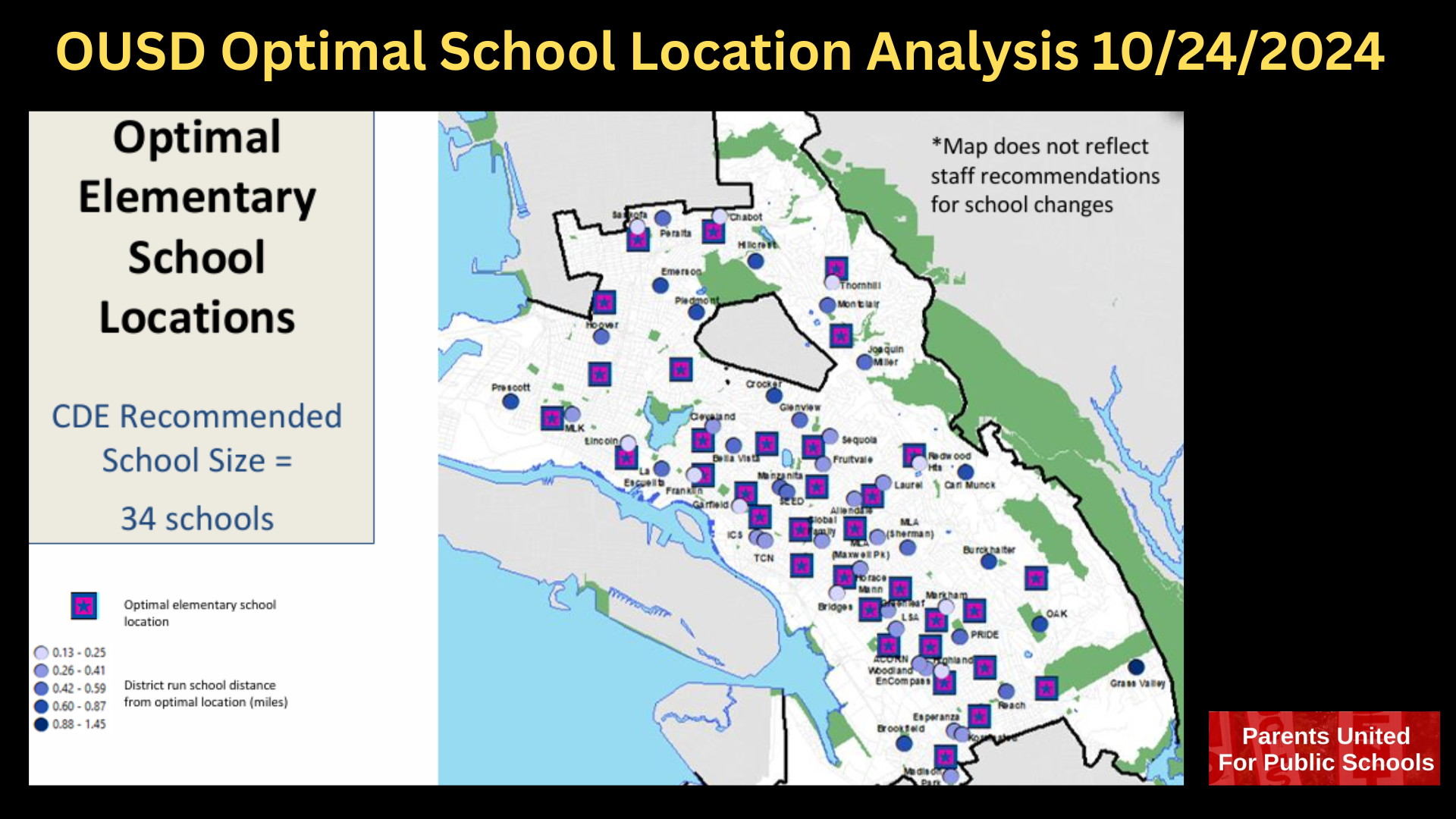
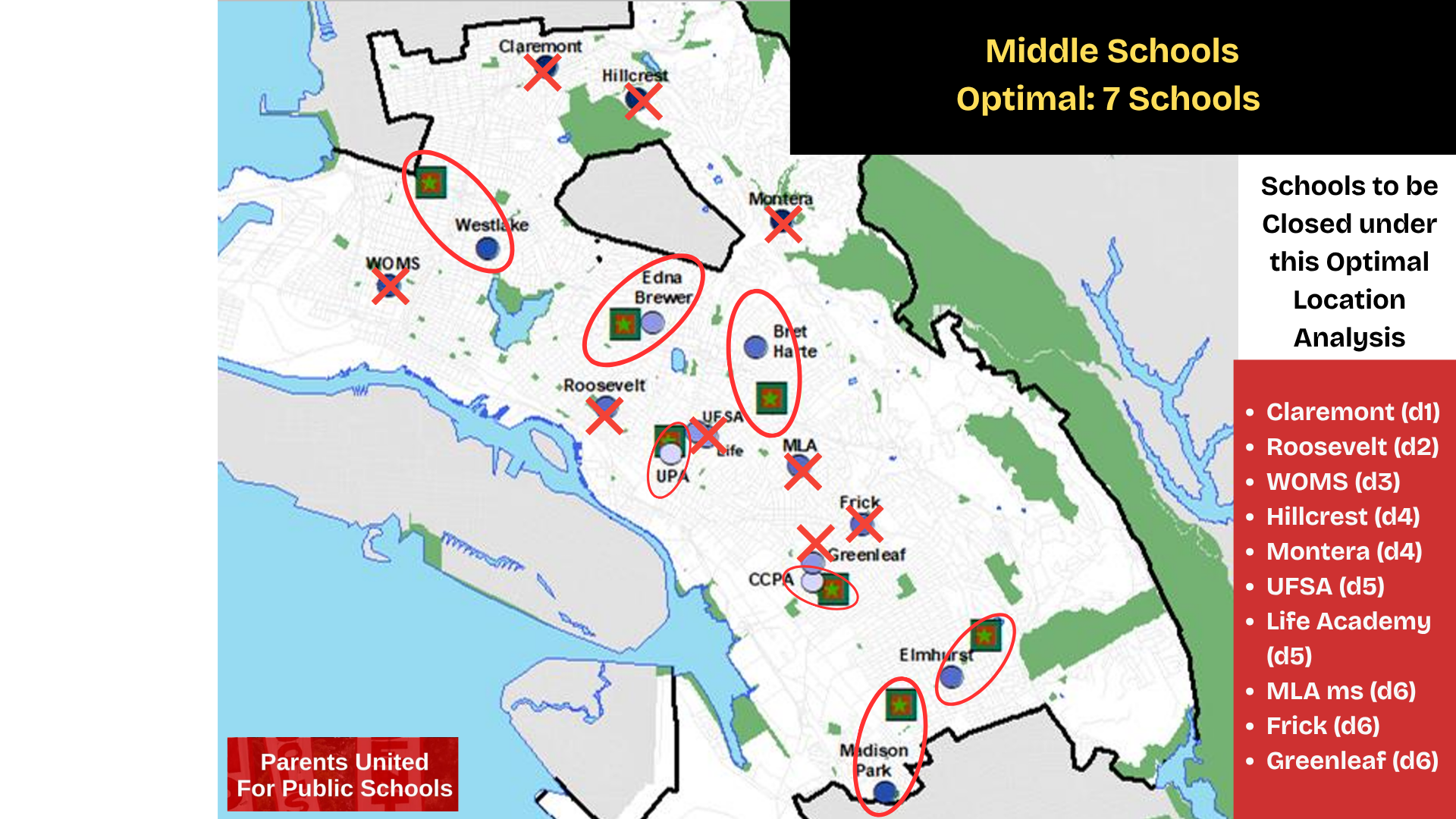
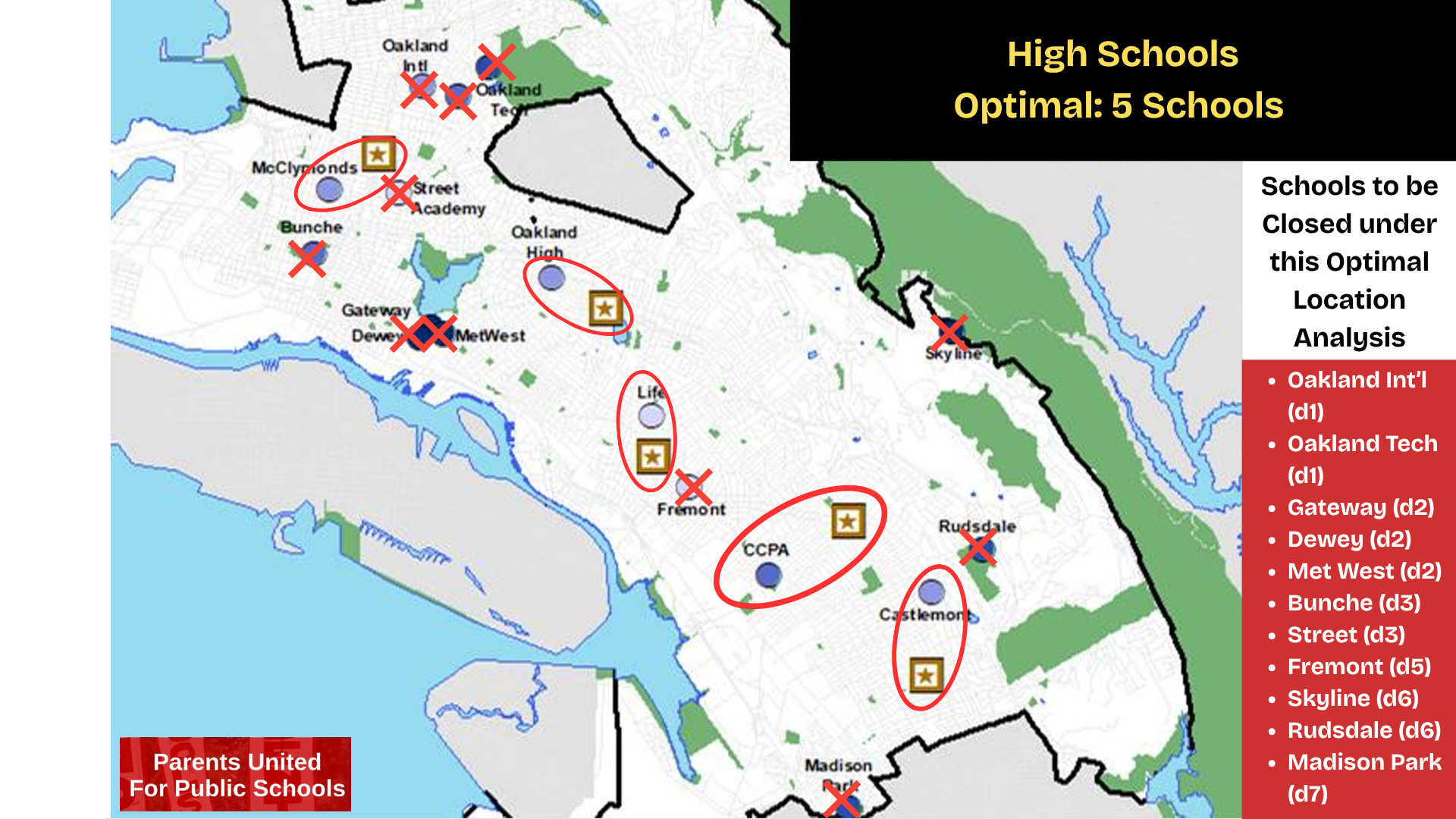
OUSD Optimal School Location Analysis
In its presentation, OUSD Staff used an “Optimal School Location Analysis” process “to determine the optimal location of school sites based on the location of students.” In other words, schools will be located closest to where students are concentrated. Although staff claimed that this was not the final recommendation for school closure decisions, a tremendous amount of work no doubt went into the creation of these maps, and as Ms Williams pointed out the maps are ready to go for the next round of closures.
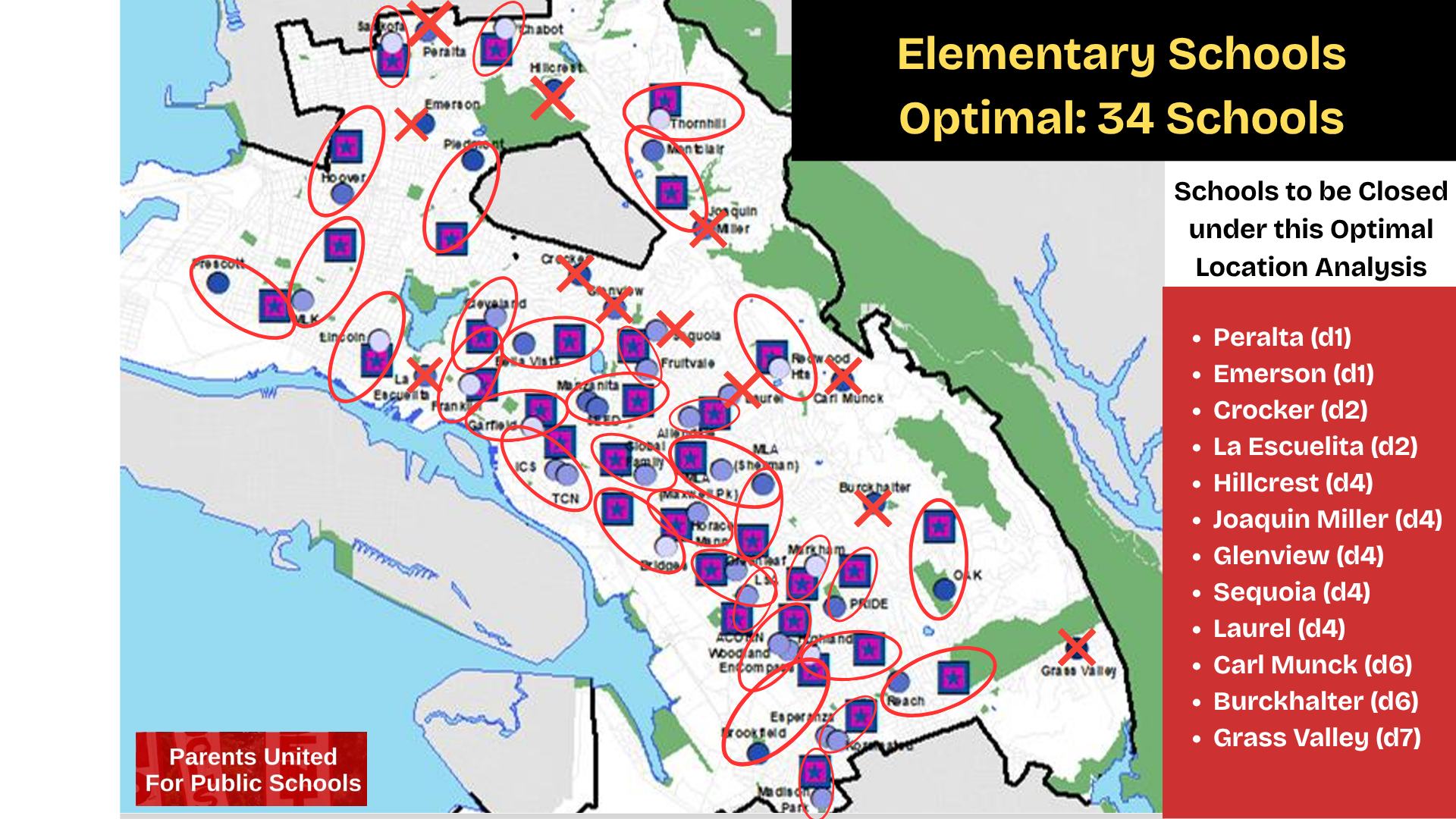
To make the presentation clearer, we have circled the closest schools to each optimal location and placed an “X” on the schools that are not in optimal locations. As you can see from the map, the Optimal Location Analysis projects closing 12 elementary schools and consolidating 8 schools, leaving 34 elementaries total. For middle schools, 10 schools would be closed, leaving 7 middle grade schools across Oakland. Finally, according to the presentation, we need only 5 high schools, meaning we would close 11 schools.
Elementary Schools – 16 fewer schools on 12 fewer campuses10
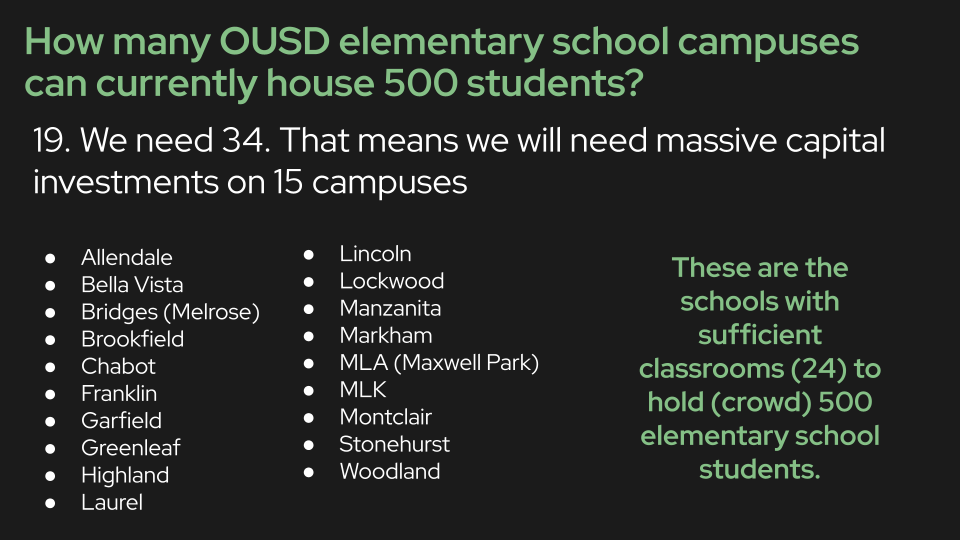
According to OUSD, the “optimal” number of elementary schools in Oakland is 34 schools of 500 students each, which means that 12 schools would be closed and 8 schools would merged or consolidated – those elementary schools that share a campus. Most of these schools were set to merge in 2024, but then-President Sam Davis was unable to even get the plan forward for a vote11. Under this “Optimal Location” map, five District 4 schools would be closed, something that has not happened before, at least in the last 25 years. 27% of the impacted students identify as white students, compared to 21% African-American students. 58% low-income12, and 19% students are Disabled, which is higher than OUSD’s overall average of 18.1% and also higher than the average of those schools identified for closure in 202213. In the 2022 school closures that the Attorney General found violated California Civil Rights Laws, 41% of impacted students were Black, while just 2.2% were white, 15.72% were Disabled and 81% were low-income.
Middle Schools – 10 fewer Schools
Under the Optimal Location analysis, OUSD would only need 7 middle schools of 1,000 each, resulting in the closure of 10 middle schools. We know that many white families leave the district at the middle school level, so overall there are slightly fewer white students at 10% and 18% African-American students. Under this closure plan, 13% of impacted students are white, 14% Black, 79% of the students are low-income and 15.9% Disabled. District 6 would be most impacted by this plan.
High School – 11 fewer schools
Under the Optimal Location Analysis, OUSD would need only 5 high schools of 2,000 students each, so would close 11 schools. Students impacted by these closures are 6.3% white, 16.5% Black, 15.5% Disabled and 92% low-income, with most schools in District 2.
Contrary to candidate Alexandra Williams’ statement that the closure plan is ready to go, clearly adjustments would need to be made to these maps in order to make even the slightest bit of sense. For instance, Glenview, Fremont and Madison Park have all recently been refurbished at great cost to tax payers and work at Roosevelt is underway. Closing those schools would rightly be considered a huge waste of taxpayer resources. Also, and perhaps most glaringly, OUSD does not have enough capacity in the schools that would remain open to absorb students from the 37 schools that would be closed.
OUSD would also need to decide what they were going to do with the closed schools (or end up with a bunch of charter schools in those buildings) in order to eliminate the cost of maintaining them. Parents United is not advocating that OUSD adopt this plan, or any school closure plan, but it is important to understand what such a plan might look like as groups like “Oakland Parents for Quality Education” and “Empower Oakland” push for school closures. While there are some parents at the more affluent schools represented by these groups who are willing to close their own school, as we saw during the closure of Kaiser, many/most of the white and affluent parents are likely to flee the district, resulting in massive loss of enrollment and therefore little to no savings achieved.
Several charter schools occupied closed OUSD schools until very recently, including Aspire Berkeley Maynard (closed), Francophone (moved), Bay Tech (moved), Community School for Creative Education (closed), Urban Montessori (closed). ↩︎
This is based on an optimal enrollment of 500 students for elementary, 1,000 for middle schools and 2,000 for high schools. Note that this is purportedly based on CDE suggestions, which is a misuse of CDE data. Those CDE numbers are for NEW construction, not ideal school size, and ignores the fact that most of our existing schools do not have the capacity required to meet these requirements. ↩︎
In the AG opinion, they focus specifically on Disabled students in special day classes; that data is not as easily available so more information is needed to make a good comparison. ↩︎
Outgoing Superintendent Dr. Johnson-Trammell has long argued that Oakland Unified School District (“OUSD”) must close schools in order to be fiscally sustainable, yet the majority of our elected school board has resisted that call, rescinding a decision to close schools in 2023, and rejecting a new plan to close and merge schools last fall. The argument is that we have too many schools for our declining enrollment, and that some schools are “underutilized” and not generating enough revenue (dependent on the Average Daily Attendance or “ADA”) to pay for itself, as if each school is a McDonald’s that needs to show a profit to stay open. We need to balance our budget as a unified system, and we need to offer accessible public education to Oakland’s kids, but we are not willing to have a real conversation about what that looks like.
Much is made about the fact that OUSD has more schools than many other California school districts per ADA. The question is, why does that matter and are we talking about public schools in the right way?
OUSD does have more schools per student than most medium to large school districts, but does that mean we have “too many schools”? Part of how you answer that question may depend on what you see as the purpose of public education and what our constitutional obligation to provide a free public education to all children requires of us. A child who can no longer go to school because her neighborhood public school has closed has no access to public education.
OUSD has argued that elementary students can walk 2 miles to school, but experts agree that is 2 to 4 times more than is reasonable.
It is important to note that OUSD does not provide transportation to most students, no yellow school buses pick kids up and take them to their neighborhood school, which means that if you do not have a car, you must walk to school or take public transit. Especially for elementary age students who most agree cannot take the bus on their own, there is a limit to how far a young child can be reasonably asked to walk to school. So long as Oakland does not provide transportation to all students, closing schools removes access to public education for many students and as such is not acceptable.
OUSD has fewer schools per square mile than most comparable school districts, most of whom provide transportation to school
So long as we are not providing transportation to students, every student needs a neighborhood public school within walking distance. Ideally, that would mean you would have at least 1 elementary school per square mile spread out evenly so that no child would have to walk more than 1/2 mile to get to school. Fontana Unified School District has approximately the same number of students as OUSD on 25 fewer campuses and has been used by OUSD as an example of a district that is “right sized”. Fontana is 52 square miles, which means they have 0.87 schools per square mile. They also provide transportation to all students who live certain distances from their neighborhood school, as shown below.
Oakland is 78 square miles and has 69 active campuses across Oakland. A sampling of ten medium to large school districts with a UPP (Unduplicated Pupil Percentage) greater than 50% (including Fontana) shows that the average number of schools per square mile is 1.06. As you can see, Oakland is at 0.88 schools per square mile which is about 2/10ths of a mile below the average and just about the same as Fontana. For comparison, Piedmont Unified has 371 ADA per school and 3 schools per square mile, fewer students per school and more schools per square mile.
OUSD only provides transportation to certain disabled students. The majority of these other school districts provide transportation beyond that to all students who qualify (usually based on location), and the only two districts that do not have approximately twice the number of schools per square mile as OUSD does. If we think about public education as a common good that must be accessible to all students, the number of schools per square mile, especially when you fail to provide transportation, is a more relevant number than the number of students per school.
So who is pushing OUSD to close schools, anyway?
The people you most often see pushing school closures, in addition to our Superintendent and certain board members (mostly no longer on board) are charter school advocates (because the primary barrier to charter school growth is access to facilities) and mostly white/affluent parents whose children attend “hills” schools, because they believe that their schools will be spared because they are “fully enrolled” and “high performing”. We have seen (with Kaiser and Hillcrest) that those parents will change their tune when their school is targeted.
“Lack of access to affordable school buildings is the single immediate and overwhelming factor containing [charter school] growth.”
So why do charter advocates care about public school closures? The answer is simple: real estate. The Center on Reinventing Public Education (“CRPE”) is a right-wing charter school think tank that understands that without facilities, it is hard to growth the “market share” of charter schools, especially in the Bay Area where real estate is so expensive.
At OUSD board meetings where school closures are on the agenda, the only people speaking in favor of them are those charter school advocates, as pointed out in 2019 by Director Hutchinson.
For many years, GO Public Schools (“GO”) flooded school board elections to stack the board with directors who would further privatize OUSD and rubberstamp the growth of charter schools. Groups like Families in Action for Justice (or Education) have taken over GO’s role in school board elections, supporting candidates who support the continued and ongoing privatization of OUSD, including through charter school growth. Interestingly but not coincidentally, the most vocal supporters of the “Bankrupt” narrative being pushed by Director Hutchinson have mostly been Families in Action members, and Director Hutchinson has now taken to endorsing those same school board candidates (Salop, Aikens, Berry and Thompson in the last election) as both Families in Action and the new anti-progressive, anti-union group “Empower Oakland”.
Under Prop 39, closed district campuses must be offered to charter schools
We have posted before about Prop 39, the law that requires school districts to provide space in its schools for charter schools who ask for it in return for a “facilities use fee” that is significantly lower than for publicly owned spaces, usually less than $5 per square foot per year (not per month). Every year, OUSD receives between 5 and 17 requests for space in OUSD schools. Most of our previously closed schools are already spoken for, so charter schools have to “co-locate” with district schools unless there are newly vacant properties through school closures.
OUSD has a long history of closing schools since 2003. From 2004 to 2018 OUSD closed 18 schools, and 14 of them became new homes for charter schools. It is no surprise, then, that charter school advocates urge OUSD to “be bold” and close schools.
In years past, California Charter Schools would submit a renewal petition every five years, but new laws and the pandemic changed all that, and all charter schools were given an extension of time of up to 3 years to seek renewal of their charters. That time is now up, and this fall, 13 Oakland based charter schools need to seek renewal of their charters in order to continue operating after the 2024-25 school year.
Since OUSD regained local governing control in 2009, the Charter School Renewal process has been largely opaque and somewhat perfunctory, with most charter schools being recommended for renewal by our prior Charter Office staff, and the board nearly always agreeing with them. This will be the first time that any of our current board members have faced a renewal petition, and among the first to be decided since the passage of AB 1505, which revised charter law, providing additional tools for holding charter schools accountable for serving the same student populations served by public school districts and evaluating the impact of charter schools on their schools.
Although the charter industry tries to blur the lines between charter schools and public schools, there are some very important differences between them, and one is that charter schools operate under a “charter” – a type of contract – that sets out goals and promises about how the charter school will function. If they fail to meet those promises, they should not be renewed for an additional term. The Charter school is exempt from certain Education Code requirements, gains certain flexibility and independence, and “gives charter schools more room to experiment and to come up with instructional and other innovations.” According to the California Charter Schools Association: “In exchange for operational freedom and flexibility, charter schools are subject to higher levels of accountability than traditional public schools.” Part of that accountability is the renewal process, determining whether the school is making progress towards state standards, and is doing it while serving the same groups of students as served by the territorial jurisdiction in which they operate.
Here’s what you need to know about renewals
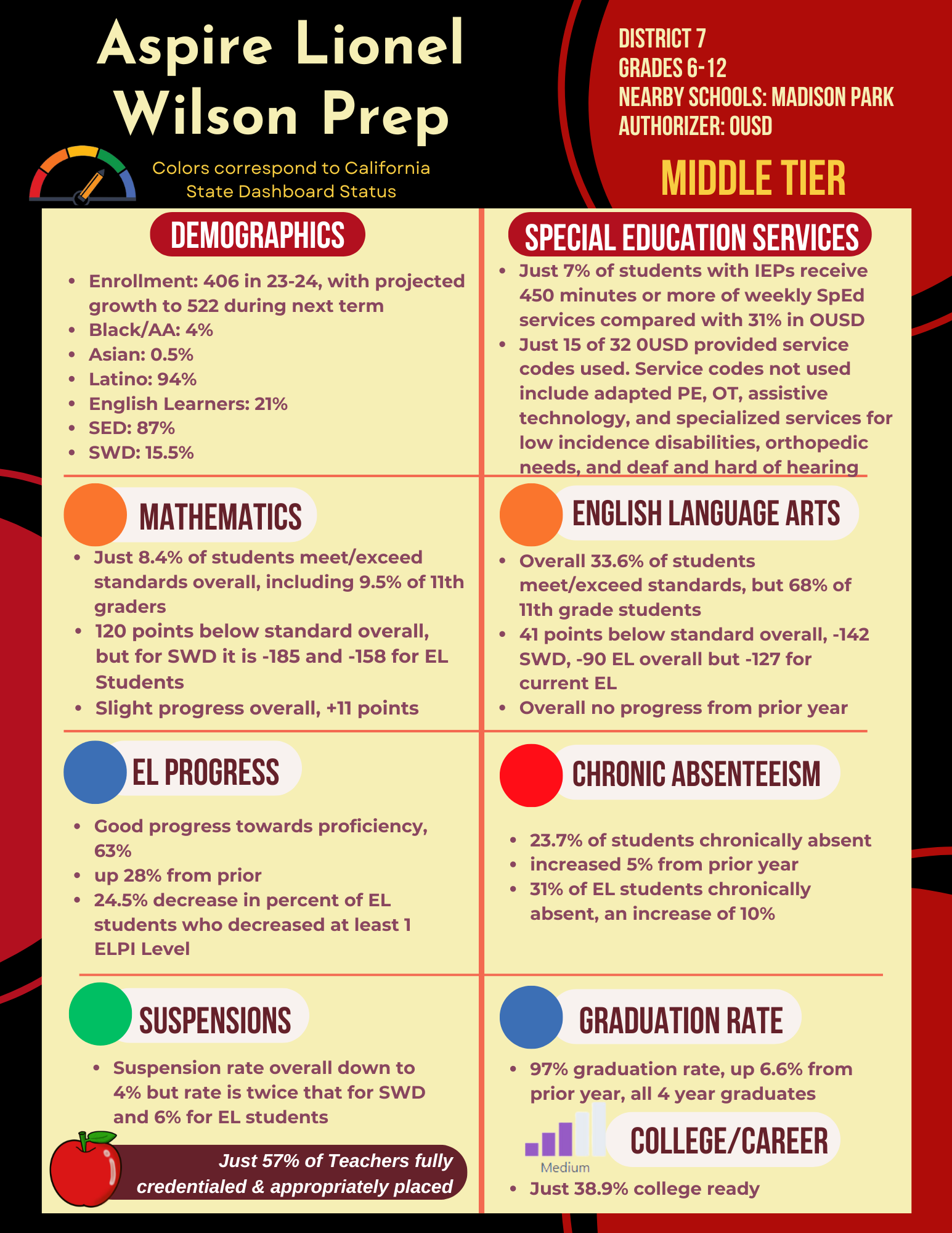
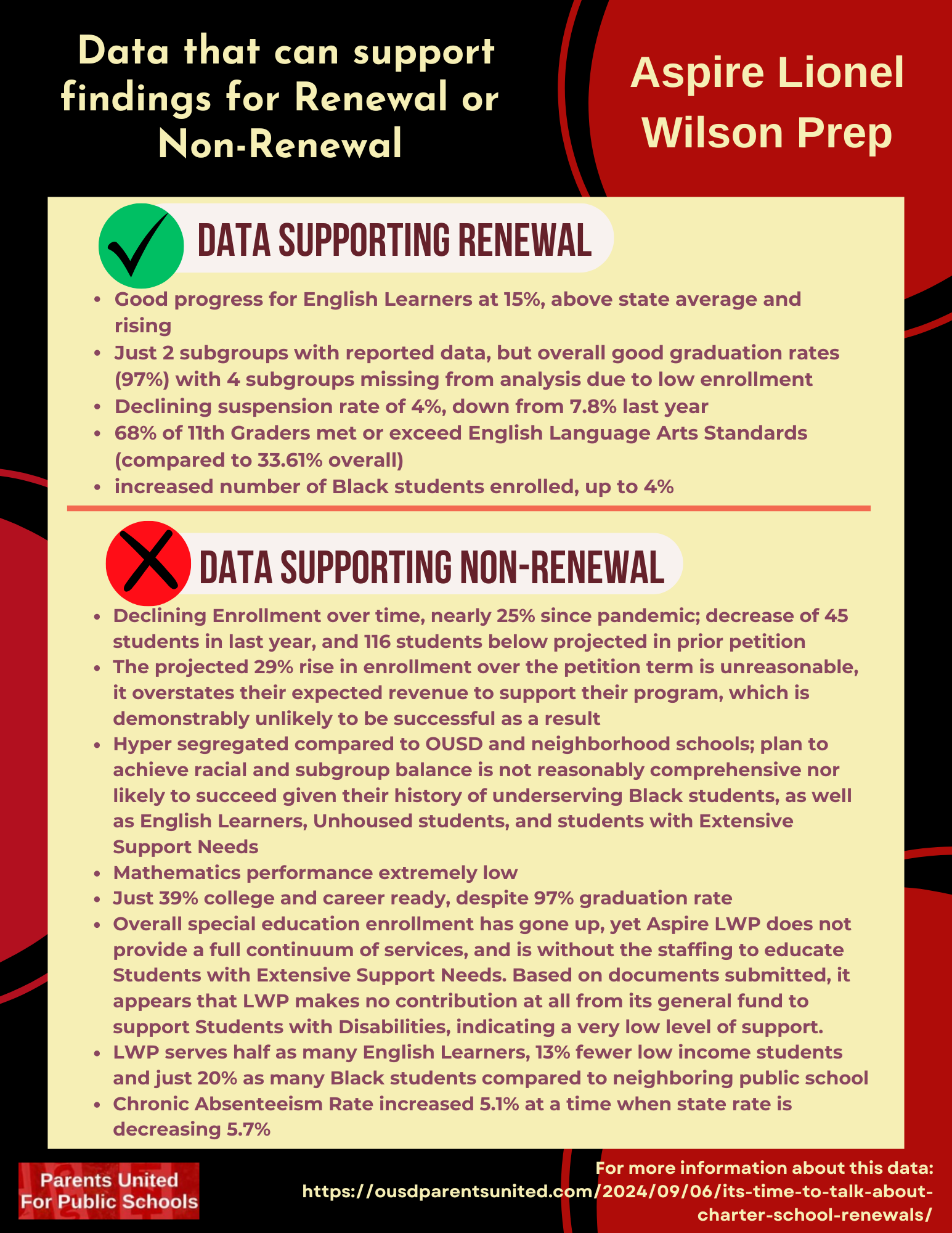
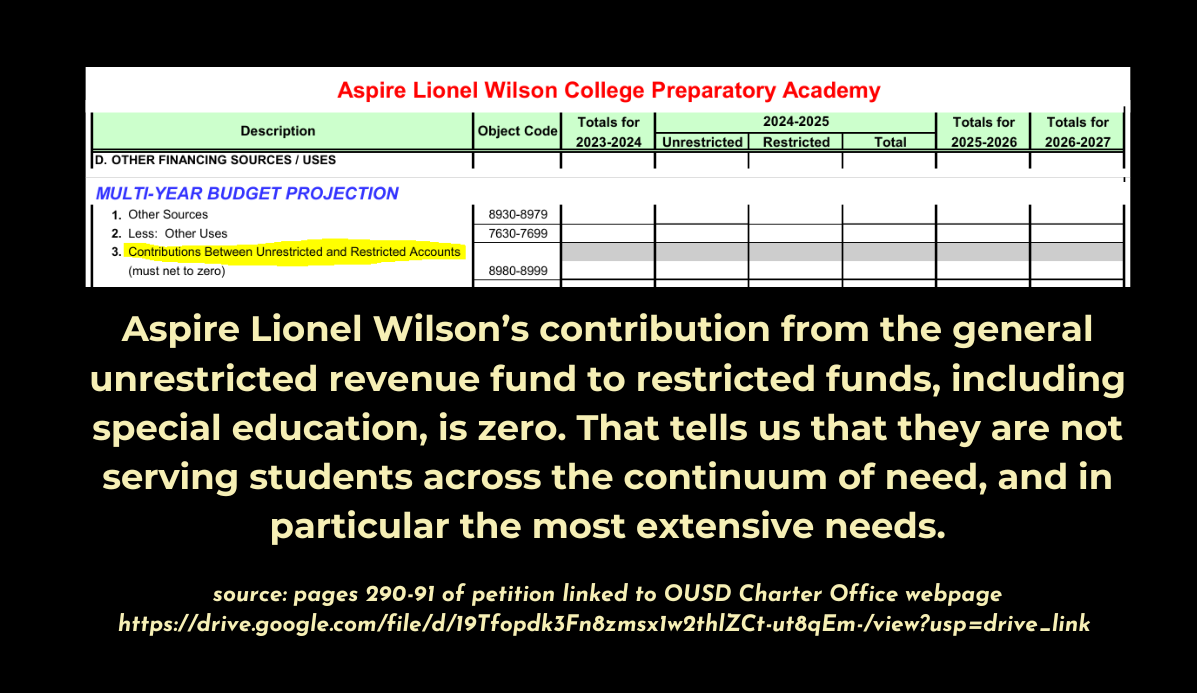
So far, two charter schools have had a public hearing in front of the OUSD Board (and one at the County board) and if you saw the petition submitted, you would know they are massive. The Aspire Lionel Wilson Prep petition attached to the agenda was 1,517 pages long. The charter law (California Education Code sections 47605 et seq) is also long and can be difficult to understand. As the OUSD Board of Education prepares to decide whether to renew or not renew the 9 charter schools expected to come before them this fall, we will be running a series of blog posts about the process, starting today. We will provide information about the renewal process, as well as snapshots of each school and the relevant data, so that the Oakland community can make sense of what often feels like an overly technical and not very accessible renewal process.
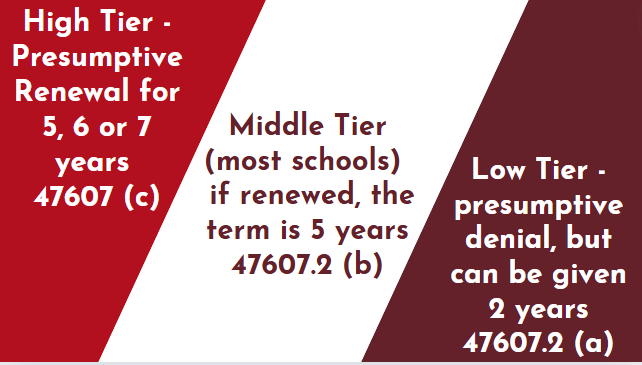
Charter schools up for renewal are placed into one of three categories by the state, and the standards for renewal are different dependent on the assigned renewal “tier”
For our purposes, how the state decides which renewal tier to assign each charter school is not really important, but if you are interested in learning more about this process, the California Department of Education website has more information. A charter school is determined to be “High performing” or “Low performing” through a formulaic assessment by the state, and all other schools are then deemed “Middle tier” by default. Most charter schools up for renewal this year are middle tier schools, and so we will primarily focus on those schools.
The High and Low tier schools are as follows:
High tier: American Indian Public Charter School II
Low tier: LPS R&D Oakland and Urban Montessori (county authorized)
High tier schools are generally presumed to be eligible for renewal for 5 to 7 years as the board decides (although there are exceptions to that rule which will become important this year). Low tier schools are presumed to be non-renewed, but the board can decide to renew for 2 years if they want to. Middle tier schools can only be renewed for 5 years, and because of the very nature of being neither high nor low performing by state standards, will have data that will suggest renewal and data that will suggest non-renewal, and it is up to the authorizing board (not the district staff) to make the decision as to whether to grant that new five year term.
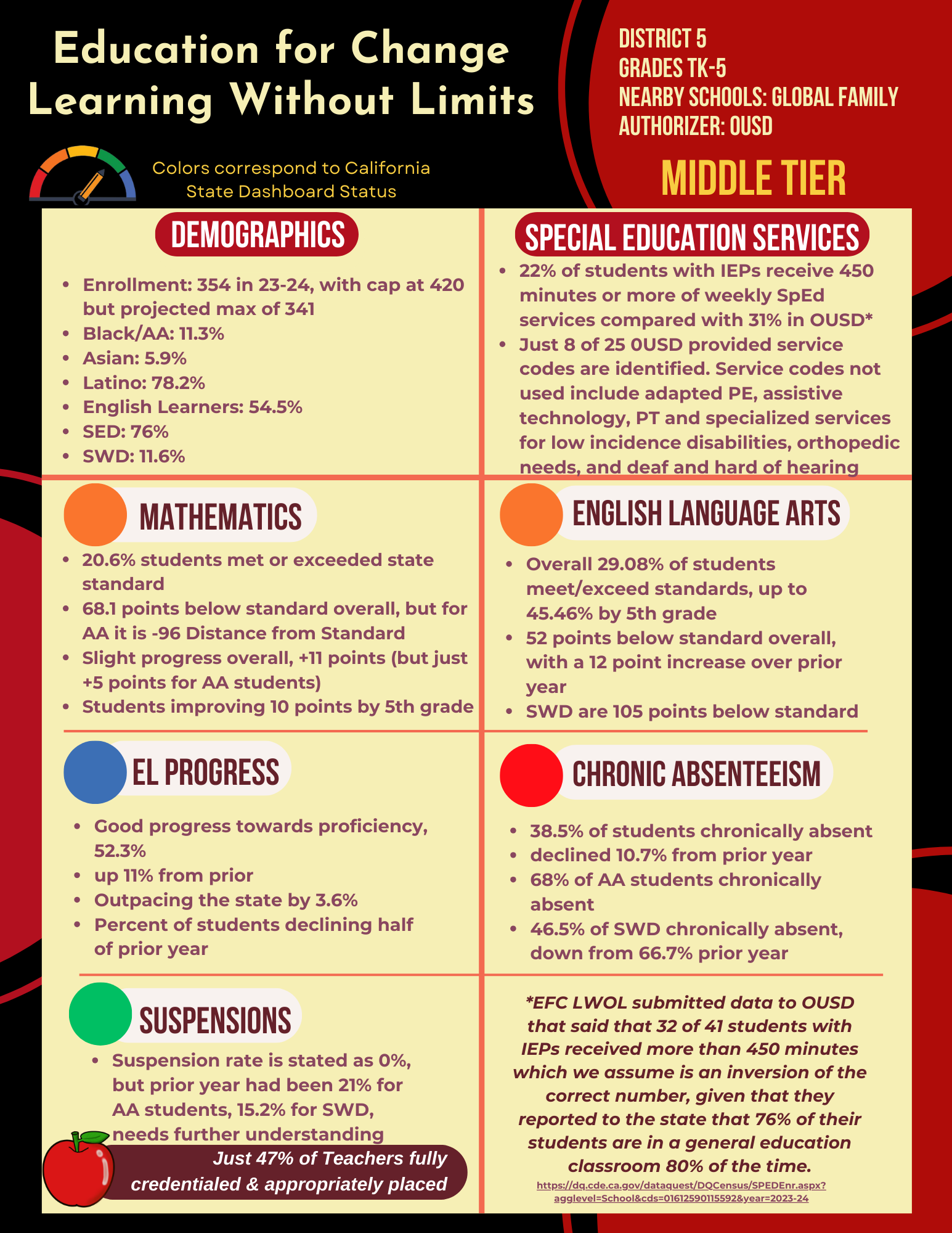
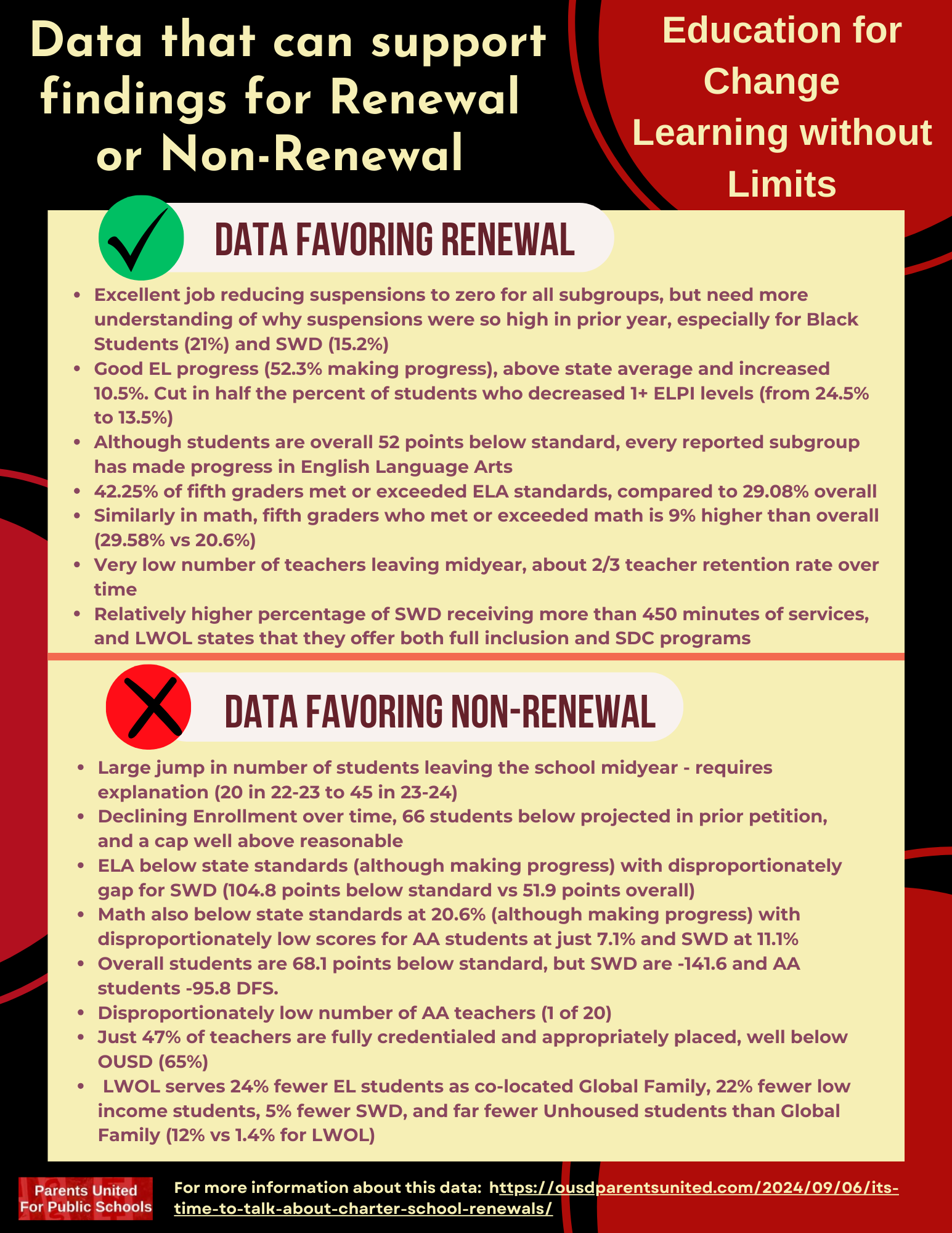
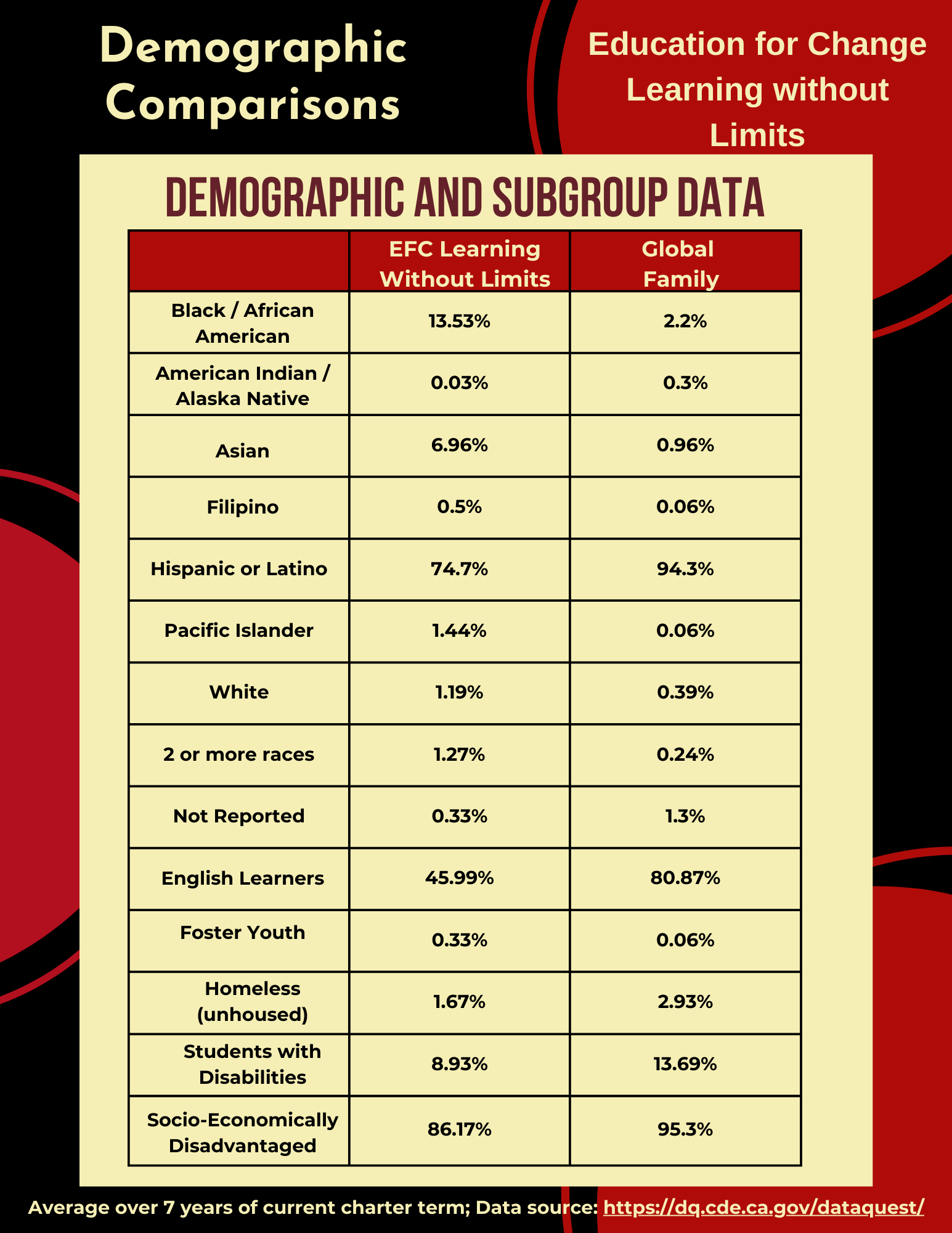
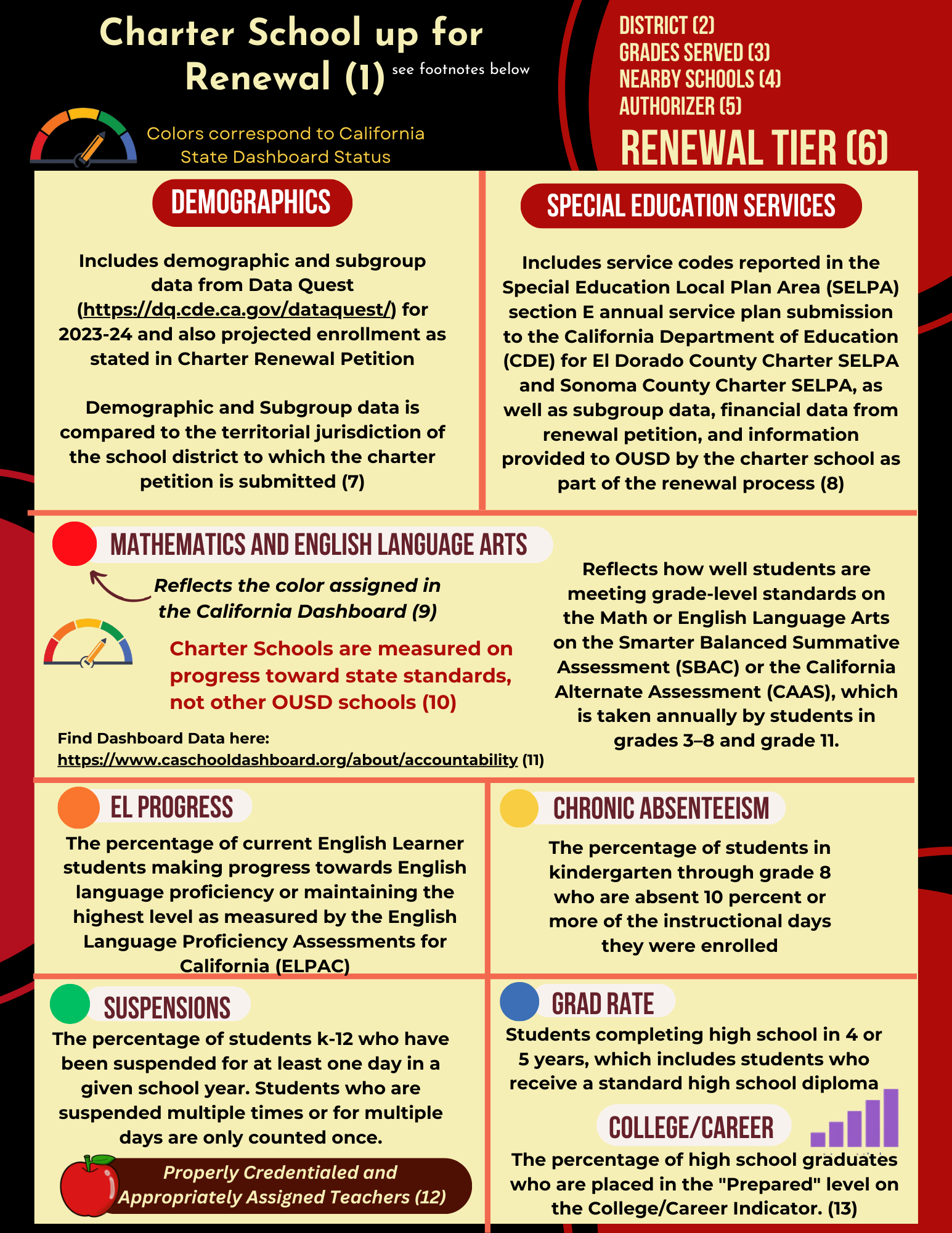
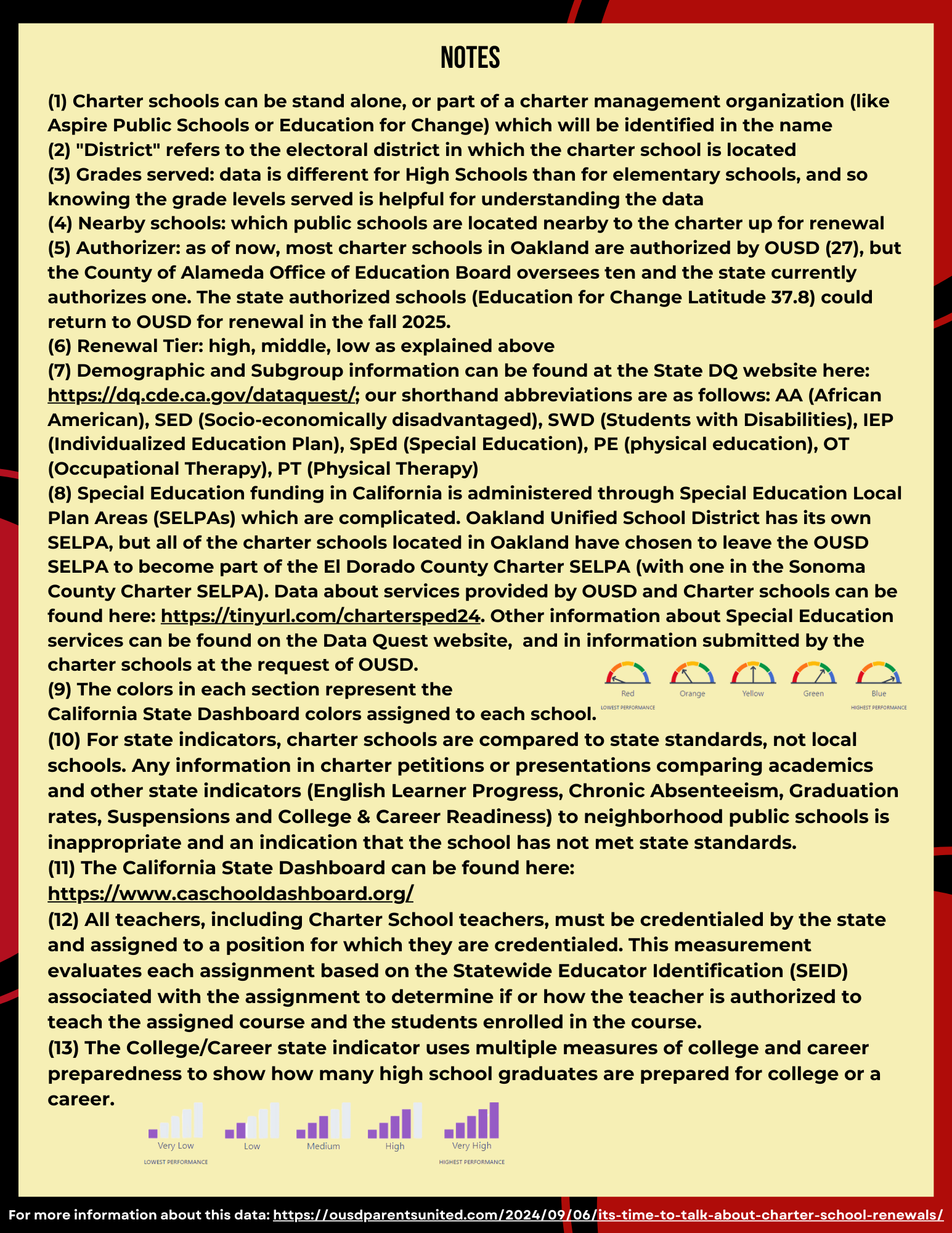
Charter School Renewal Report Cards – our distillation of the information that OUSD will be considering when deciding whether or not to renew a middle tier school
In order to simplify what seems a complicated process, Parents United will be creating Renewal Report Cards for each of the charter schools up for renewal this year. It’s not easy to distill a 1,500 page petition, an academic performance dashboard, disaggregated demographic and subgroup data and charter submitted information into a two-page Renewal Report Card, but we have tried to provide an overview and significant highlights to help Oaklanders understand the Renewal process better. Here is our “explainer” for what that data represents:
Most of the data comes from the California State Dashboard and it is really important to remember that charter schools are not evaluated by how they are performing compared to the local public schools, they must meet the promises in their charter and make progress towards the Statestandards, and that is the only appropriate comparison. It is only when looking at Local indicators, including whether the charter school serves all students, that we consider local data. When a charter school compares its academic data to neighborhood public schools, they are doing that to distract from the fact that they are not meeting state standards.
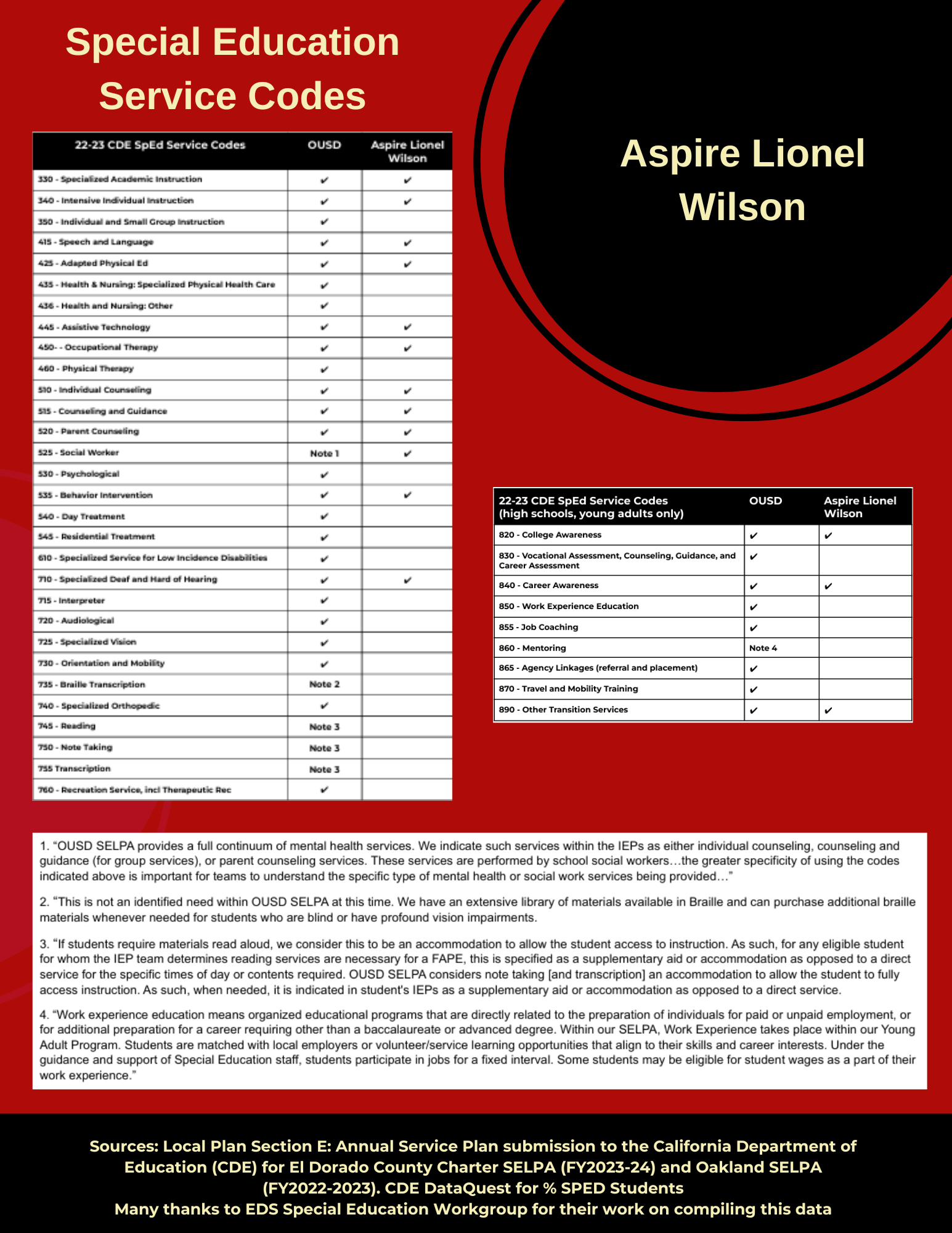
To understand the different pieces of the Renewal Report Card, we have given an explainer and added the below footnotes for additional information. Look for future posts about individual charter school renewal petitions, a deeper dive into the consequences of “failing to serve all students” and the different kinds of analyses used when a charter school has special fiscal or governance issues, or is not serving all students who wish to attend. We will also be digging more deeply into the issues surrounding Special Education, and the impact of the collective failure of charter schools to serve students with the most significant disabilities.
We want to give a special thanks to the Educators for Democratic Schools (“EDS”) Special Education Workgroup for their generous help in gathering and understanding this data. Their collective expertise has been invaluable.
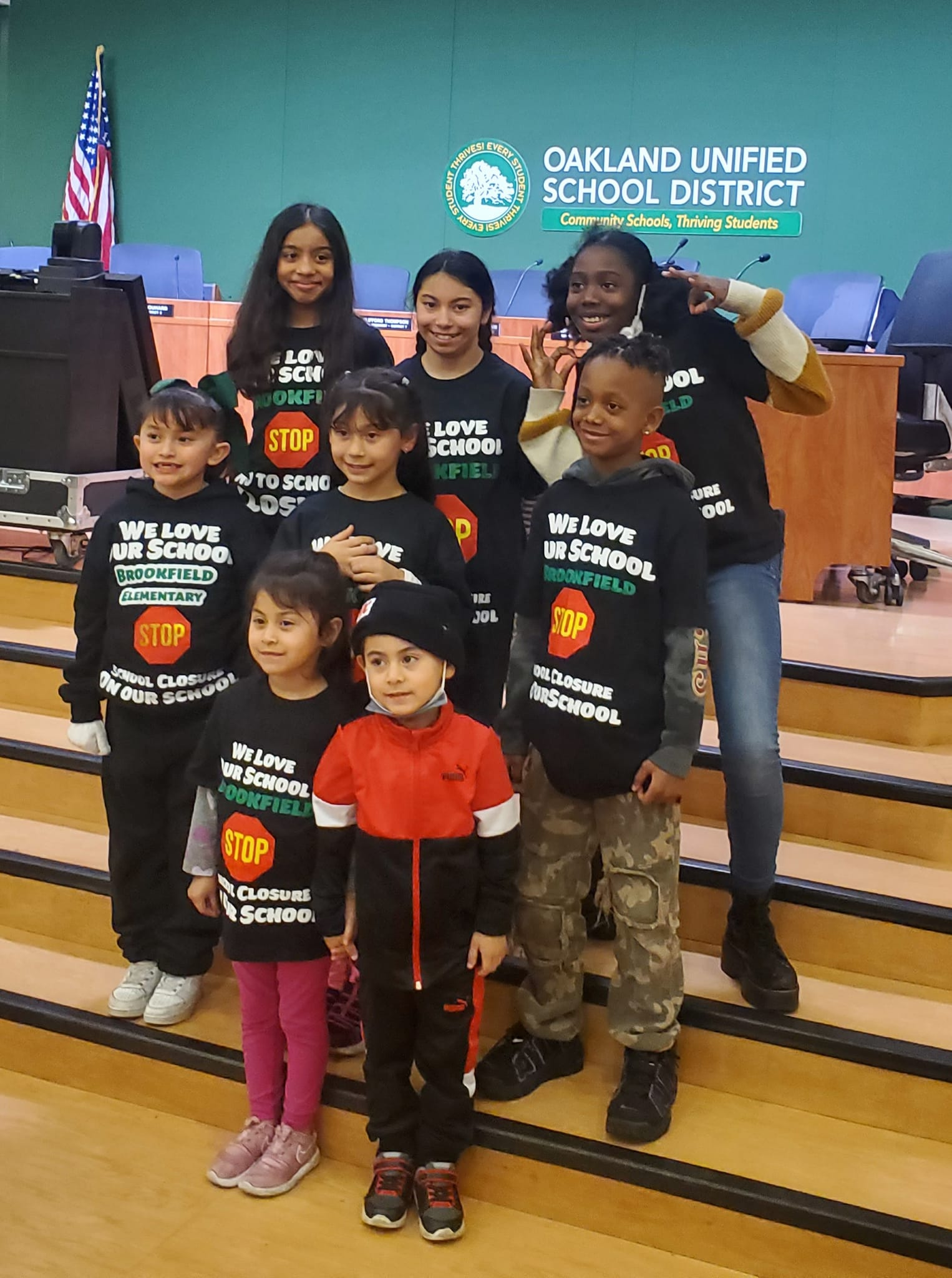
Brookfield students showed up for the vote to keep their school open! Photo credit to Corrin Haskell
On Wednesday night, in the first official act of the new progressive majority, the Oakland Unified School District (“OUSD”) Board of Directors voted to rescind planned closures of 5 elementary schools and 1 middle school program at the end of this school year. Students, parents, educators and community were on hand to witness newly elected board members Jennifer Brouhard and Valarie Bachelor join with sitting directors VanCedric Williams and Mike Hutchinson to fulfill the mandate of the 67% of voters who supported their platform of ending school closures which target schools in Black and Brown neighborhoods and destroy communities while fueling the gentrification of Oakland.
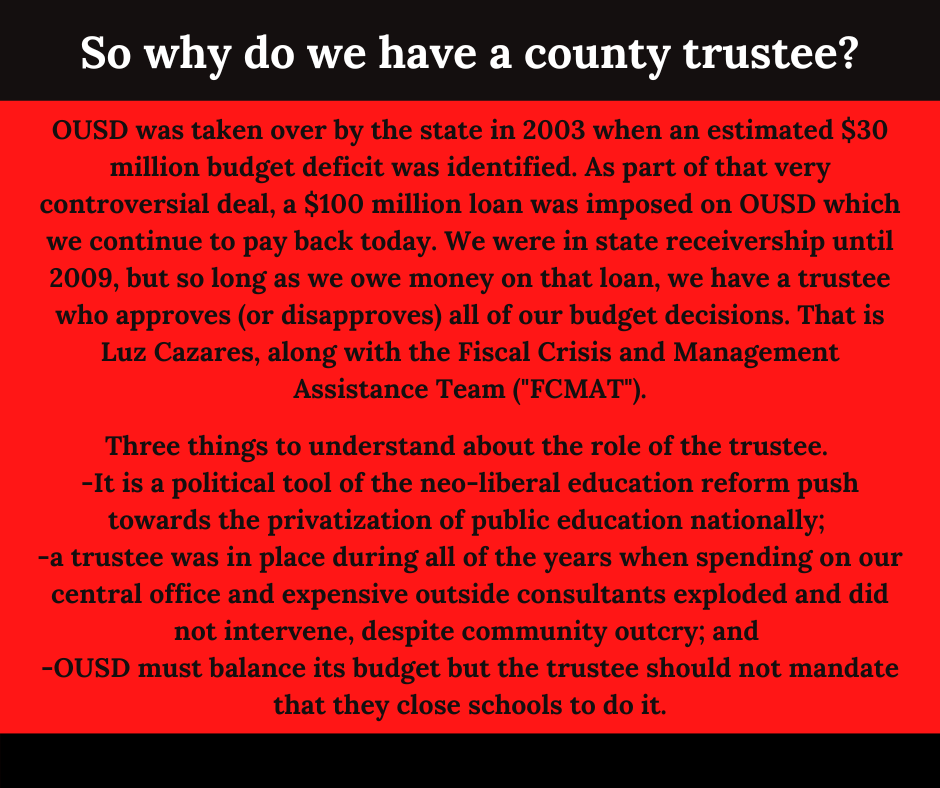
The fight is not over. No sooner was the vote complete than the Alameda County trustee Luz Cazares, appointed to oversee OUSD’s finances, informed OUSD that they reserved the right to stay and rescind the board’s action to end school closures, because OUSD did not provide a Fiscal Impact Analysis as required by its own board bylaws prior to the vote.
District staff should have prepared that Analysis as soon as the matter was introduced by Director (now President) Hutchinson on November 30th, but failed to do so, and it appears that both Director Sam Davis and Director Hutchinson, who had each declared their intention to become board President, allowed staff to delay the Fiscal Impact Analysis until January 25th. This was done despite the urgency of needing to fix the enrollment system immediately to include the targeted schools and begin the budget development for school sites. That willingness to delay and worsen the harm to students led to Director Williams being elected president and immediately calling a special meeting for Wednesday, January 11th for a vote on the rescission resolution, which passed. President Williams’ decision to act immediately to help the targeted school communities jump start planning their futures was also a rebuke against the deliberate slow rolling by staff and politicking by board members. We are grateful for his leadership and for putting students first.
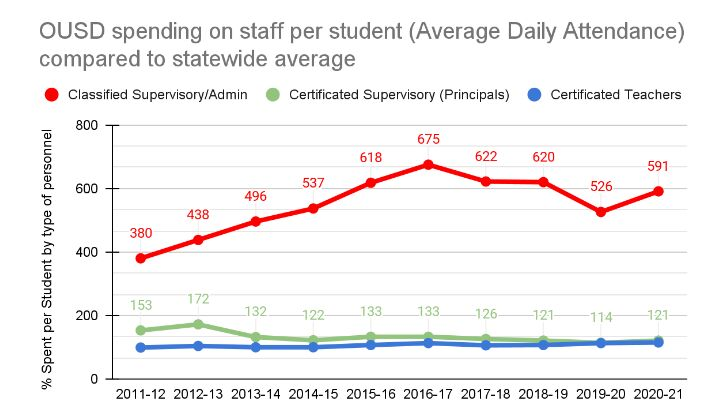
It is now up to District staff to prepare the necessary analysis so that we can avoid action by the County trustee and move on with the planning for how we support the targeted schools to repair the harm done by years of uncertainty and underinvestment. We must also rethink our solvency strategies to ensure we are no longer balancing our budget on the backs of our most vulnerable students. We must restructure our district from a top heavy, consultant-dependent “business model” to a district built from the bottom up, where we prioritize students and classrooms in true Community Schools. We must push our city, county and state leaders to support us in creating a district that serves the whole child, addressing community needs so that students are prepared to learn and excel in life. It is possible to educate students in equitably funded neighborhood public schools with staff who are valued and paid a living wage.
OUSD receives more money per student than almost any other large school district. It is time we invested those funds in the classrooms where they belong. Let’s get to work.
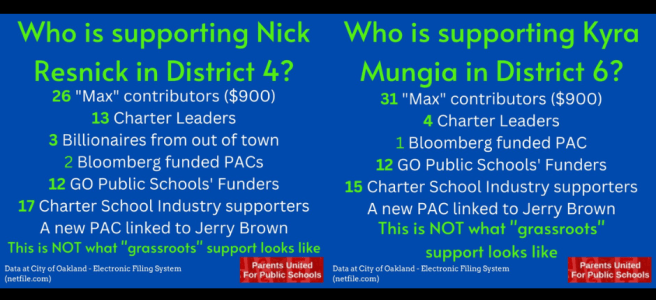
There is a lot of talk right now in Oakland School Board Electoral Politics about what it means to be a “charter candidate”. Both Nick Resnick and Kyra Mungia proclaim that they are not “charter candidates” because they don’t support adding new charter schools, but despite that, they are supported by Charter School Leaders, Charter School Supporters, Charter School Funders, Charter Supporting PACs and, for Nick Resnick, out of town billionaires who support Charter Schools. And GO Public Schools donors. Not only are they directly funded by Charter School Supporters, they also are being supported by a new Political Action Committee (“PAC”) entirely funded by former Mayor/Governor Jerry Brown who started two high profile charter schools in Oakland and still sits as the Chairman of one of those charter schools (Oakland Military Institute “OMI”).
This PAC has not a single Oakland teacher associated with it, yet it is misnamed “United Teachers of Oakland supporting Resnick and Mungia” in hopes of tricking Oakland voters into thinking that these candidates are supported by Oakland’s beloved teachers, which they most certainly are not.
If your campaign is being pushed by all of these folks, you MUST be the charter candidate…
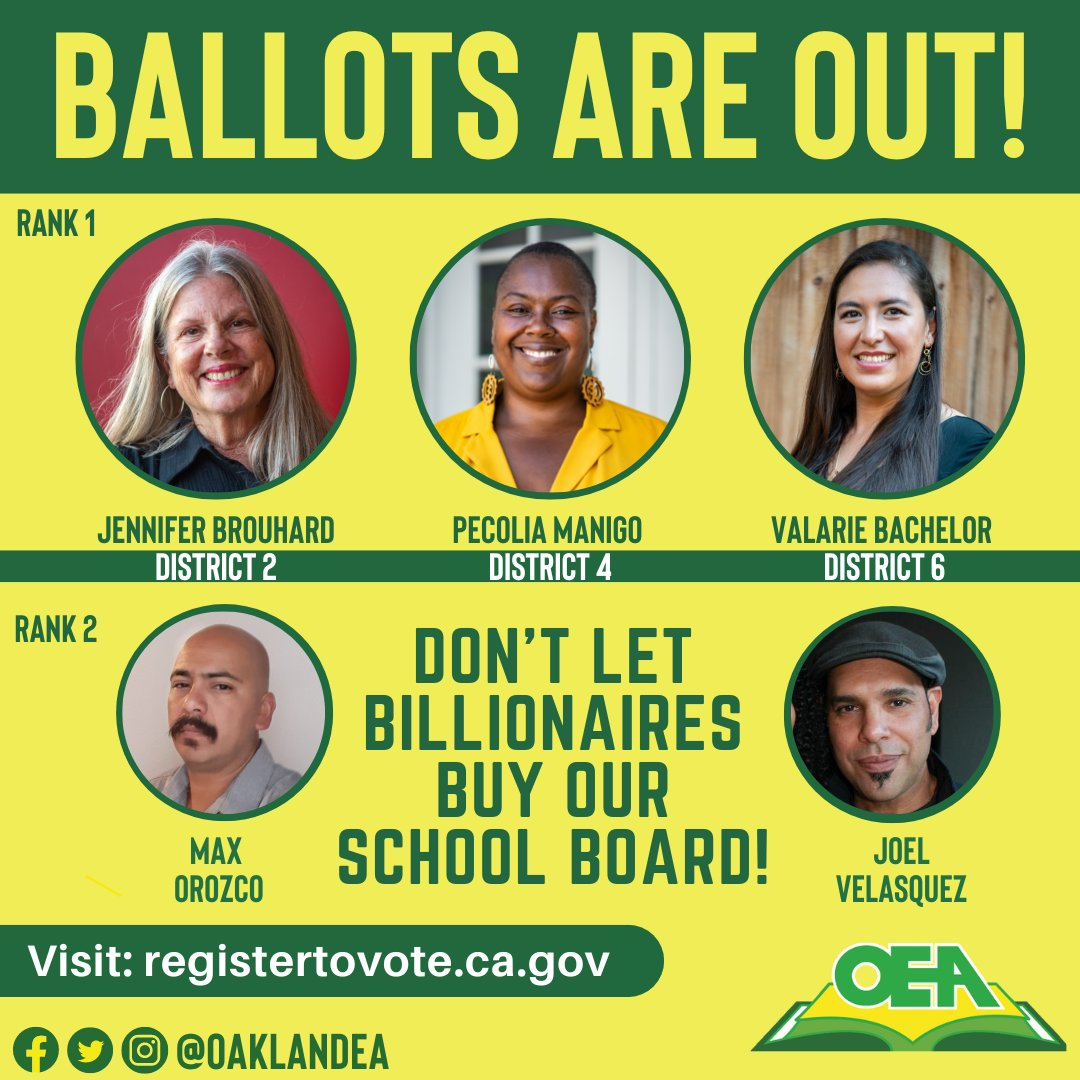
Don’t be tricked, choose the candidates who are ACTUALLY endorsed by Oakland’s Teachers. Make sure your vote counts by ranking BOTH of your chosen candidates #1 and #2, and not voting for Resnick and Mungia.
In Oakland, school board elections have become big business. Since 2012, billionaire backed SuperPACs have spent nearly $2 million to elect candidates to rubber stamp the school privatization policies that they are pushing. Common enrollment, school closures, portfolio “community of schools” policies, and charter school expansion have all accelerated since 2012 and have put Oakland’s public schools and the primarily Black, Brown and low income students they serve at risk. This is all part of a well-funded privatization movement which harms our most vulnerable students by literally pushing them out of classrooms and into closets.
In 2020, families, teachers and grassroots organizations came together and won 3 of the 4 open School Board seats, and last night we had our first real evidence of how important local elections are, with the passage of the Enrollment Stabilization policy by a narrow margin1. This policy will do the following:
Support schools with marketing and outreach, including a district level designated employee and possible stipends for parents at low income schools;
Allow school sites to create their own enrollment stabilization plan;
Encourage school board members to celebrate and support their district schools;
Direct the superintendent and staff to encourage parents from charter or private schools that are closing to enroll in OUSD;
Make the enrollment process more accessible in a variety of ways; and
Prohibit the use of OUSD resources to market or support competing schools such as charter or private schools. OUSD will no longer share the School Finder tool with charter schools, nor will they be listed on our enrollment map, the enrollment office will not offer competing school information to families, competing schools cannot come to district enrollment fairs, etc.
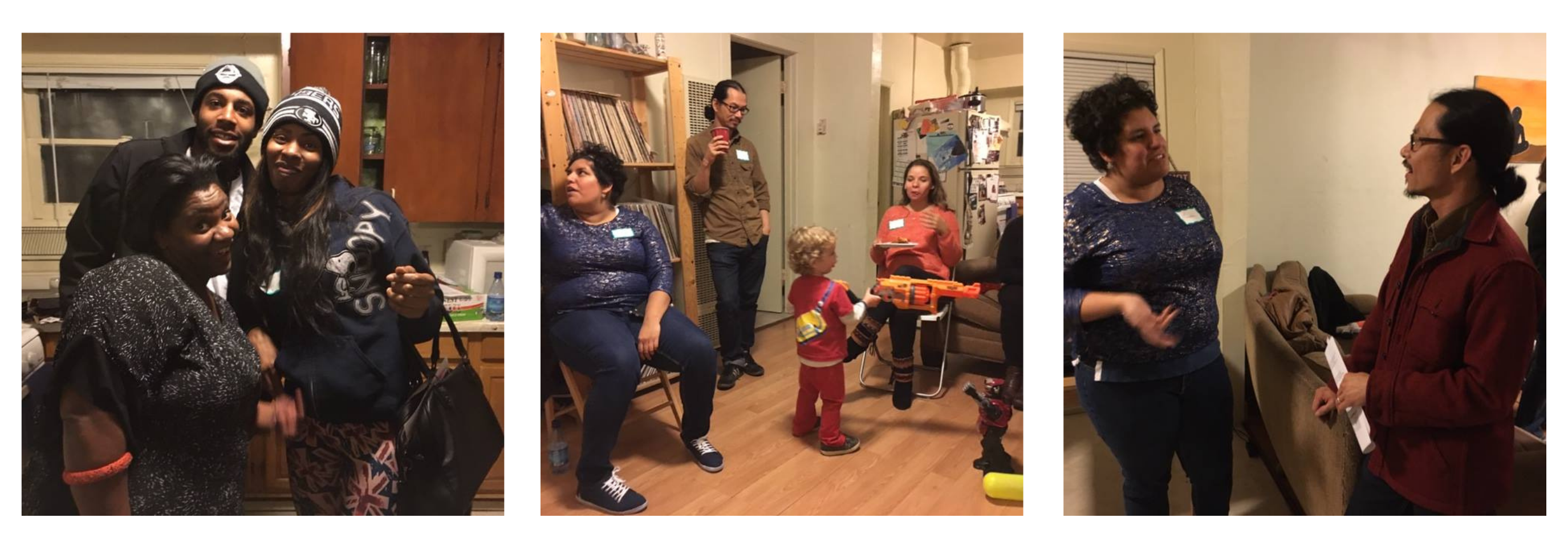
This policy eliminates the shared enrollment information system created by former Superintendent Antwan Wilson, with funding from local privatization organizations GO Public Schools (which also funds school board elections through its SuperPAC) and Educate78. In 2015, Superintendent Wilson asked the OUSD school board to adopt a “common enrollment” system where district and charter schools would be included together in one electronic enrollment platform. Parents United worked with parents and teachers to push back on the proposal, which is part of the “Portfolio Playbook” used to undermine public schools nationwide. Parents and teachers held house parties with school board members and ran a public information campaign, and ultimately the Board did not approve Common Enrollment in Oakland. Although Superintendent Wilson lost the common enrollment fight, he effectively backdoored the policy into existence by unilaterally including charters side by side with district schools in our school enrollment guide and electronic finder tool. The adoption of this Enrollment Stabilization policy last night undoes the harm of common enrollment and is one of the reasons why school board elections are so critical to the success of neighborhood public schools that serve all students.
Common Enrollment House parties January 2016
ALL of the comments against the policy change last night were couched in the incorrect assumption that only charter schools are quality schools. The data shows that is not true, but more importantly it exposes the lie that we are just one happy district/charter “community of schools” and that families are making individual decisions based on what is best for their child — coming in and out of the district and charter systems as needed. The truth is, charter schools generally market themselves as being better than district schools and when it comes time to move from one grade span to another, this narrative of “district schools are bad” means only 9% of charter students enroll in a district school for the next grade level2.
Hands on learning at a quality neighborhood district school
That is not an accident. The charter industry guides students and families to choose another charter school for middle or high school rather than exploring public school options. Charter schools want access to the district’s enrollment system (particularly at the elementary level), but they don’t otherwise support the public school system. They blur the lines between public schools and “tuition free public charter schools” when it suits them, but every single commenter against the Enrollment Stabilization policy accused OUSD of trying to “hide” the quality options (or charter schools) and force families to choose substandard (or district) schools. Truth is, families will still be able to get the information they need to enroll their student in either a district school or a charter school as they choose, and the charter school industry will still repeat the lie that charter schools are inherently better than district schools. The big difference in enrollment will be at the elementary level, and that is why the charter school industry and privatization organizations are so upset about the loss of Common Enrollment in Oakland.
The policy passed 4/28/2021 by a margin of 4 ayes (Directors Gonzales, Davis, Williams, Hutchinson), 1 nay (Director Thompson) and 3 abstentions (Student Director Ramos and Directors Eng and Yee)