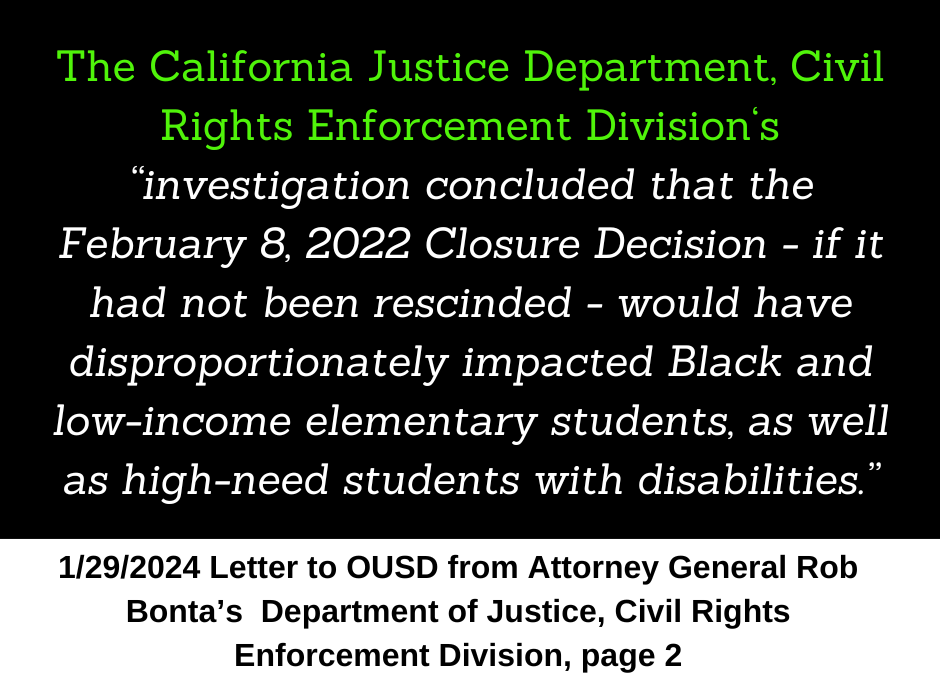
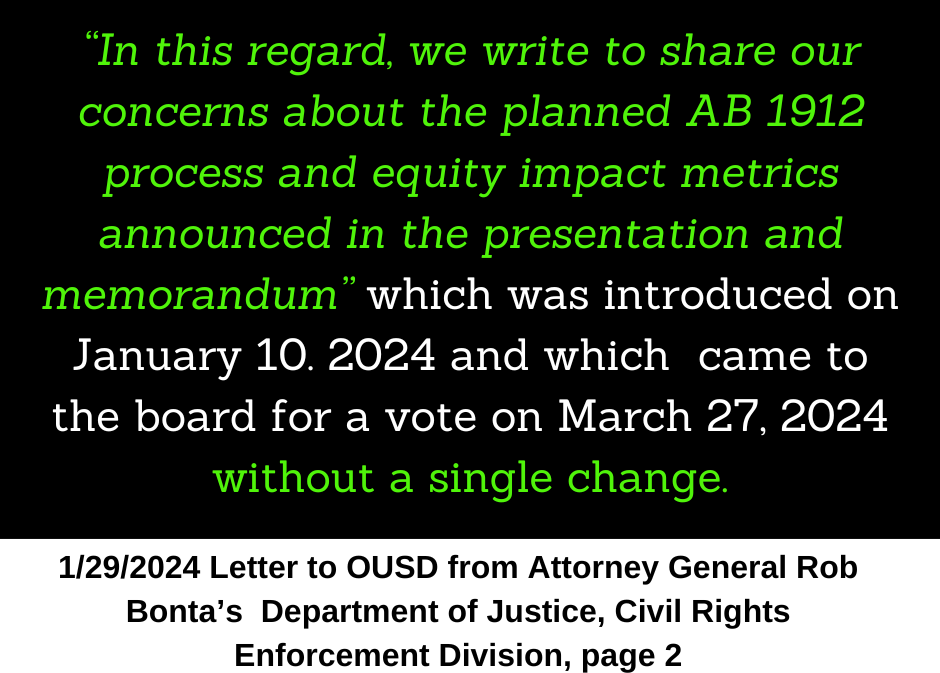
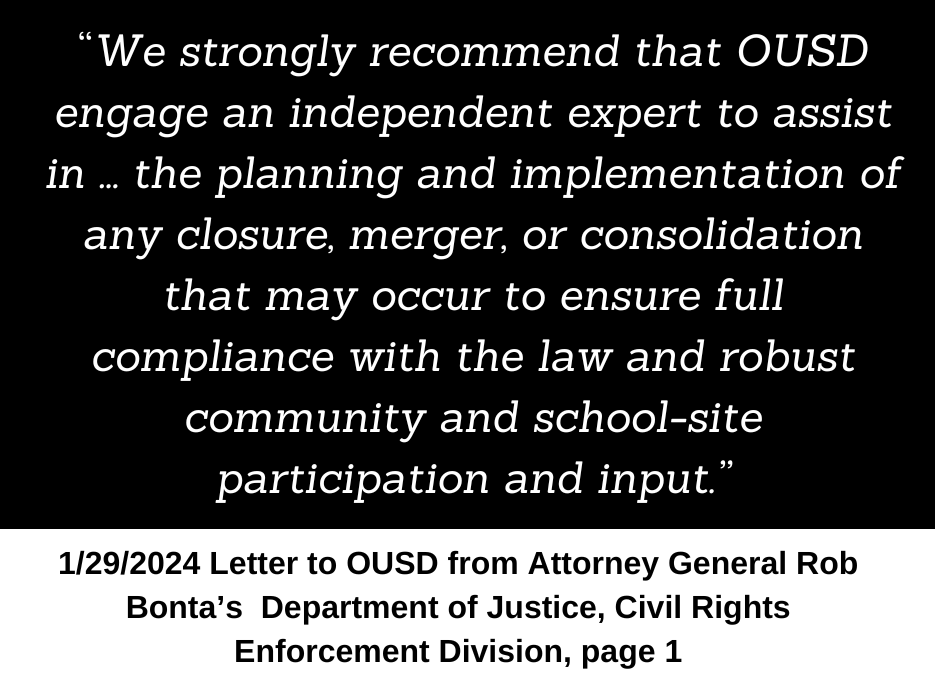
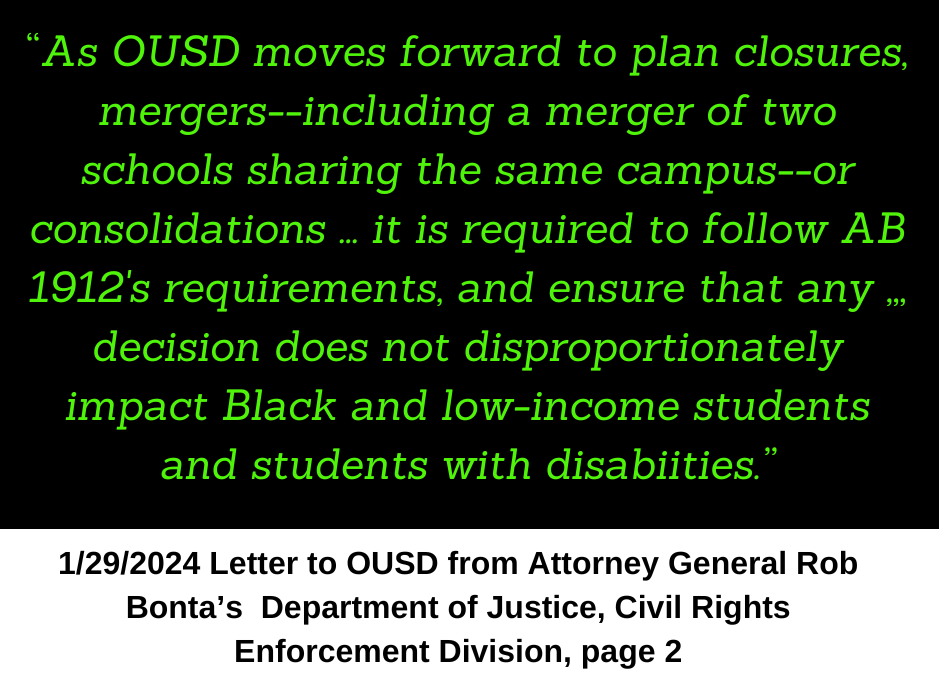
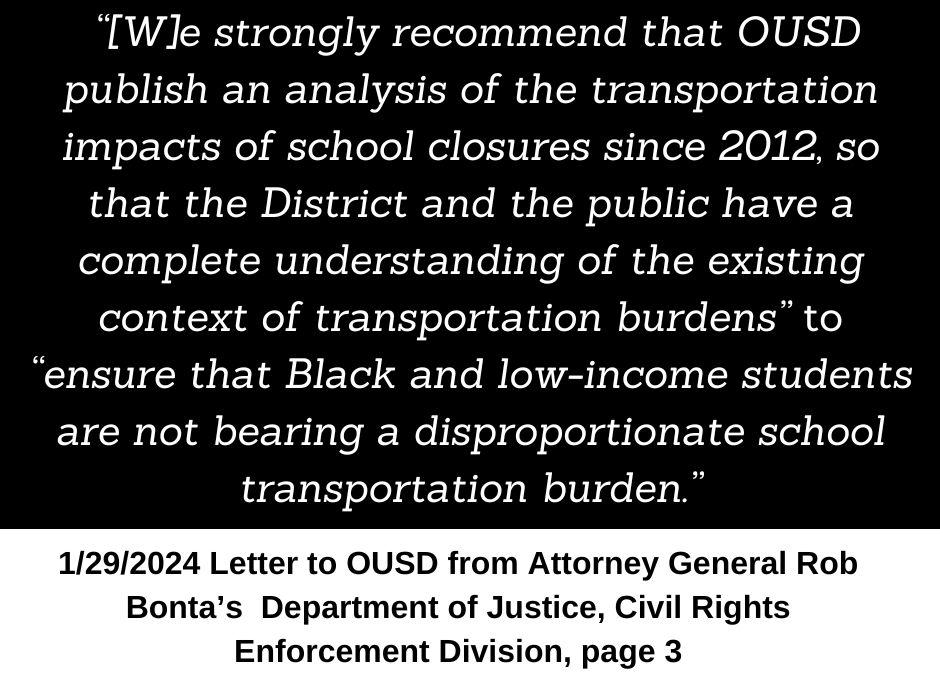
The California AG has concluded that Oakland Unified’s school closures have disproportionately harmed Black and Disabled students, and issued very specific guidance to OUSD about how to avoid repeating that harm in the future. Will OUSD listen to that advice as they push forward with mergers, consolidations and closures in future?

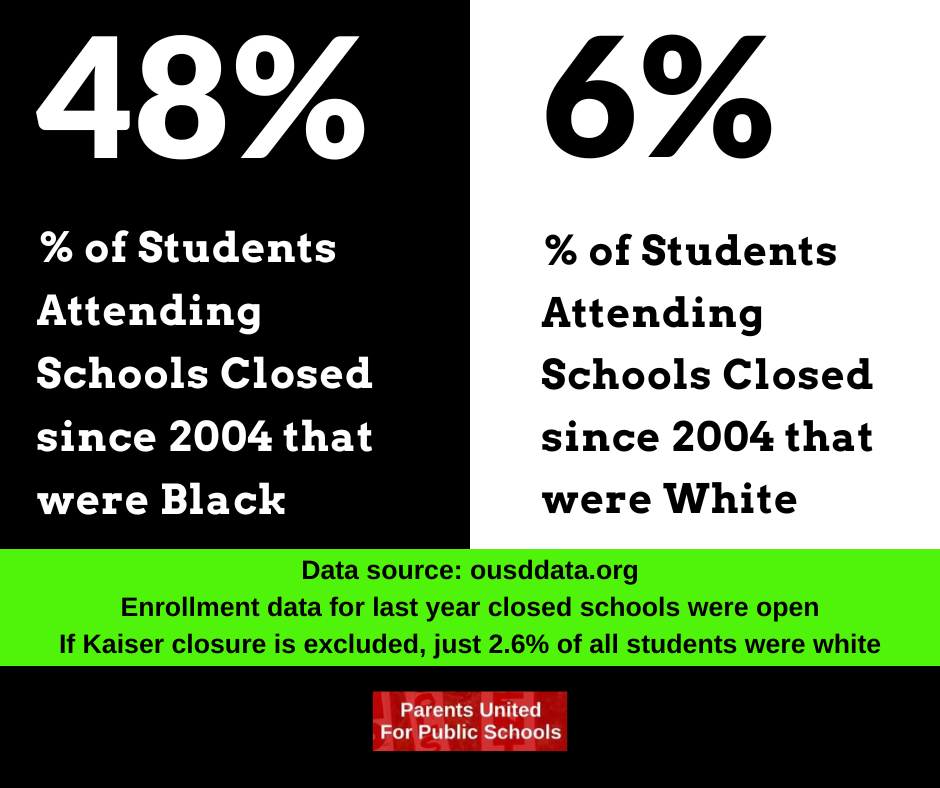
Justice for Oakland Students Graphic regarding School closures from 2004 to 2017

OUSD has a long history of school closures in Black communities that have accelerated gentrification and resulted in disproportionate harm to Black students.

Oakland Unified School District (“OUSD”) has closed many schools over the past twenty years, following a pattern of using so called “Sustainability” metrics: utilization and enrollment data. In a 2004 discussion about school closures, former school board member Gary Yee articulated that “[t]he primary concern for any school site reutilization was that the school is effective and relatively inexpensive to run.”1 That philosophy reinforced racist and ableist patterns and behaviors and resulted in the devastation of the Black student population in OUSD over time.
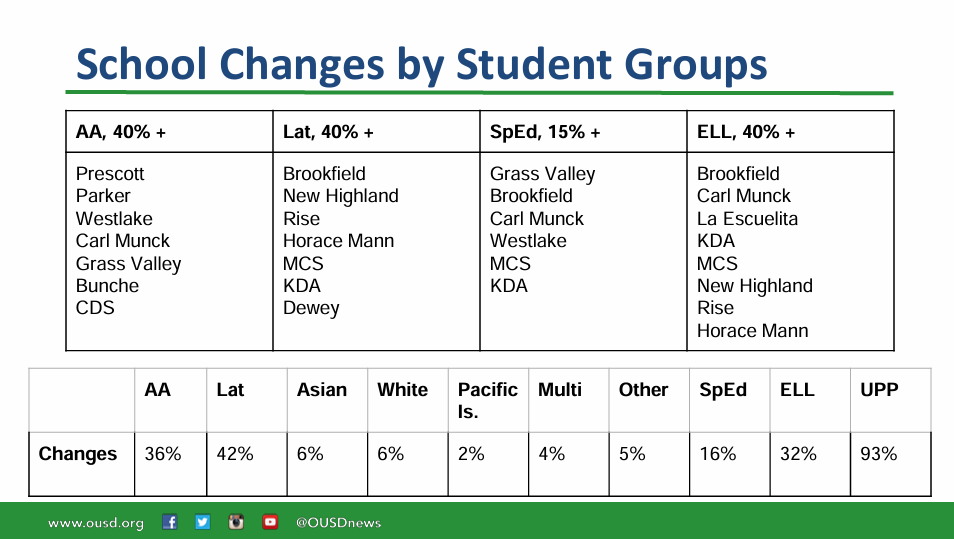
In February of 2022, the OUSD board voted to close schools over two years, again using the same kind of “Sustainability” metrics as the selection criteria, and once again disproportionately harming Black, low-income and Disabled students.
AB 1912 and the AG investigation grew out of the February 2022 closure decision, and led to the currently proposed Equity Impact Metrics to be presented to the board this week for adoption.

In response to the closure decision, the American Civil Liberties Union (“ACLU”) filed a complaint2 with the California Attorney General (“AG”) alleging that the school closures violated the constitutional and statutory civil rights of Black students in OUSD. The AG opened an investigation into the closures sometime in 2022, and Assemblymember Mia Bonta authored a law (“AB 1912”) requiring an equitable process before deciding to close schools.3 In January, 2023, a newly elected OUSD Board majority rescinded the closure decision for those schools set to be closed in June, 2023 and then voted to “merge” 10+ schools at the end of the 2023-24 school year as part of their budget development, which triggered the need for the AB 1912 equitable process.

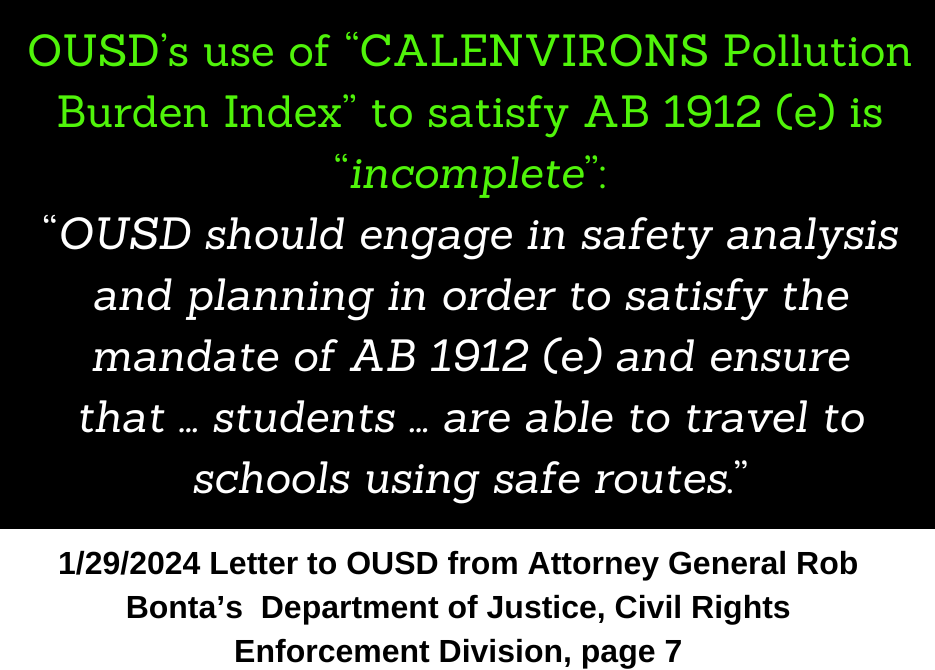
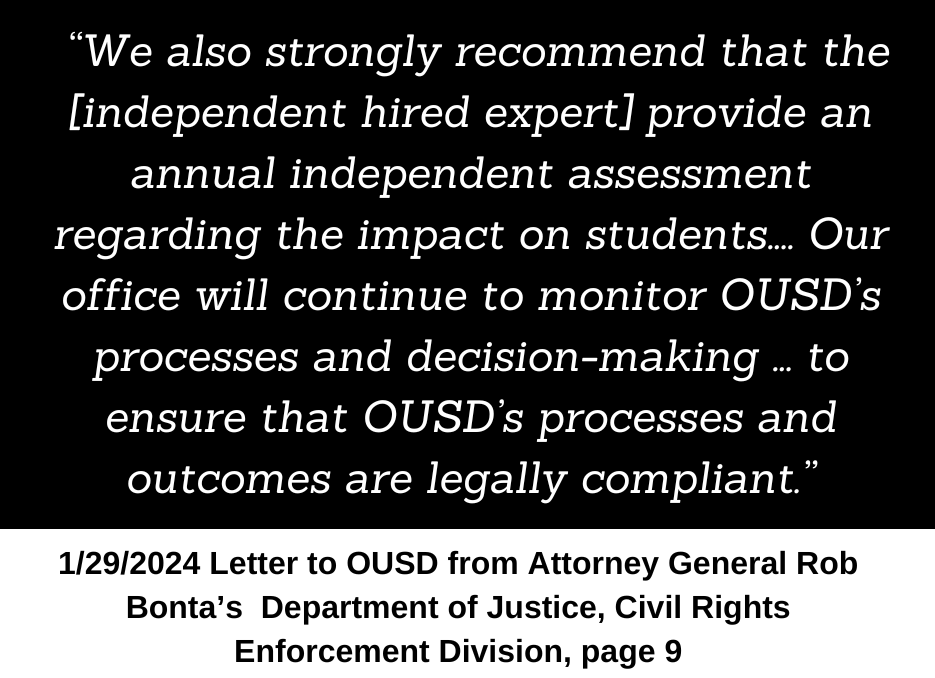
OUSD staff presented the Equity Impact Metrics to the Board January 10, 2024 including the same racist and discriminatory “Sustainability” metrics that have been used since 2004, which resulted in a letter from the AG’s office dated January 29, 20244 outlining the AG’s concerns with those metrics. After failing to adopt the identical metrics on March 27, 2024, the OUSD State appointed Trustee warned the board that because they failed to take the steps necessary to “merge” 10+ schools as promised in the 2023 budget resolution, the Trustee would not allow them to negotiate compensation increases for OUSD union employees. In response, Board President Sam Davis has scheduled a vote on a revised set of metrics this Wednesday, April 10th.
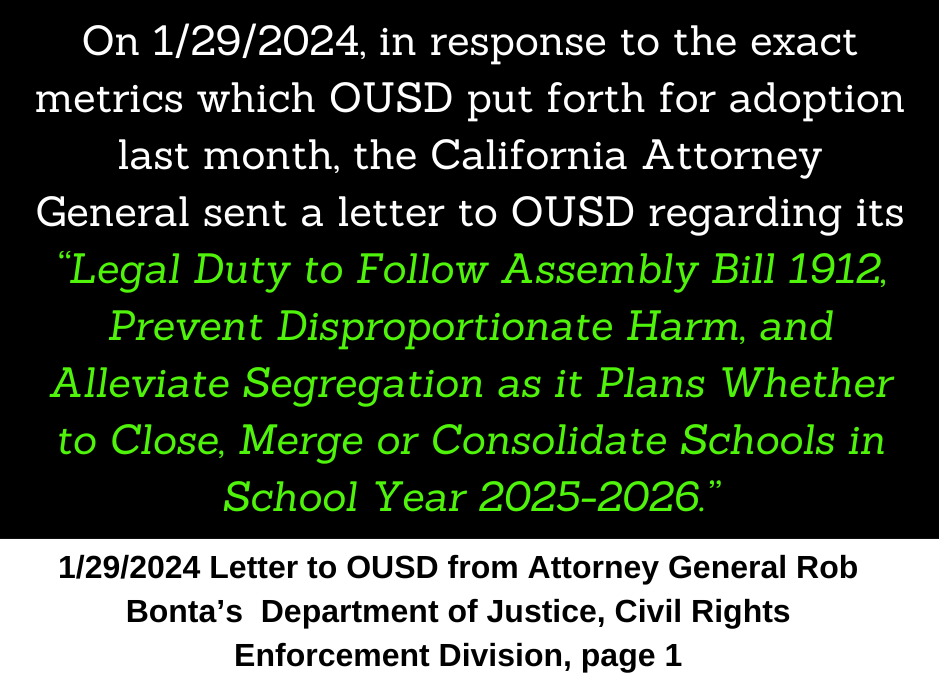
What guidance did the AG provide to OUSD? We summarized it so you don’t have to.

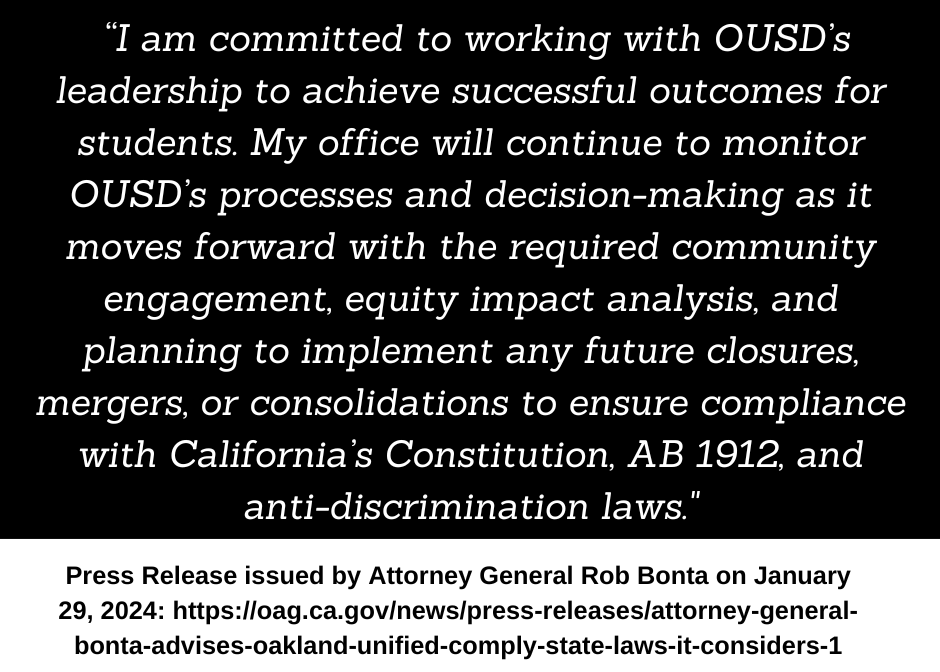
So what does the AG have to say about the SPECIFIC metrics that OUSD is proposing?
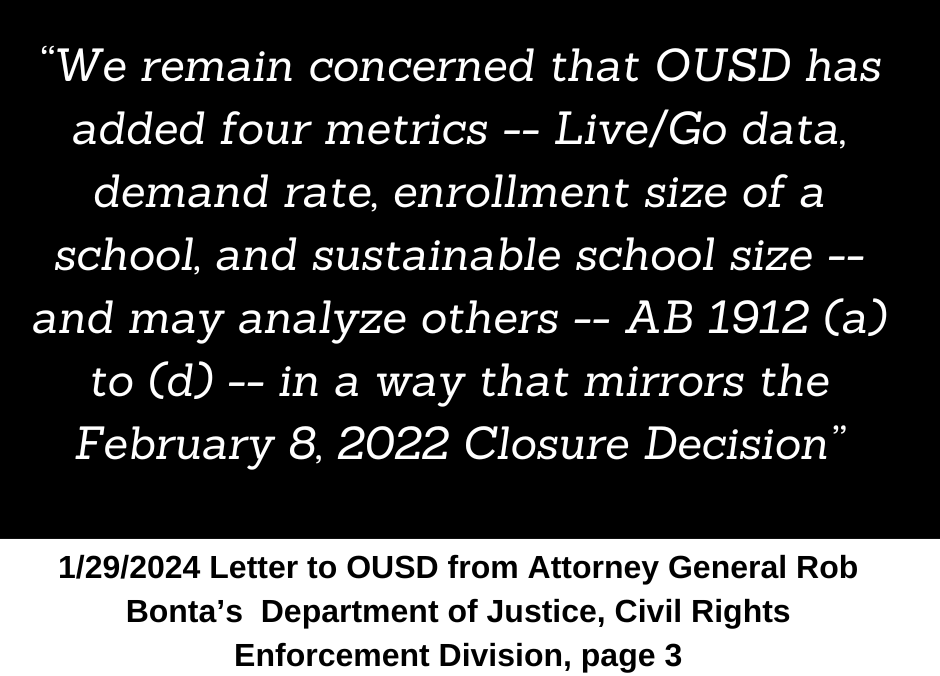
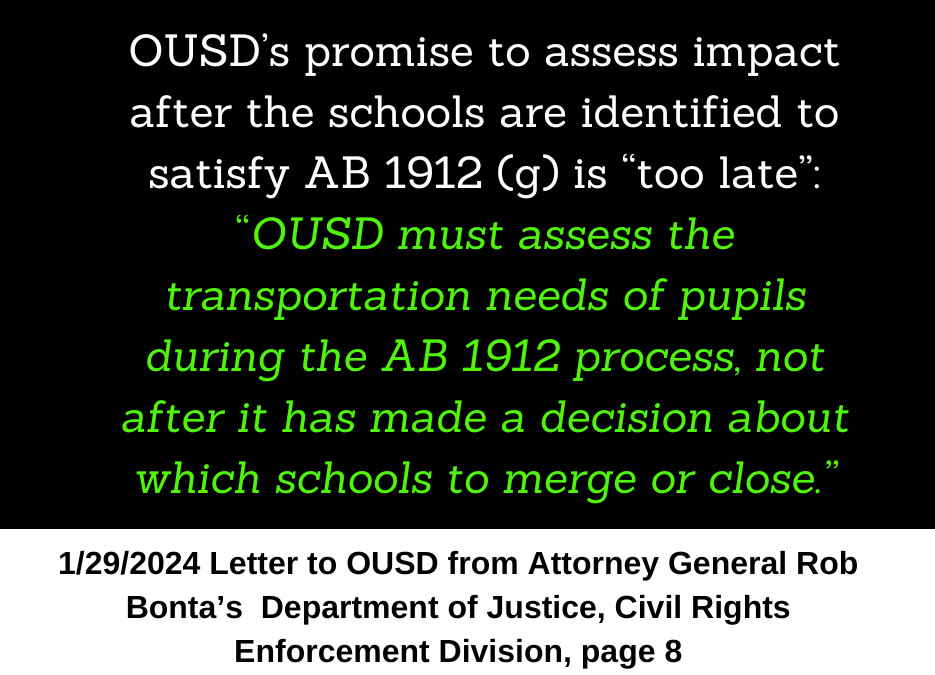
We are grateful to staff and the Board for removing the four “Sustainability” metrics from the proposal that the AG made clear would repeat the same disproportionate harm as in past years. But the proposed metrics also include other metrics that the AG found problematic or incomplete. The Board should heed the following advice from the AG.
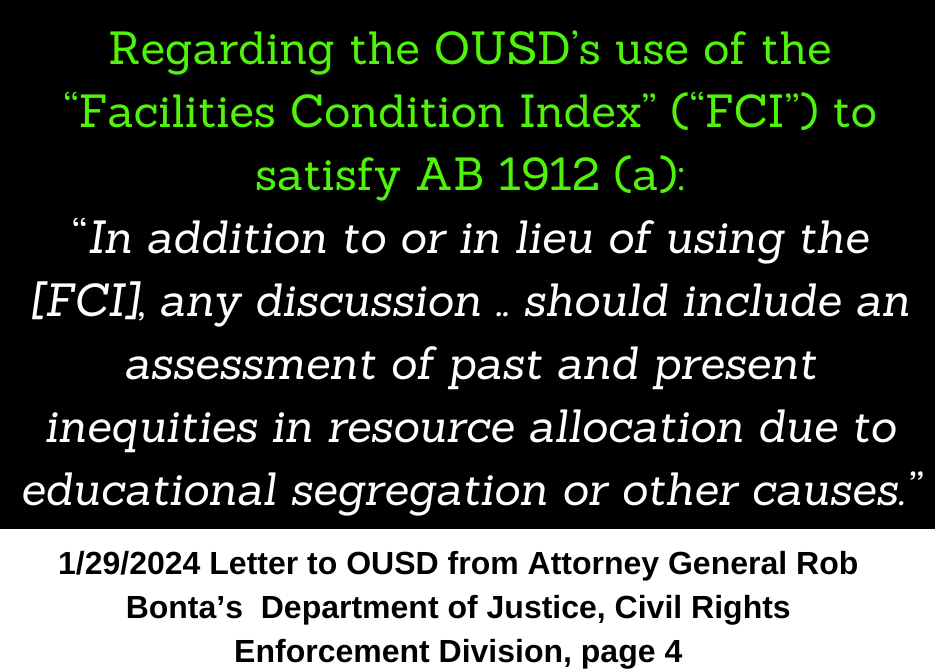
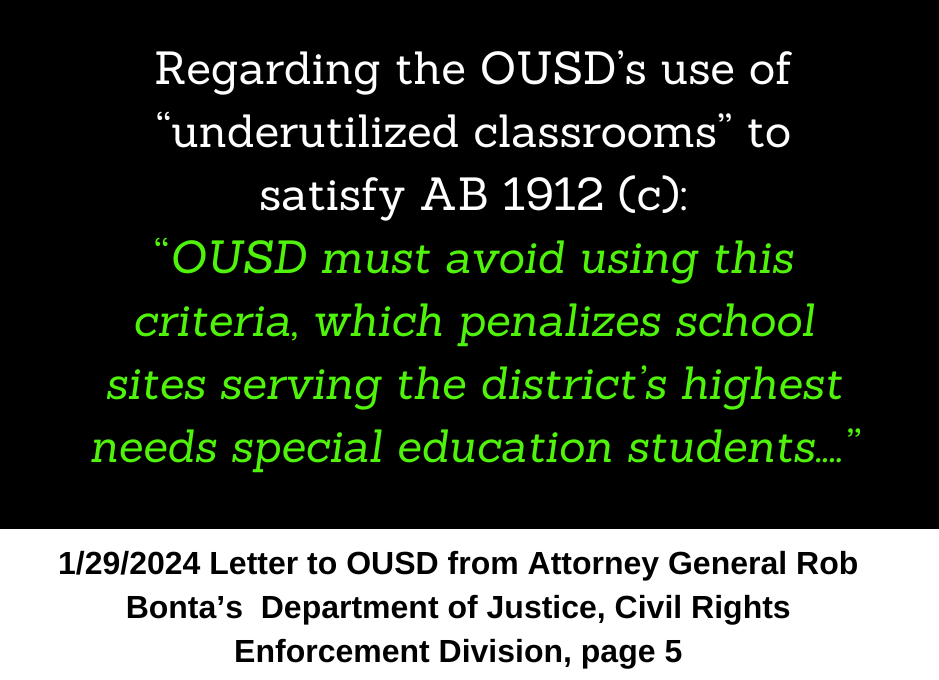
The AG will continue to monitor OUSD as they plan for mergers next year, and any closures or consolidations in the future. OUSD MUST ensure that they take actions that are constitutional, legally compliant, and repair harm to Black and Disabled students rather than replicate it.
We urge the board to make additional changes to the metrics necessary to ensure that they comply with the constitution, the law and the guidance of the California Attorney General. We also urge them to mandate a robust and transparent community input process throughout any decision-making or implementation process.

  1. OUSD board minutes 1/4/2004 ↩︎
  2. https://www.aclunc.org/sites/default/files/2022.04.11_J4OS_Complaint_to_AG%20Bonta_re_OUSD_Closures.pdf ↩︎
  3. https://oag.ca.gov/system/files/media/letter-school-districts-school-closures-04112023.pdf ↩︎
  4. https://oag.ca.gov/system/files/attachments/press-docs/CalDOJ.LettertoOaklandUnifedRePotentialClosures.1.29.24.final_.pdf ↩︎

OUSD is planning “across the board” school site budget cuts that disproportionately harm Black and Brown schools while also using Learning Loss funds to give most of our affluent, whiter elementary schools extra staffing that other schools have to pay for out of their limited (and reduced) site budgets. That is NOT #BudgetEquity!

School budgeting is complicated. Right now, site principals are trying to create budgets for their schools from a “one pager” – the budget document created every January for each school showing how much money and staff that they will receive in the following year1. We know, because the board approved budget “adjustments” for 2024-25 as part of last year’s long-term budget planning2, that school sites will lose $10 – 20 per student (dependent on grade level) in “base” funds, and also $110 per student in “Supplemental” funds received based on their Unduplicated Pupil Percentage (“UPP”)3. UPP is measured by counting the number of low-income students, English learners and Foster Youth in a school community and converting that to a percentage4. It is easy to understand how cutting the Supplemental funds across the board disproportionately harms the primarily Black and Brown students who generate the Supplemental funds in the first place – the more wealth in a school community, the smaller the cut.

But it is also true that “across the board” cuts in Base (per pupil) funding disproportionately impacts lower income communities who do not have other means to make up the difference.

see citation below

In 2017 when faced with drastic budget cuts, some board members asked for a more “equitable” process than the “across the board” strategy, and staff responded that it was just too difficult:

“Sondra Aguilera, deputy chief of student services for OUSD, told board members Wednesday that this is the “best option.” She said a more tailored approach for cutting the budget at each school would be difficult, in part because some parent-teacher associations raise their own grants but are not required to report those funds to the district. “We began to see this rabbit hole that we were going to go down mapping all the different sources,” Aguilera said. “You can’t possibly map all the different sources that school sites receive.””

https://www.kqed.org/news/11635537/oakland-unified-proposing-9-million-in-midyear-budget-cuts-to-schools

OUSD is willing to implement “across the board” budget cuts which they know disproportionately impact low-income Black and Brown families because it’s harder to figure out how much money PTAs pull in for their schools.5 That is NOT #BudgetEquity.

Given that OUSD understands that “across the board cuts” disproportionately harm Black and Brown schools, why is OUSD giving even MORE of our students’ precious resources to higher income, whiter schools?

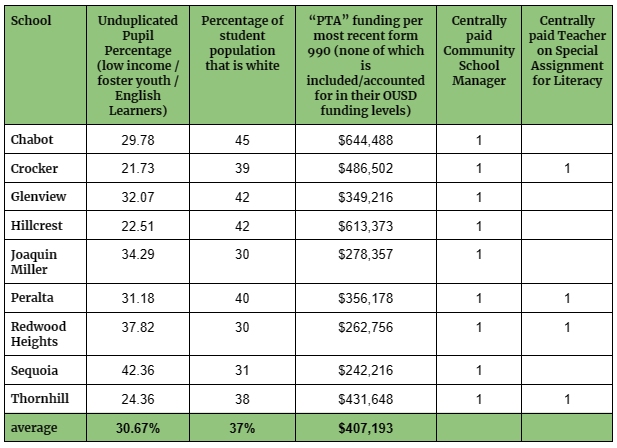
According to the OUSD School Site Funding Profile (“Proposed Budget”) the following wealthy, primarily white elementary schools are receiving “additional centrally provided” Community School Managers (“CSM”) (and a few are also receiving additional centrally provided Literacy Teachers on Special Assignment “TSAs”):

These schools are getting “free to them” Community School Managers despite the fact that they are not community schools6, and do not qualify as community schools per the California Community School Partnership Program (“CCSPP”) grant because their UPP is below the 50% threshold7. In fact, most of the schools on this list fall far short of that UPP and represent 9 of the 10 schools with the highest percentage of white students in OUSD.8 These schools collectively reported nearly $3.7 million in PTA revenue in their most recent disclosures.9

Some OUSD Community Schools receive partial funding for their CSM (about half of the cost) as part of their “enrollment based” staffing, but 10 schools receive no CSM allocation, and so must pay for their CSM out of their discretionary funds – thereby decreasing the amount left for important student services. It is hard to understand why OUSD, when considering which schools to “centrally provide additional” staff to in the most equitable way – a value which OUSD claims to hold at the center of everything they do – decided to provide “free to them” Community School Managers to elementary schools which are not Community Schools (and cannot qualify under CCSPP) instead of providing them to the 10 elementary schools which received NO allocation (not even partial) for their CSM. Given the history of anti-Blackness in OUSD, it is not surprising that 7 of the 10 elementary schools which received no CSM allocation are 7 of the Blackest elementary schools in OUSD10.

OUSD must redo the one pagers to reflect #BudgetEquity by eliminating “across the board” cuts and reallocating “centrally provided staffing” from affluent, white elementary schools to the primarily Black elementary schools which have NO allocation for Community School Managers.

Equity is not just a buzzword, it is enshrined in OUSD Board Policy 503211 which states: “we hold the powerful belief that equity is providing students with what they need to achieve at the highest possible level” and “to interrupt patterns of institutional bias at all levels of the organization”. Continuing to offer disparate and inequitable funding levels to majority Black schools is not interrupting that pattern. The OUSD board must direct staff to revise these and other areas of inequity in the budget to make the changes that are necessary to create #BudgetEquity.

  1. There are three general categories included in the One Pagers: (1) dollar allocations which schools can decide how they want to spend; (2) staff allocations based on enrollment and student population; and (3) centrally provided additional staff placed at the discretion of OUSD staff (which are “free” to the school and in addition to the staffing generally provided to other schools). ↩︎
  2. From a staff presentation to the Budget and Finance Committee on October 12, 2023. https://ousd.legistar.com/View.ashx?M=F&ID=12354388&GUID=E0330B30-D391-4BA3-BB28-C142E0CD19A5 ↩︎
  3. This is part of the “Local Control Funding Formula” (“LCFF”) adopted by California in order to provide more funding to school districts with higher proportions of higher need students. Beginning in 2013-14, school districts would receive equal “Base” funding per pupil, but also would receive “Supplemental” funding for higher need students, and “Concentration” dollars for the highest need students. OUSD, which has a UPP of 77.96% according to 2023-24 adopted budget, receives significant additional Supplemental and Concentration funding generated by its high need populations. For information about LCFF see https://publicadvocates.org/our-work/education/public-school-funding/lcff/ ↩︎
  4. The count is “unduplicated” because each student is only counted once, even if they fall into multiple categories. So if a student is a Foster Youth AND an English Learner, they are only counted one time. ↩︎
  5. That is not quite true. PTAs and similar “tax exempt” parent organizations are required to file federal forms called 990s that identify how much revenue is raised, and how that money is spent. You can find them on public websites like ProPublica: https://projects.propublica.org/nonprofits/ ↩︎
  6. There are two other Elementary schools which received this centrally provided additional staff member, Cleveland Elementary and Piedmont Avenue. Each of those schools meets the CCSPP threshold and are not included in this analysis as a result. ↩︎
  7. 50% is the base threshold, but the competitive grant threshold (in practice) was 80% UPP (https://cslx.org/assets/g-files/CCSPP-Grant-QA-V1.pdf). ↩︎
  8. The only affluent, white elementary school not on this list is Montclair Elementary which is 34% white and has an UPP of 29.49%. We are not clear on why only this “Hills” school was not included. ↩︎
  9. See the ProPublica website, ibid. ↩︎
  10. The elementary schools which did not receive a CSM allocation are, including percentage of African-American (AA) or Black students: Burckhalter (50%), Grass Valley (53%), Laurel (31%), Lincoln (9%), Montclair (12%), Carl Munck (43%), OAK (formerly Howard) (44%), Manzanita SEED (11%), Prescott (51%) and Sankofa (36%) ↩︎
  11. https://boepublic.ousd.org/Policies.aspx↩︎

Tell OUSD to Install Outdoor Classrooms at ALL Oakland elementary schools immediately!

Last spring, as part of its Covid-19 planning, OUSD announced that it would be installing temporary outdoor classrooms at every elementary school to enable students to learn outside where the risk of transmission of the virus is much lower. Along with upgrading ventilation systems, this was a key strategy for a safe return to school. This presentation from April 28th makes clear that ALL elementary schools were to receive these Outdoor Learning Spaces by the end of July, 2021.

From OUSD Superintendent presentation to the board April 28, 2021

Now, just two weeks before school is due to start on August 9th, as the delta variant is causing a spike in cases and parent and educator apprehension about returning to school is rising, we have learned that 20 schools still have not received their Outdoor Learning Spaces. Although staff has stated they are expected in the “next few weeks”, we are concerned that they will not be available for back to school on August 9th. Given that August weather is often sunny and hot, as well as the rise in cases in Alameda County and the greater risk of transmission with indoor contact, those Outdoor Learning Spaces are critical for student safety and comfort on day one.

https://covid-19.acgov.org/data accessed July 29, 2021 at 7:30 am

OUSD prioritized schools serving white and affluent students while leaving our most vulnerable students without the outdoor classrooms needed for a safe return to school

Data for the 20 elementary schools for the 2020-21 school year from OUSDData.org dashboard

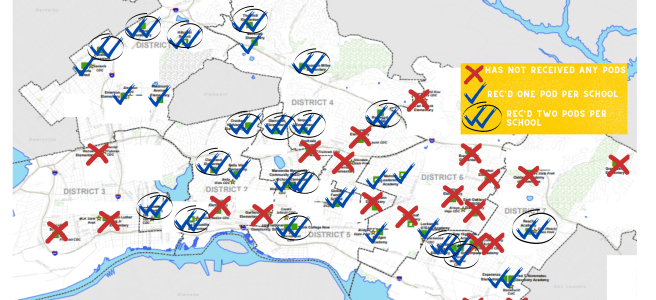
97% of white OUSD elementary students attend schools that already have the outdoor classrooms in place, despite making up just 11% of our student population. Even more troubling is that students in East and West Oakland were left out of the original distribution, areas that historically have had the highest case rates and are likely to again as cases surge. While schools in the hills, North Oakland and around the lake already have those outdoor classrooms ready for day one, the mostly Black and Brown families in most of the East and all of the West are poised to start school in a few weeks without shaded outdoor spaces for children to learn more safely. This is not equity, nor is it good public health policy. It violates OUSD’s Reparations for Black students and Equity Policies, and it is simply unacceptable. OUSD needs to remedy this IMMEDIATELY, provide Outdoor Learning pods for all schools in Oakland, and to do it by the first day of school. 

Map created using information received from OUSD Staff July 20, 2021

When systems and structures are built on white supremacy, we must act with intention to dismantle those structures. We understand that OUSD staff intended to provide shade structures first for those schools with higher enrollment and a higher intent to return last spring, which were largely the more affluent, whiter schools. Given the structural racism that underlies both of those conditions, any outcomes based on them were by definition inequitable and racist. This was a predictable outcome that OUSD should have avoided, but because we are a district steeped in white supremacy and anti-Black and Brown racism, we did not.

On top of the prioritization of white and affluent families in the rollout, OUSD has provided almost all of the most affluent hills schools with not one but two of the pods, while providing a single pod to most other sites, regardless of number of students enrolled or the concentration of Covid cases in the community. OUSD must provide a minimum of two pods to EVERY elementary site, and especially to those communities with high case incidence and limited community resources to privately fund shade structures and outdoor learning equipment.

Certainly, the failure to provide these Outdoor Learning Spaces to the remaining 20 schools, and the some 6500 non-white students that attend them, by August 9th will simply compound these inequities at a time when we need to be reassuring families that it is safe for their children to be back in school. Knowing that children can be learning outdoors, in shaded classroom pods, will help to ease parent concerns about whether it is safe to return to school. OUSD must do better, examining every decision for white supremacy bias and centering racial justice and equity every single time. They must act NOW to prevent further harm.

CONTACT THE SUPERINTENDENT AND BOARD MEMBERS TODAY!

Please take a minute to email Superintendent Kyla Johnson-Trammell and your school board director to demand that the remaining 20 schools receive their Outdoor Learning Spaces before August 9th, and that all schools be given two pods if they don’t already have them.

Per OUSD Staff via email dated July 20, 2021, the Outdoor Learning Spaces are allocated (# of pods per school in parentheses)