Why does OUSD keep trying to close schools to balance its budget when it clearly doesn’t work? The answer might be that the people pushing that narrative aren’t interested in our budget, they are interested in our buildings.

Outgoing Superintendent Dr. Johnson-Trammell has long argued that Oakland Unified School District (“OUSD”) must close schools in order to be fiscally sustainable, yet the majority of our elected school board has resisted that call, rescinding a decision to close schools in 2023, and rejecting a new plan to close and merge schools last fall. The argument is that we have too many schools for our declining enrollment, and that some schools are “underutilized” and not generating enough revenue (dependent on the Average Daily Attendance or “ADA”) to pay for itself, as if each school is a McDonald’s that needs to show a profit to stay open. We need to balance our budget as a unified system, and we need to offer accessible public education to Oakland’s kids, but we are not willing to have a real conversation about what that looks like. 

Much is made about the fact that OUSD has more schools than many other California school districts per ADA. The question is, why does that matter and are we talking about public schools in the right way?

OUSD does have more schools per student than most medium to large school districts, but does that mean we have “too many schools”? Part of how you answer that question may depend on what you see as the purpose of public education and what our constitutional obligation to provide a free public education to all children requires of us. A child who can no longer go to school because her neighborhood public school has closed has no access to public education.

OUSD has argued that elementary students can walk 2 miles to school, but experts agree that is 2 to 4 times more than is reasonable. 

It is important to note that OUSD does not provide transportation to most students, no yellow school buses pick kids up and take them to their neighborhood school, which means that if you do not have a car, you must walk to school or take public transit. Especially for elementary age students who most agree cannot take the bus on their own, there is a limit to how far a young child can be reasonably asked to walk to school. So long as Oakland does not provide transportation to all students, closing schools removes access to public education for many students and as such is not acceptable.

OUSD has fewer schools per square mile than most comparable school districts, most of whom provide transportation to school

So long as we are not providing transportation to students, every student needs a neighborhood public school within walking distance. Ideally, that would mean you would have at least 1 elementary school per square mile spread out evenly so that no child would have to walk more than 1/2 mile to get to school. Fontana Unified School District has approximately the same number of students as OUSD on 25 fewer campuses and has been used by OUSD as an example of a district that is “right sized”. Fontana is 52 square miles, which means they have 0.87 schools per square mile. They also provide transportation to all students who live certain distances from their neighborhood school, as shown below.

Oakland is 78 square miles and has 69 active campuses across Oakland. A sampling of ten medium to large school districts with a UPP (Unduplicated Pupil Percentage) greater than 50% (including Fontana) shows that the average number of schools per square mile  is 1.06.  As you can see, Oakland is at 0.88 schools per square mile which is about 2/10ths of a mile below the average and just about the same as Fontana. For comparison, Piedmont Unified has 371 ADA per school and 3 schools per square mile, fewer students per school and more schools per square mile.

OUSD only provides transportation to certain disabled students. The majority of these other school districts provide transportation beyond that to all students who qualify (usually based on location), and the only two districts that do not have approximately twice the number of schools per square mile as OUSD does. If we think about public education as a common good that must be accessible to all students, the number of schools per square mile, especially when you fail to provide transportation, is a more relevant number than the number of students per school. 

So who is pushing OUSD to close schools, anyway?

The people you most often see pushing school closures, in addition to our Superintendent and certain board members (mostly no longer on board) are charter school advocates (because the primary barrier to charter school growth is access to facilities) and mostly white/affluent parents whose children attend “hills” schools, because they believe that their schools will be spared because they are “fully enrolled” and “high performing”. We have seen (with Kaiser and Hillcrest) that those parents will change their tune when their school is targeted.

“Lack of access to affordable school buildings is the single immediate and overwhelming factor containing [charter school] growth.”

So why do charter advocates care about public school closures? The answer is simple: real estate. The Center on Reinventing Public Education (“CRPE”) is a right-wing charter school think tank that understands that without facilities, it is hard to growth the “market share” of charter schools, especially in the Bay Area where real estate is so expensive.

At OUSD board meetings where school closures are on the agenda, the only people speaking in favor of them are those charter school advocates, as pointed out in 2019 by Director Hutchinson.

For many years, GO Public Schools (“GO”) flooded school board elections to stack the board with directors who would further privatize OUSD and rubberstamp the growth of charter schools. Groups like Families in Action for Justice (or Education) have taken over GO’s role in school board elections, supporting candidates who support the continued and ongoing privatization of OUSD, including through charter school growth. Interestingly but not coincidentally, the most vocal supporters of the “Bankrupt” narrative being pushed by Director Hutchinson have mostly been Families in Action members, and Director Hutchinson has now taken to endorsing those same school board candidates (Salop, Aikens, Berry and Thompson in the last election) as both Families in Action and the new anti-progressive, anti-union group “Empower Oakland”.

Under Prop 39, closed district campuses must be offered to charter schools

We have posted before about Prop 39, the law that requires school districts to provide space in its schools for charter schools who ask for it in return for a “facilities use fee” that is significantly lower than for publicly owned spaces, usually less than $5 per square foot per year (not per month). Every year, OUSD receives between 5 and 17 requests for space in OUSD schools. Most of our previously closed schools are already spoken for, so charter schools have to “co-locate” with district schools unless there are newly vacant properties through school closures.

OUSD has a long history of closing schools since 2003. From 2004 to 2018 OUSD closed 18 schools, and 14 of them became new homes for charter schools. It is no surprise, then, that charter school advocates urge OUSD to “be bold” and close schools.

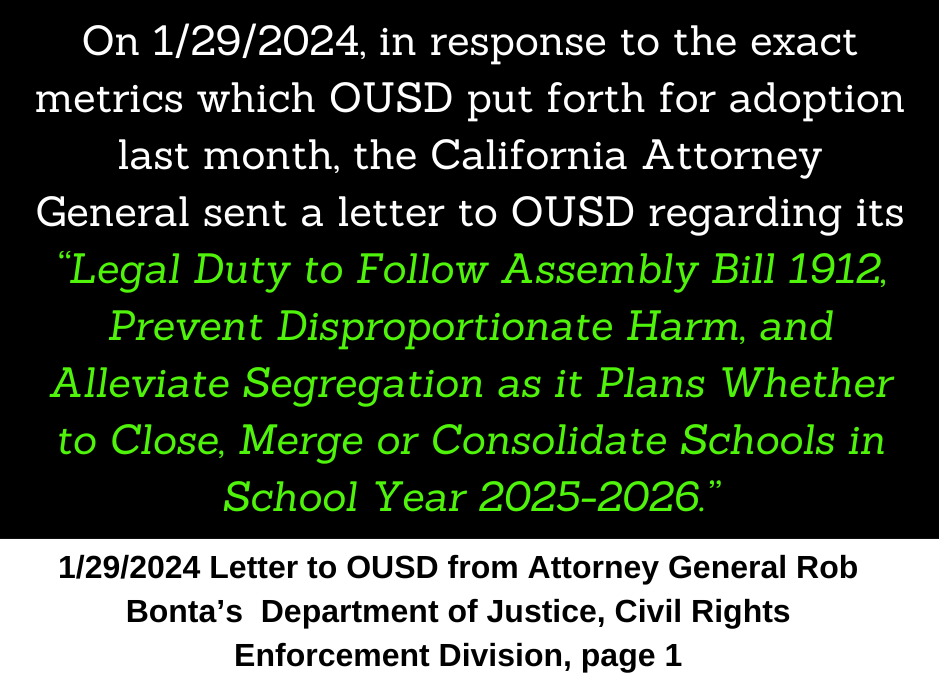
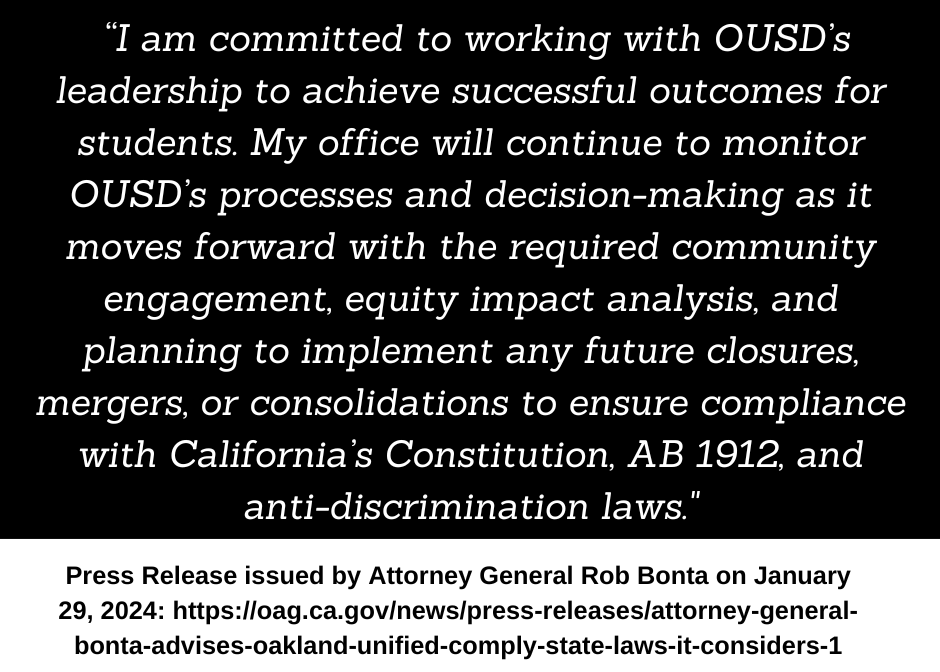
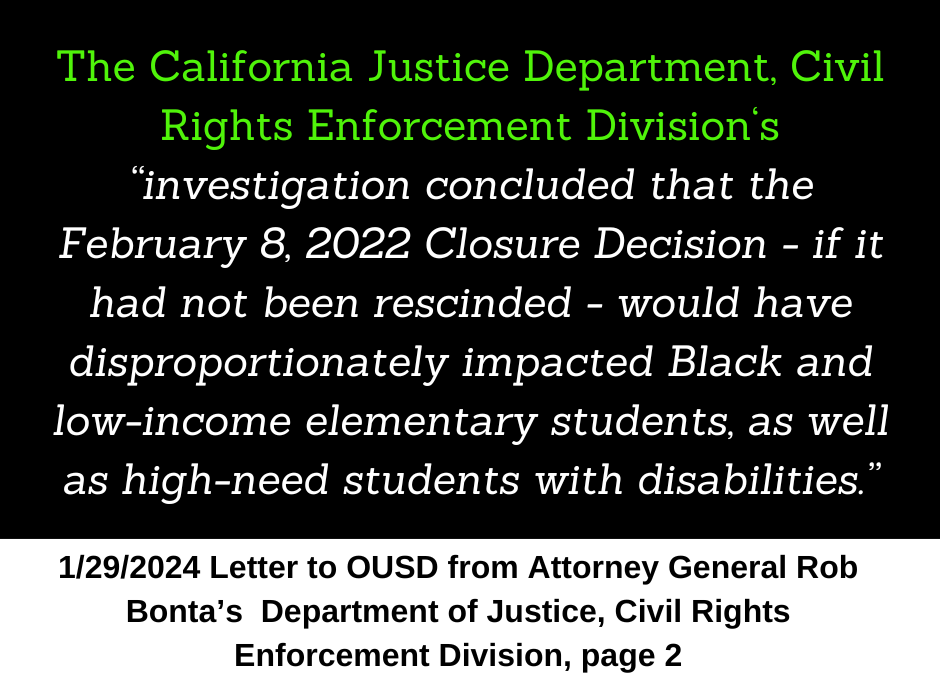
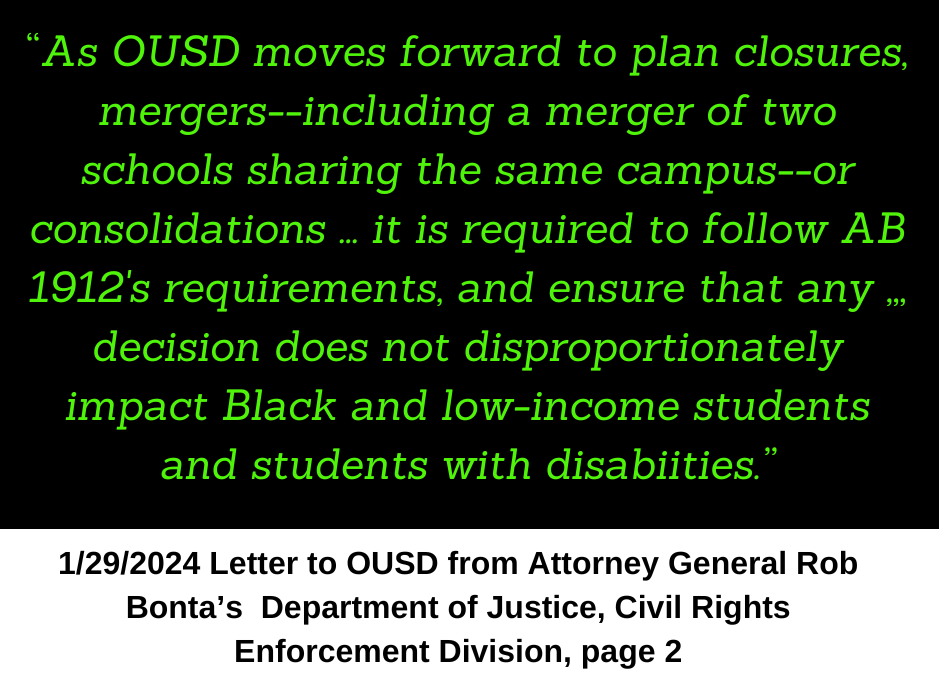
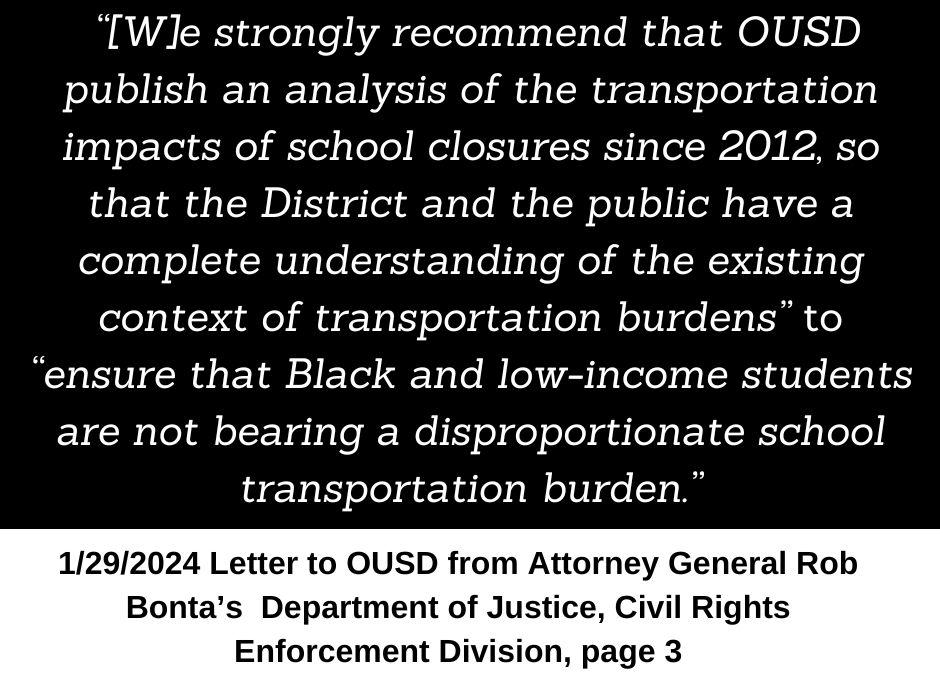
The California AG has concluded that Oakland Unified’s school closures have disproportionately harmed Black and Disabled students, and issued very specific guidance to OUSD about how to avoid repeating that harm in the future. Will OUSD listen to that advice as they push forward with mergers, consolidations and closures in future?

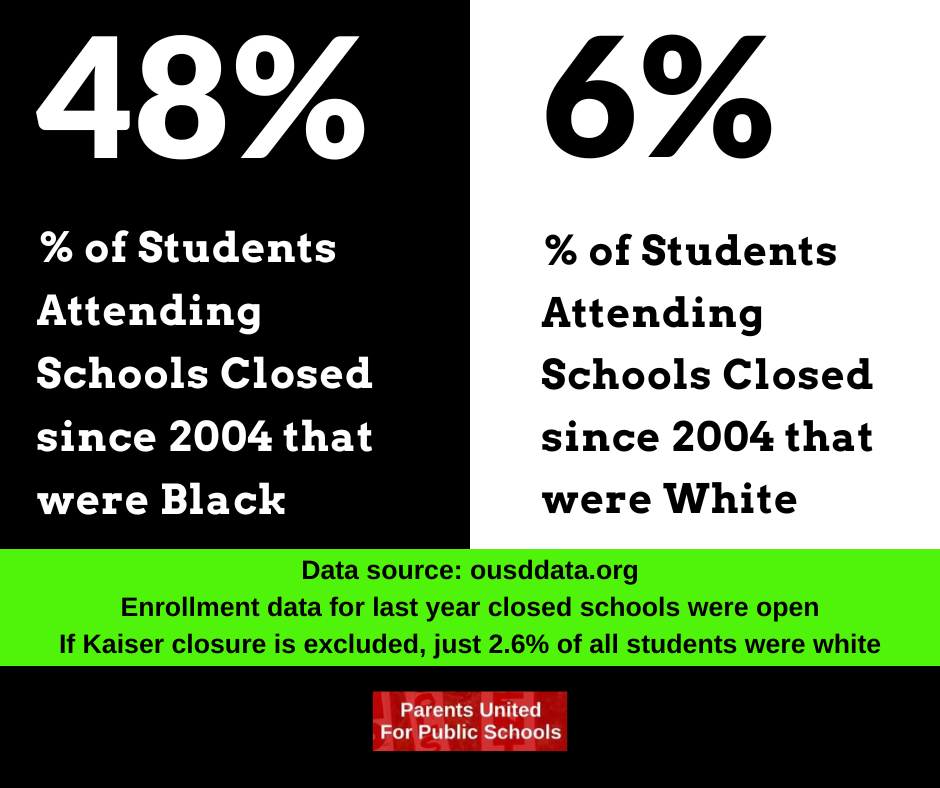
Justice for Oakland Students Graphic regarding School closures from 2004 to 2017

OUSD has a long history of school closures in Black communities that have accelerated gentrification and resulted in disproportionate harm to Black students.

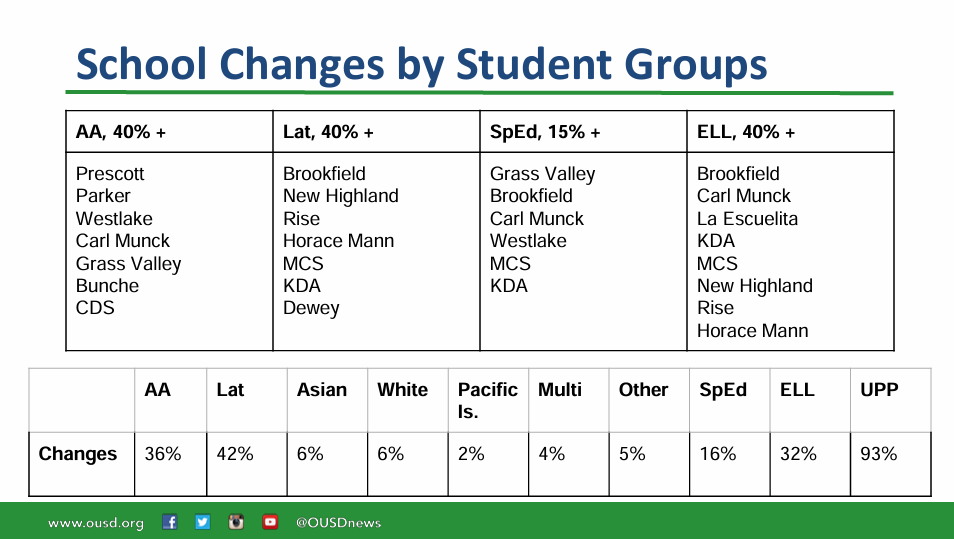
Oakland Unified School District (“OUSD”) has closed many schools over the past twenty years, following a pattern of using so called “Sustainability” metrics: utilization and enrollment data. In a 2004 discussion about school closures, former school board member Gary Yee articulated that “[t]he primary concern for any school site reutilization was that the school is effective and relatively inexpensive to run.”1 That philosophy reinforced racist and ableist patterns and behaviors and resulted in the devastation of the Black student population in OUSD over time.

In February of 2022, the OUSD board voted to close schools over two years, again using the same kind of “Sustainability” metrics as the selection criteria, and once again disproportionately harming Black, low-income and Disabled students.

AB 1912 and the AG investigation grew out of the February 2022 closure decision, and led to the currently proposed Equity Impact Metrics to be presented to the board this week for adoption.

In response to the closure decision, the American Civil Liberties Union (“ACLU”) filed a complaint2 with the California Attorney General (“AG”) alleging that the school closures violated the constitutional and statutory civil rights of Black students in OUSD. The AG opened an investigation into the closures sometime in 2022, and Assemblymember Mia Bonta authored a law (“AB 1912”) requiring an equitable process before deciding to close schools.3 In January, 2023, a newly elected OUSD Board majority rescinded the closure decision for those schools set to be closed in June, 2023 and then voted to “merge” 10+ schools at the end of the 2023-24 school year as part of their budget development, which triggered the need for the AB 1912 equitable process.

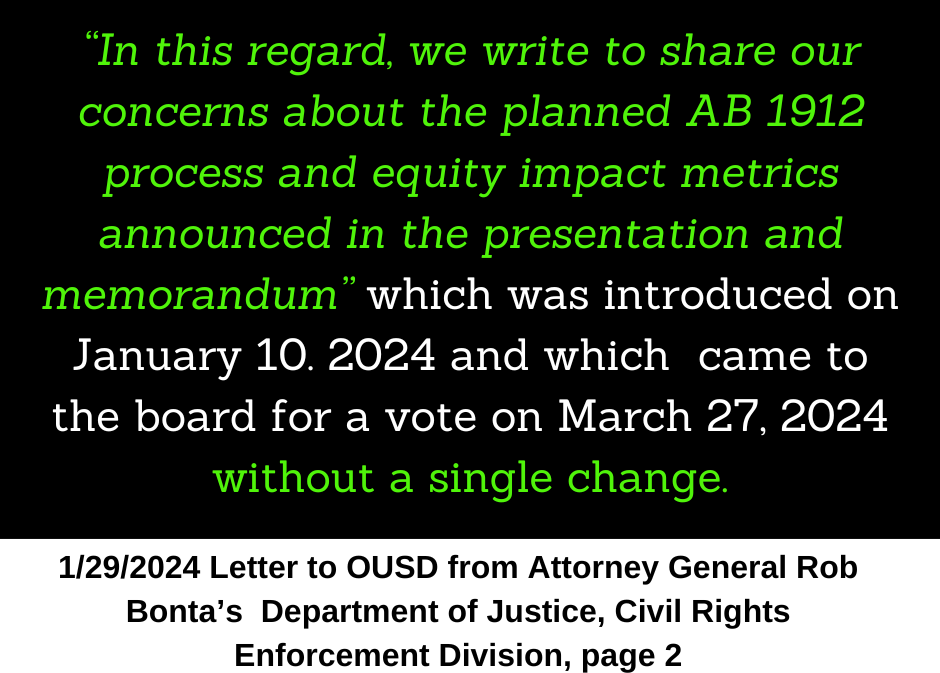
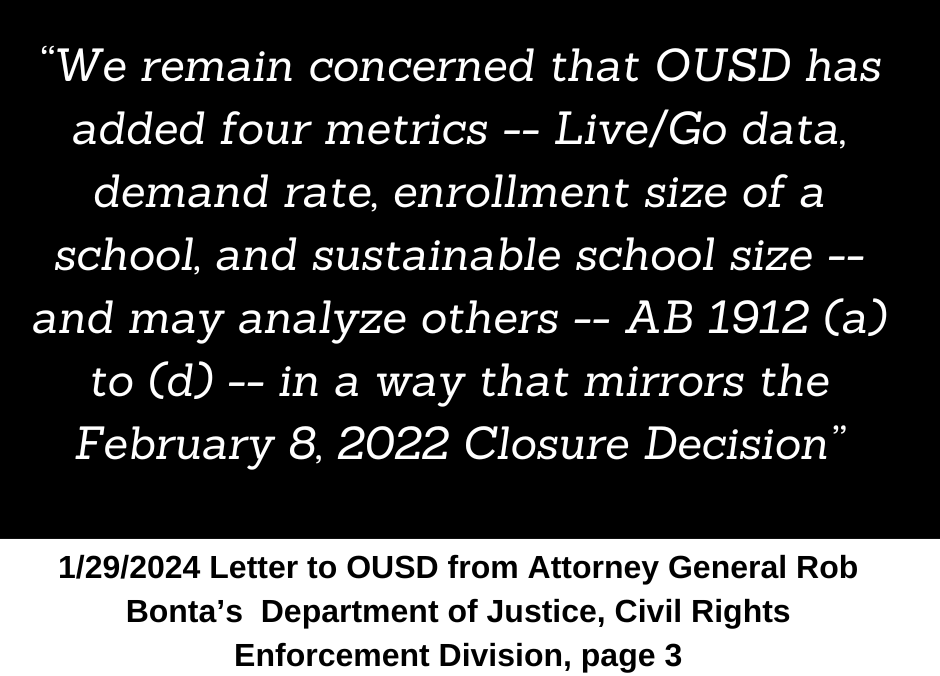
OUSD staff presented the Equity Impact Metrics to the Board January 10, 2024 including the same racist and discriminatory “Sustainability” metrics that have been used since 2004, which resulted in a letter from the AG’s office dated January 29, 20244 outlining the AG’s concerns with those metrics. After failing to adopt the identical metrics on March 27, 2024, the OUSD State appointed Trustee warned the board that because they failed to take the steps necessary to “merge” 10+ schools as promised in the 2023 budget resolution, the Trustee would not allow them to negotiate compensation increases for OUSD union employees. In response, Board President Sam Davis has scheduled a vote on a revised set of metrics this Wednesday, April 10th.

What guidance did the AG provide to OUSD? We summarized it so you don’t have to.

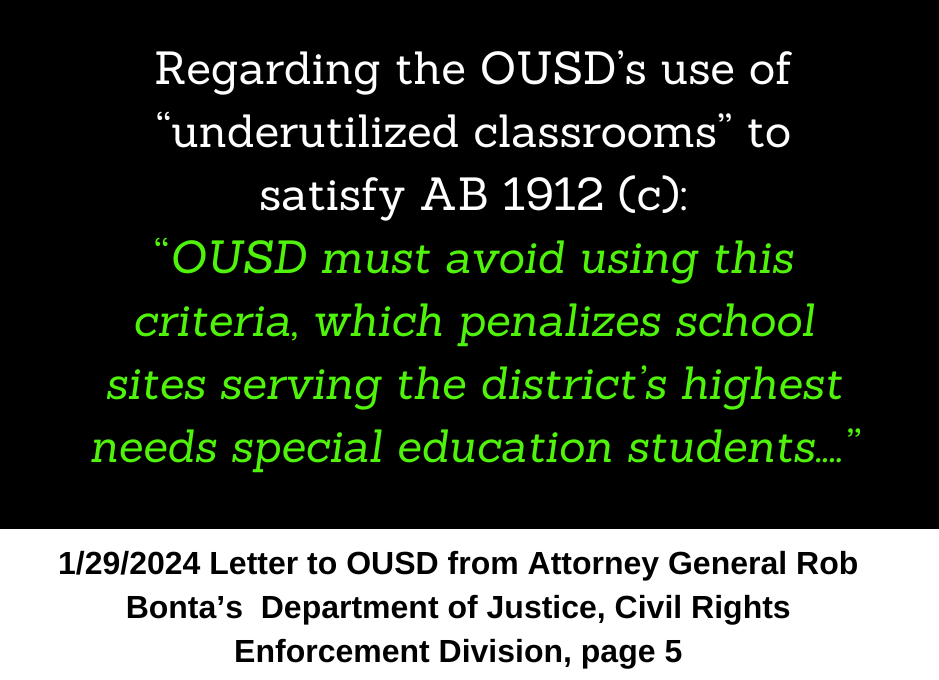
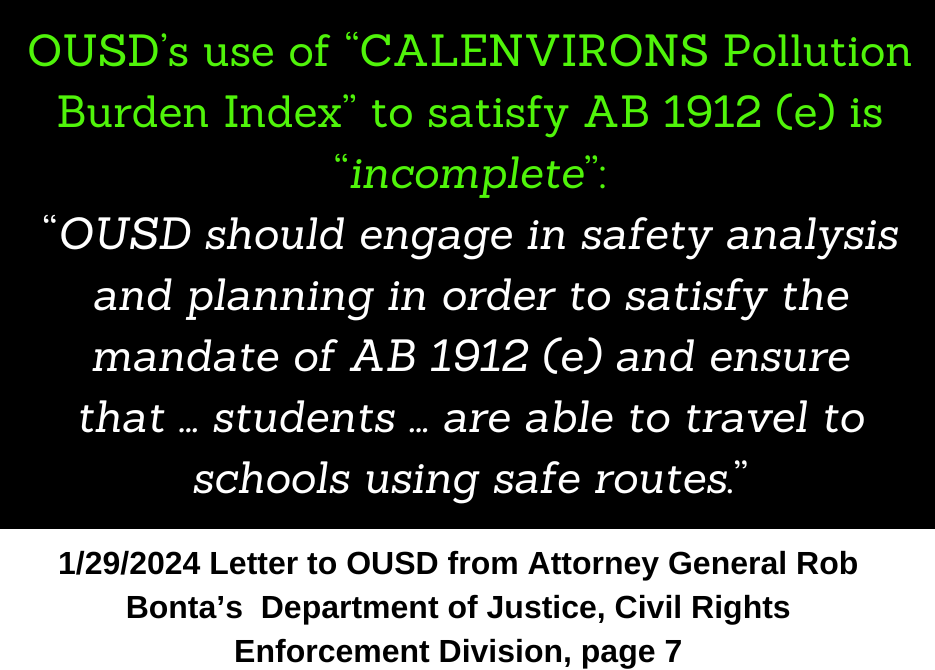
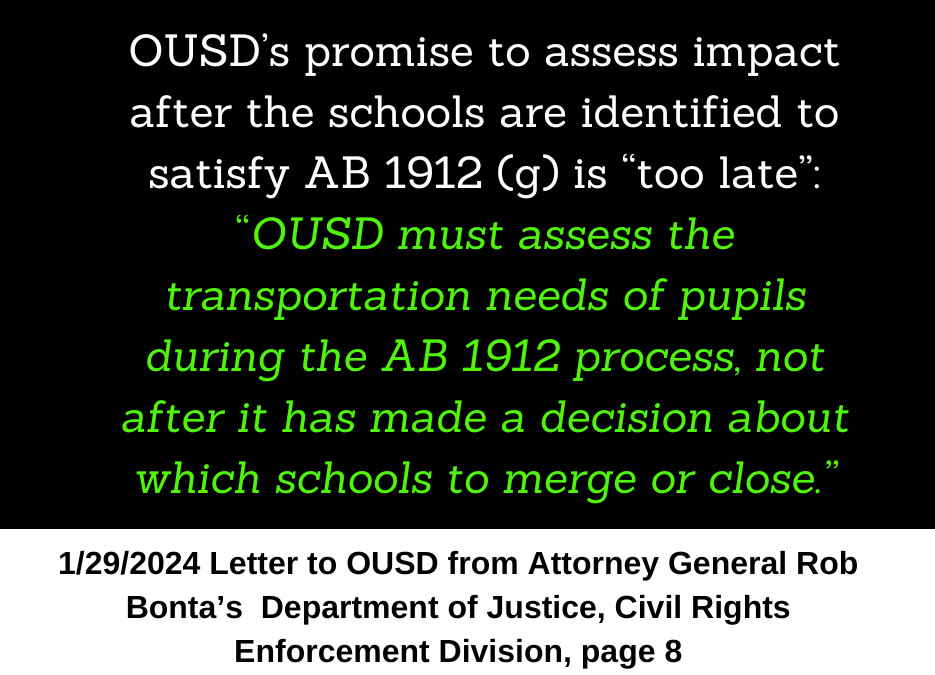
So what does the AG have to say about the SPECIFIC metrics that OUSD is proposing?

We are grateful to staff and the Board for removing the four “Sustainability” metrics from the proposal that the AG made clear would repeat the same disproportionate harm as in past years. But the proposed metrics also include other metrics that the AG found problematic or incomplete. The Board should heed the following advice from the AG.

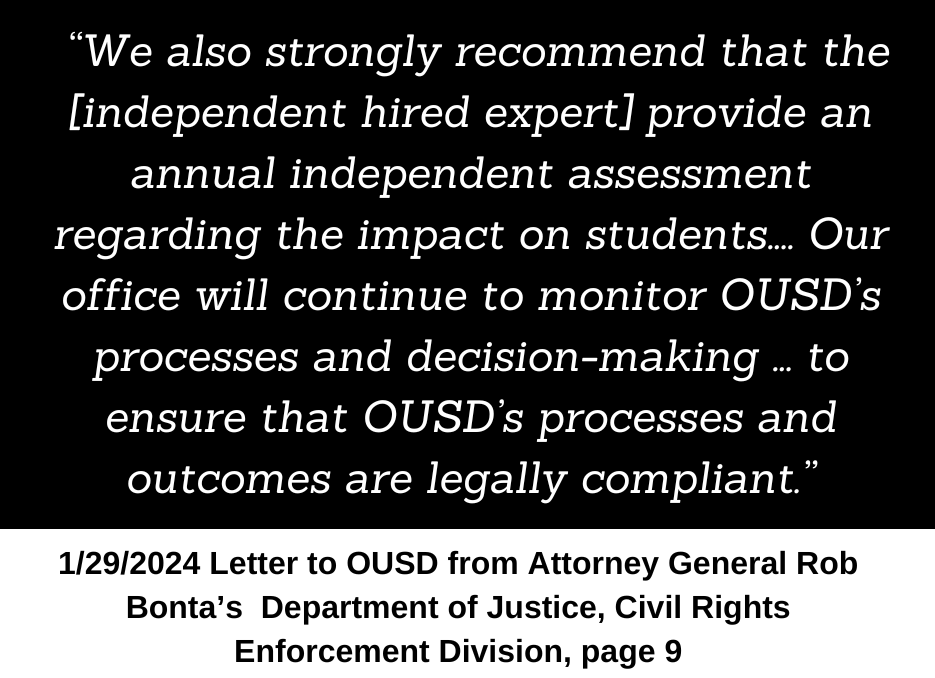
The AG will continue to monitor OUSD as they plan for mergers next year, and any closures or consolidations in the future. OUSD MUST ensure that they take actions that are constitutional, legally compliant, and repair harm to Black and Disabled students rather than replicate it.

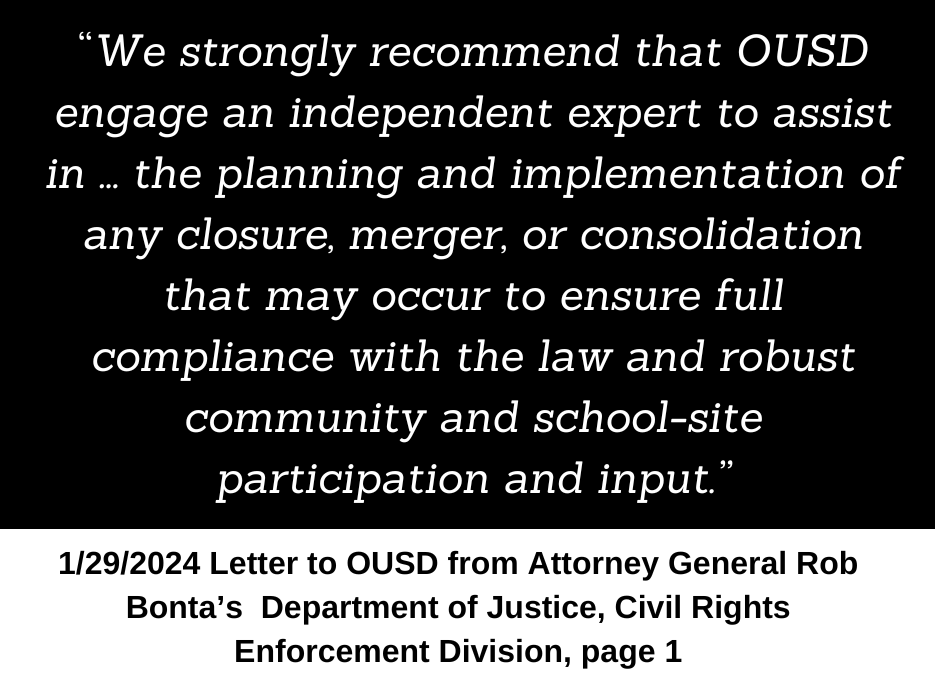
We urge the board to make additional changes to the metrics necessary to ensure that they comply with the constitution, the law and the guidance of the California Attorney General. We also urge them to mandate a robust and transparent community input process throughout any decision-making or implementation process.

  1. OUSD board minutes 1/4/2004 ↩︎
  2. https://www.aclunc.org/sites/default/files/2022.04.11_J4OS_Complaint_to_AG%20Bonta_re_OUSD_Closures.pdf ↩︎
  3. https://oag.ca.gov/system/files/media/letter-school-districts-school-closures-04112023.pdf ↩︎
  4. https://oag.ca.gov/system/files/attachments/press-docs/CalDOJ.LettertoOaklandUnifedRePotentialClosures.1.29.24.final_.pdf ↩︎

Our newly elected, progressive OUSD Board majority just reversed school closures. Now it’s time to get to work to realize our vision of a community led, anti-racist, people-over-profit centered school district.

.

Brookfield students showed up for the vote to keep their school open! Photo credit to Corrin Haskell

On Wednesday night, in the first official act of the new progressive majority, the Oakland Unified School District (“OUSD”) Board of Directors voted to rescind planned closures of 5 elementary schools and 1 middle school program at the end of this school year. Students, parents, educators and community were on hand to witness newly elected board members Jennifer Brouhard and Valarie Bachelor join with sitting directors VanCedric Williams and Mike Hutchinson to fulfill the mandate of the 67% of voters who supported their platform of ending school closures which target schools in Black and Brown neighborhoods and destroy communities while fueling the gentrification of Oakland. 

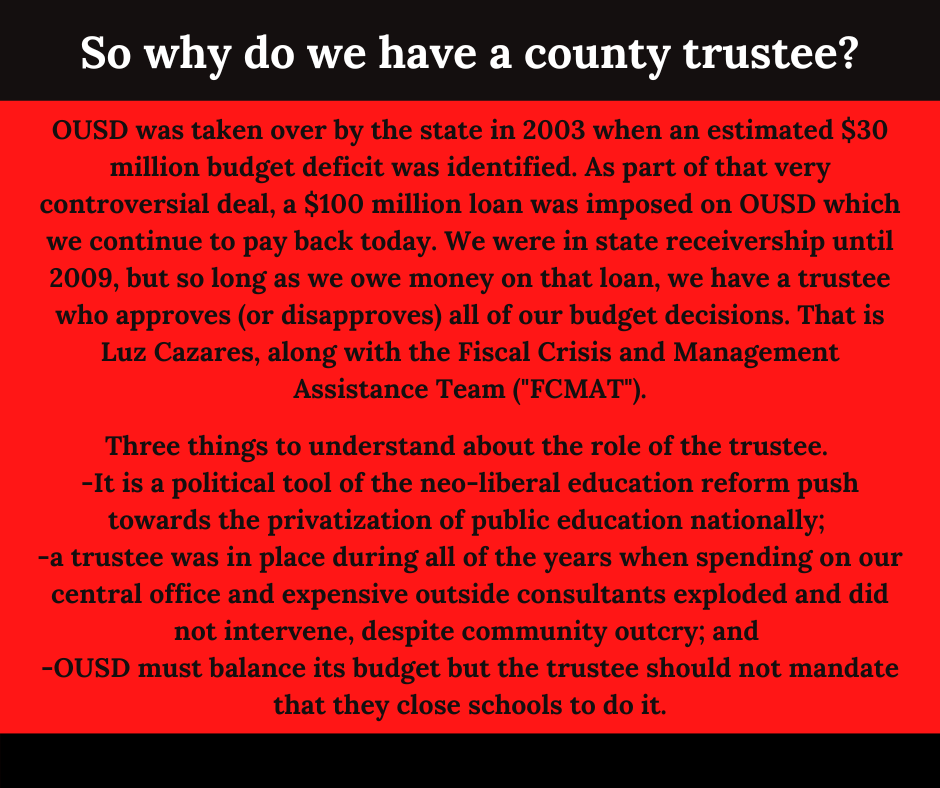
The fight is not over. No sooner was the vote complete than the Alameda County trustee Luz Cazares, appointed to oversee OUSD’s finances, informed OUSD that they reserved the right to stay and rescind the board’s action to end school closures, because OUSD did not provide a Fiscal Impact Analysis as required by its own board bylaws prior to the vote.

District staff should have prepared that Analysis as soon as the matter was introduced by Director (now President) Hutchinson on November 30th, but failed to do so, and it appears that both Director Sam Davis and Director Hutchinson, who had each declared their intention to become board President, allowed staff to delay the Fiscal Impact Analysis until January 25th. This was done despite the urgency of needing to fix the enrollment system immediately to include the targeted schools and begin the budget development for school sites. That willingness to delay and worsen the harm to students led to Director Williams being elected president and immediately calling a special meeting for Wednesday, January 11th for a vote on the rescission resolution, which passed. President Williams’ decision to act immediately to help the targeted school communities jump start planning their futures was also a rebuke against the deliberate slow rolling by staff and politicking by board members. We are grateful for his leadership and for putting students first.

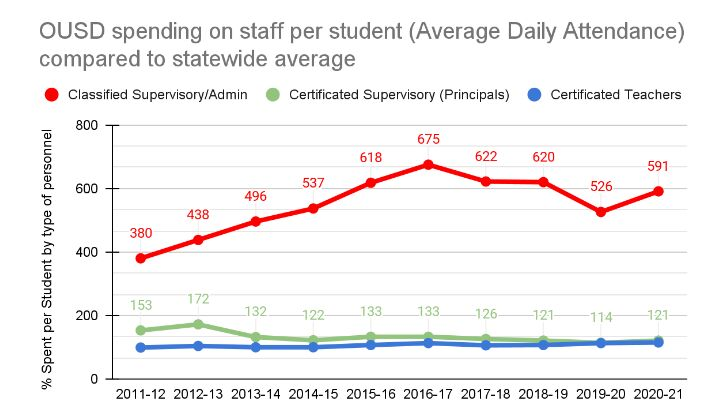
It is now up to District staff to prepare the necessary analysis so that we can avoid action by the County trustee and move on with the planning for how we support the targeted schools to repair the harm done by years of uncertainty and underinvestment. We must also rethink our solvency strategies to ensure we are no longer balancing our budget on the backs of our most vulnerable students. We must restructure our district from a top heavy, consultant-dependent “business model” to a district built from the bottom up, where we prioritize students and classrooms in true Community Schools. We must push our city, county and state leaders to support us in creating a district that serves the whole child, addressing community needs so that students are prepared to learn and excel in life. It is possible to educate students in equitably funded neighborhood public schools with staff who are valued and paid a living wage. 

OUSD receives more money per student than almost any other large school district. It is time we invested those funds in the classrooms where they belong. Let’s get to work.