

In years past, California Charter Schools would submit a renewal petition every five years, but new laws and the pandemic changed all that, and all charter schools were given an extension of time of up to 3 years to seek renewal of their charters. That time is now up, and this fall, 13 Oakland based charter schools need to seek renewal of their charters in order to continue operating after the 2024-25 school year.

Since OUSD regained local governing control in 2009, the Charter School Renewal process has been largely opaque and somewhat perfunctory, with most charter schools being recommended for renewal by our prior Charter Office staff, and the board nearly always agreeing with them. This will be the first time that any of our current board members have faced a renewal petition, and among the first to be decided since the passage of AB 1505, which revised charter law, providing additional tools for holding charter schools accountable for serving the same student populations served by public school districts and evaluating the impact of charter schools on their schools.

Although the charter industry tries to blur the lines between charter schools and public schools, there are some very important differences between them, and one is that charter schools operate under a “charter” – a type of contract – that sets out goals and promises about how the charter school will function. If they fail to meet those promises, they should not be renewed for an additional term. The Charter school is exempt from certain Education Code requirements, gains certain flexibility and independence, and “gives charter schools more room to experiment and to come up with instructional and other innovations.” According to the California Charter Schools Association: “In exchange for operational freedom and flexibility, charter schools are subject to higher levels of accountability than traditional public schools.” Part of that accountability is the renewal process, determining whether the school is making progress towards state standards, and is doing it while serving the same groups of students as served by the territorial jurisdiction in which they operate.
Here’s what you need to know about renewals
So far, two charter schools have had a public hearing in front of the OUSD Board (and one at the County board) and if you saw the petition submitted, you would know they are massive. The Aspire Lionel Wilson Prep petition attached to the agenda was 1,517 pages long. The charter law (California Education Code sections 47605 et seq) is also long and can be difficult to understand. As the OUSD Board of Education prepares to decide whether to renew or not renew the 9 charter schools expected to come before them this fall, we will be running a series of blog posts about the process, starting today. We will provide information about the renewal process, as well as snapshots of each school and the relevant data, so that the Oakland community can make sense of what often feels like an overly technical and not very accessible renewal process.
Charter schools up for renewal are placed into one of three categories by the state, and the standards for renewal are different dependent on the assigned renewal “tier”
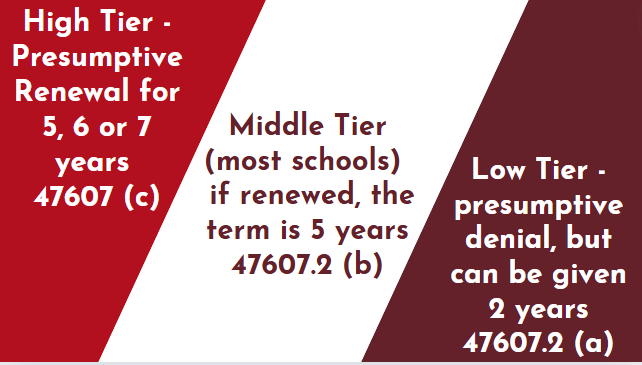
For our purposes, how the state decides which renewal tier to assign each charter school is not really important, but if you are interested in learning more about this process, the California Department of Education website has more information. A charter school is determined to be “High performing” or “Low performing” through a formulaic assessment by the state, and all other schools are then deemed “Middle tier” by default. Most charter schools up for renewal this year are middle tier schools, and so we will primarily focus on those schools.
The High and Low tier schools are as follows:
- High tier: American Indian Public Charter School II
- Low tier: LPS R&D Oakland and Urban Montessori (county authorized)
High tier schools are generally presumed to be eligible for renewal for 5 to 7 years as the board decides (although there are exceptions to that rule which will become important this year). Low tier schools are presumed to be non-renewed, but the board can decide to renew for 2 years if they want to. Middle tier schools can only be renewed for 5 years, and because of the very nature of being neither high nor low performing by state standards, will have data that will suggest renewal and data that will suggest non-renewal, and it is up to the authorizing board (not the district staff) to make the decision as to whether to grant that new five year term.
Charter School Renewal Report Cards – our distillation of the information that OUSD will be considering when deciding whether or not to renew a middle tier school
In order to simplify what seems a complicated process, Parents United will be creating Renewal Report Cards for each of the charter schools up for renewal this year. It’s not easy to distill a 1,500 page petition, an academic performance dashboard, disaggregated demographic and subgroup data and charter submitted information into a two-page Renewal Report Card, but we have tried to provide an overview and significant highlights to help Oaklanders understand the Renewal process better. Here is our “explainer” for what that data represents:
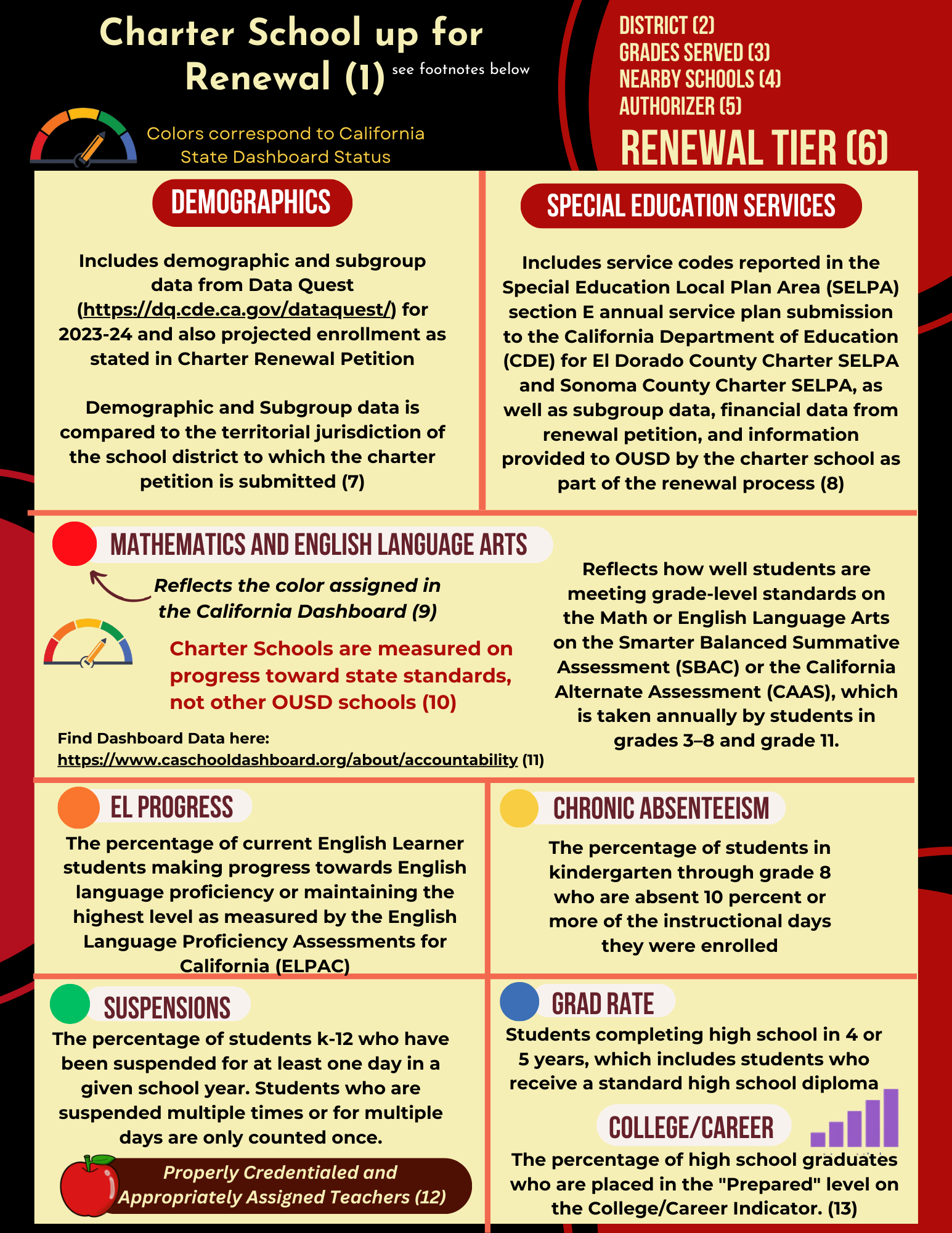
Most of the data comes from the California State Dashboard and it is really important to remember that charter schools are not evaluated by how they are performing compared to the local public schools, they must meet the promises in their charter and make progress towards the State standards, and that is the only appropriate comparison. It is only when looking at Local indicators, including whether the charter school serves all students, that we consider local data. When a charter school compares its academic data to neighborhood public schools, they are doing that to distract from the fact that they are not meeting state standards.
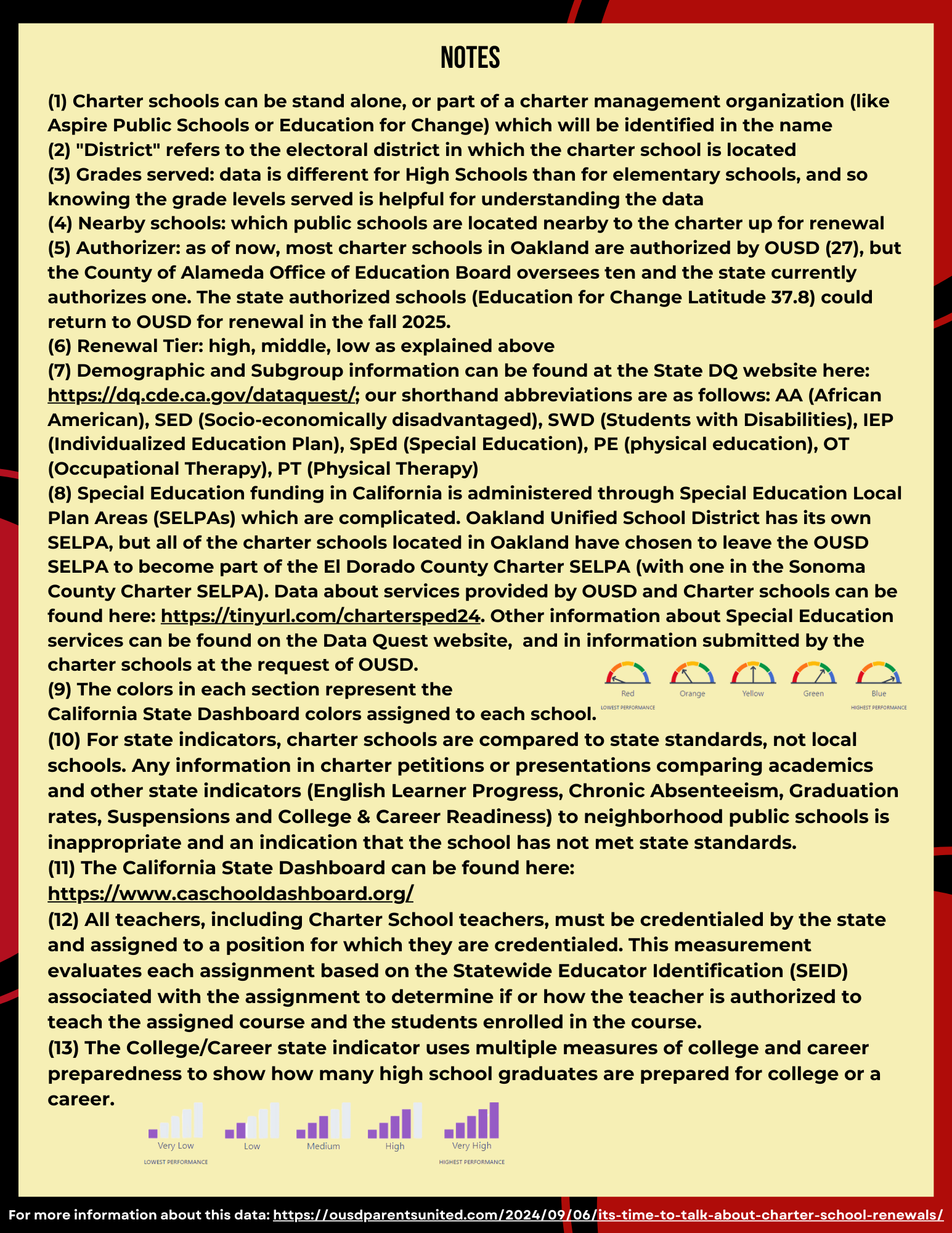
To understand the different pieces of the Renewal Report Card, we have given an explainer and added the below footnotes for additional information. Look for future posts about individual charter school renewal petitions, a deeper dive into the consequences of “failing to serve all students” and the different kinds of analyses used when a charter school has special fiscal or governance issues, or is not serving all students who wish to attend. We will also be digging more deeply into the issues surrounding Special Education, and the impact of the collective failure of charter schools to serve students with the most significant disabilities.
We want to give a special thanks to the Educators for Democratic Schools (“EDS”) Special Education Workgroup for their generous help in gathering and understanding this data. Their collective expertise has been invaluable.
#charterschoolrenewals #ousd #specialeducation
 Parents United for Public Schools