It’s Time to Talk about Charter School Renewals

In years past, California Charter Schools would submit a renewal petition every five years, but new laws and the pandemic changed all that, and all charter schools were given an extension of time of up to 3 years to seek renewal of their charters. That time is now up, and this fall, 13 Oakland based charter schools need to seek renewal of their charters in order to continue operating after the 2024-25 school year.

Since OUSD regained local governing control in 2009, the Charter School Renewal process has been largely opaque and somewhat perfunctory, with most charter schools being recommended for renewal by our prior Charter Office staff, and the board nearly always agreeing with them. This will be the first time that any of our current board members have faced a renewal petition, and among the first to be decided since the passage of AB 1505, which revised charter law, providing additional tools for holding charter schools accountable for serving the same student populations served by public school districts and evaluating the impact of charter schools on their schools.

Although the charter industry tries to blur the lines between charter schools and public schools, there are some very important differences between them, and one is that charter schools operate under a “charter” – a type of contract – that sets out goals and promises about how the charter school will function. If they fail to meet those promises, they should not be renewed for an additional term. The Charter school is exempt from certain Education Code requirements, gains certain flexibility and independence, and “gives charter schools more room to experiment and to come up with instructional and other innovations.” According to the California Charter Schools Association: “In exchange for operational freedom and flexibility, charter schools are subject to higher levels of accountability than traditional public schools.” Part of that accountability is the renewal process, determining whether the school is making progress towards state standards, and is doing it while serving the same groups of students as served by the territorial jurisdiction in which they operate.

Here’s what you need to know about renewals

So far, two charter schools have had a public hearing in front of the OUSD Board (and one at the County board) and if you saw the petition submitted, you would know they are massive. The Aspire Lionel Wilson Prep petition attached to the agenda was 1,517 pages long. The charter law (California Education Code sections 47605 et seq) is also long and can be difficult to understand. As the OUSD Board of Education prepares to decide whether to renew or not renew the 9 charter schools expected to come before them this fall, we will be running a series of blog posts about the process, starting today. We will provide information about the renewal process, as well as snapshots of each school and the relevant data, so that the Oakland community can make sense of what often feels like an overly technical and not very accessible renewal process.

Charter schools up for renewal are placed into one of three categories by the state, and the standards for renewal are different dependent on the assigned renewal “tier”
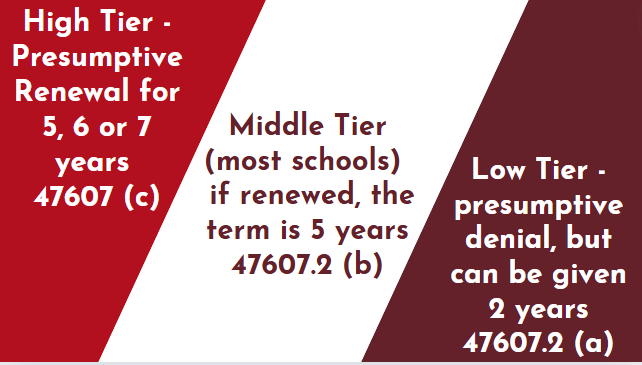
For our purposes, how the state decides which renewal tier to assign each charter school is not really important, but if you are interested in learning more about this process, the California Department of Education website has more information. A charter school is determined to be “High performing” or “Low performing” through a formulaic assessment by the state, and all other schools are then deemed “Middle tier” by default. Most charter schools up for renewal this year are middle tier schools, and so we will primarily focus on those schools.

The High and Low tier schools are as follows:

  • High tier: American Indian Public Charter School II
  • Low tier: LPS R&D Oakland and Urban Montessori (county authorized)

High tier schools are generally presumed to be eligible for renewal for 5 to 7 years as the board decides (although there are exceptions to that rule which will become important this year). Low tier schools are presumed to be non-renewed, but the board can decide to renew for 2 years if they want to. Middle tier schools can only be renewed for 5 years, and because of the very nature of being neither high nor low performing by state standards, will have data that will suggest renewal and data that will suggest non-renewal, and it is up to the authorizing board (not the district staff) to make the decision as to whether to grant that new five year term.

Charter School Renewal Report Cards – our distillation of the information that OUSD will be considering when deciding whether or not to renew a middle tier school

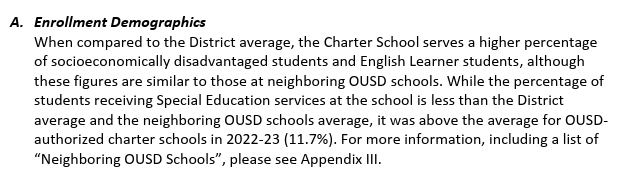
In order to simplify what seems a complicated process, Parents United will be creating Renewal Report Cards for each of the charter schools up for renewal this year. It’s not easy to distill a 1,500 page petition, an academic performance dashboard, disaggregated demographic and subgroup data and charter submitted information into a two-page Renewal Report Card, but we have tried to provide an overview and significant highlights to help Oaklanders understand the Renewal process better. Here is our “explainer” for what that data represents:
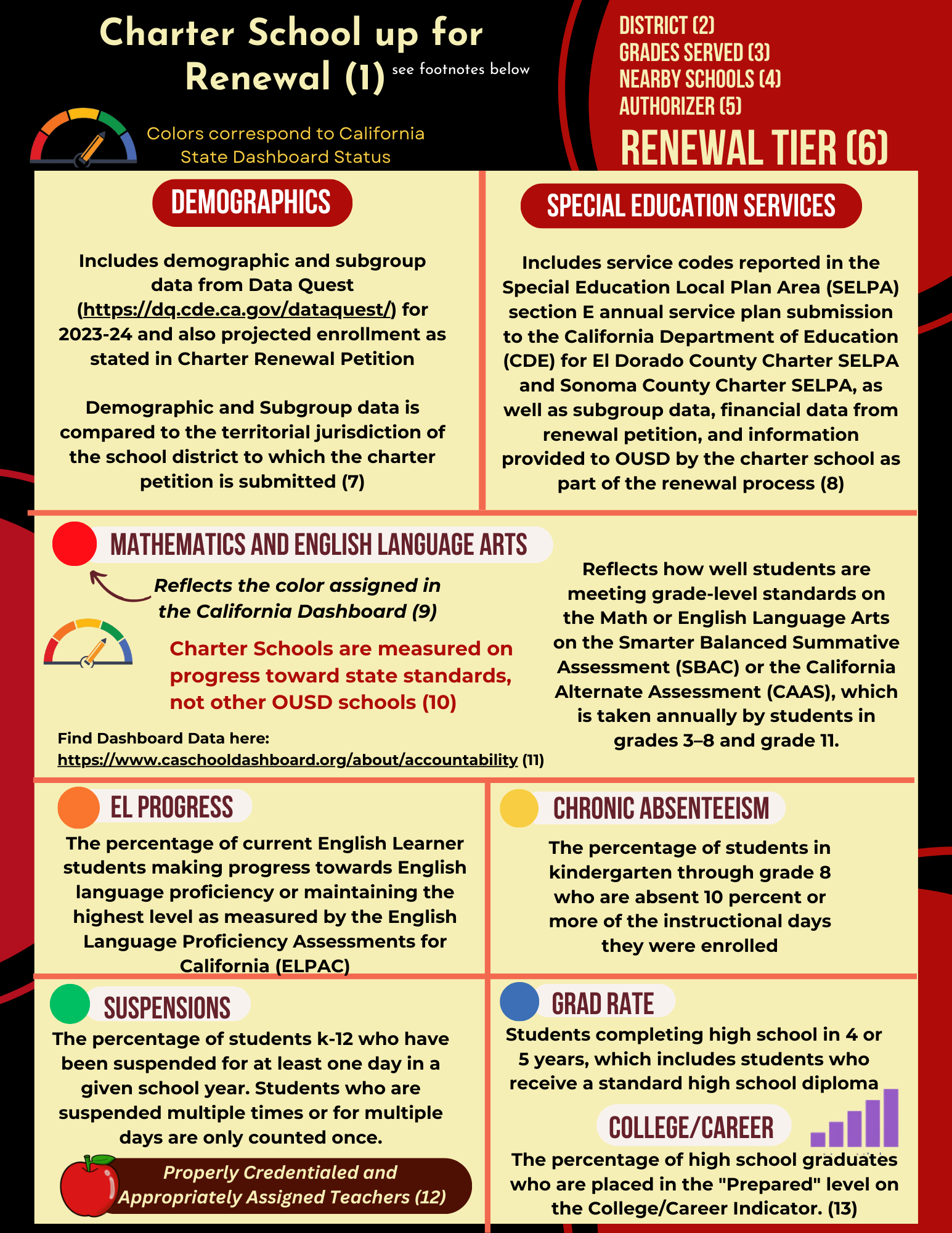
Most of the data comes from the California State Dashboard and it is really important to remember that charter schools are not evaluated by how they are performing compared to the local public schools, they must meet the promises in their charter and make progress towards the State standards, and that is the only appropriate comparison. It is only when looking at Local indicators, including whether the charter school serves all students, that we consider local data. When a charter school compares its academic data to neighborhood public schools, they are doing that to distract from the fact that they are not meeting state standards.

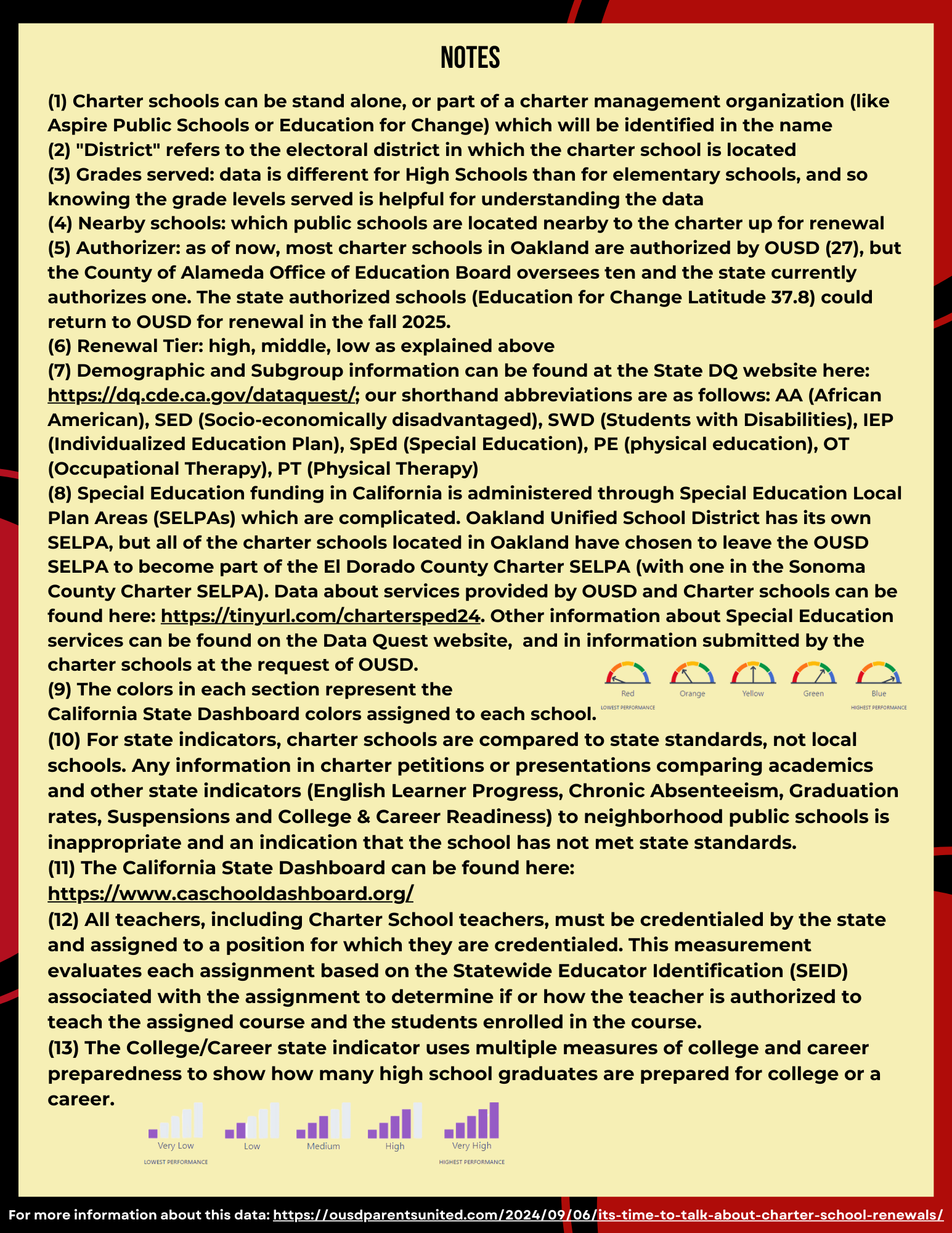
To understand the different pieces of the Renewal Report Card, we have given an explainer and added the below footnotes for additional information. Look for future posts about individual charter school renewal petitions, a deeper dive into the consequences of “failing to serve all students” and the different kinds of analyses used when a charter school has special fiscal or governance issues, or is not serving all students who wish to attend. We will also be digging more deeply into the issues surrounding Special Education, and the impact of the collective failure of charter schools to serve students with the most significant disabilities.

We want to give a special thanks to the Educators for Democratic Schools (“EDS”) Special Education Workgroup for their generous help in gathering and understanding this data. Their collective expertise has been invaluable.
#charterschoolrenewals #ousd #specialeducation

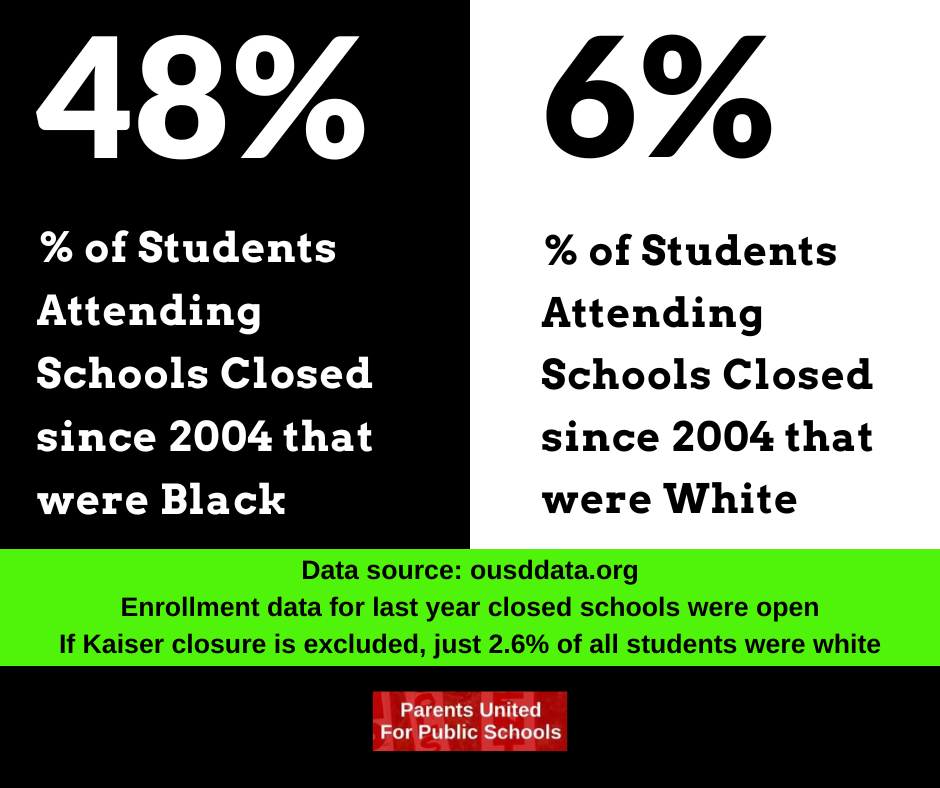
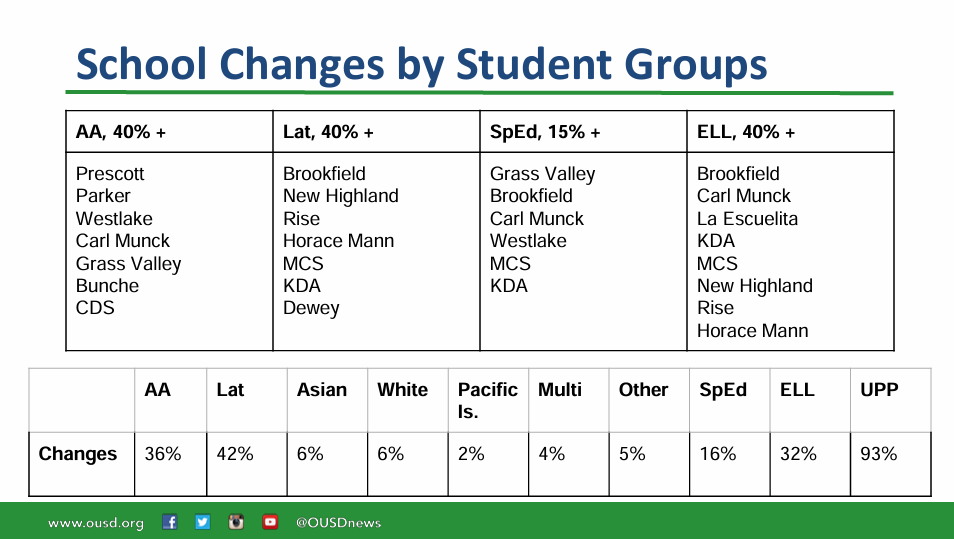
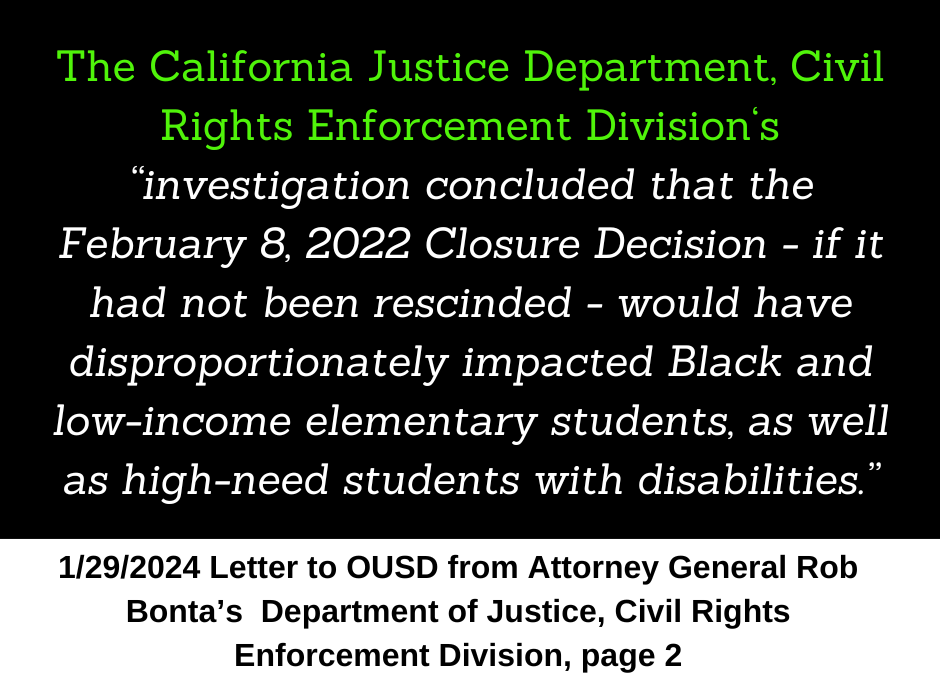
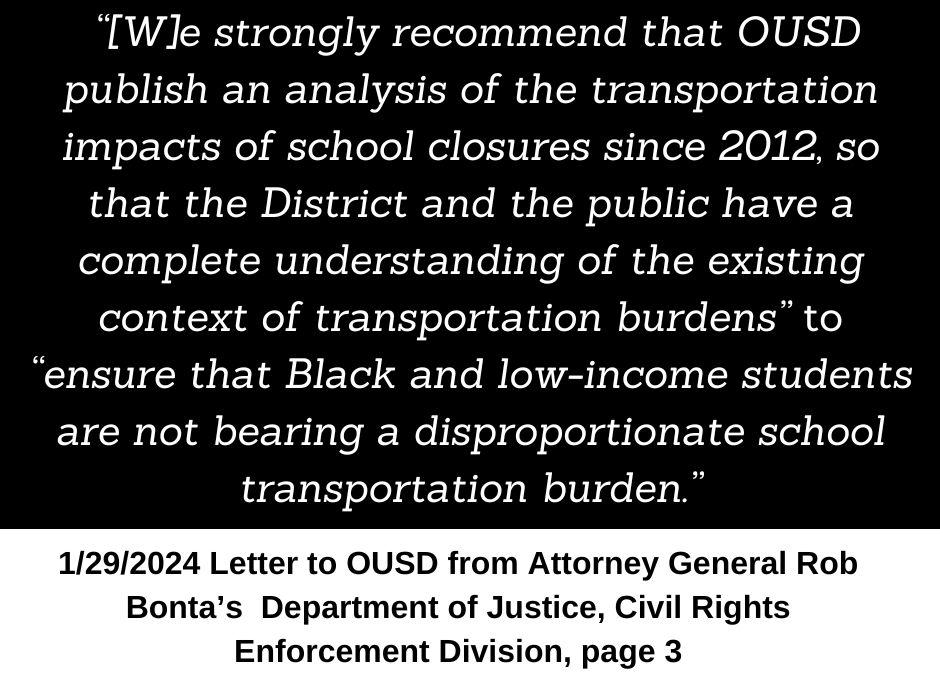
The California AG has concluded that Oakland Unified’s school closures have disproportionately harmed Black and Disabled students, and issued very specific guidance to OUSD about how to avoid repeating that harm in the future. Will OUSD listen to that advice as they push forward with mergers, consolidations and closures in future?

Justice for Oakland Students Graphic regarding School closures from 2004 to 2017

OUSD has a long history of school closures in Black communities that have accelerated gentrification and resulted in disproportionate harm to Black students.

Oakland Unified School District (“OUSD”) has closed many schools over the past twenty years, following a pattern of using so called “Sustainability” metrics: utilization and enrollment data. In a 2004 discussion about school closures, former school board member Gary Yee articulated that “[t]he primary concern for any school site reutilization was that the school is effective and relatively inexpensive to run.”1 That philosophy reinforced racist and ableist patterns and behaviors and resulted in the devastation of the Black student population in OUSD over time.

In February of 2022, the OUSD board voted to close schools over two years, again using the same kind of “Sustainability” metrics as the selection criteria, and once again disproportionately harming Black, low-income and Disabled students.

AB 1912 and the AG investigation grew out of the February 2022 closure decision, and led to the currently proposed Equity Impact Metrics to be presented to the board this week for adoption.

In response to the closure decision, the American Civil Liberties Union (“ACLU”) filed a complaint2 with the California Attorney General (“AG”) alleging that the school closures violated the constitutional and statutory civil rights of Black students in OUSD. The AG opened an investigation into the closures sometime in 2022, and Assemblymember Mia Bonta authored a law (“AB 1912”) requiring an equitable process before deciding to close schools.3 In January, 2023, a newly elected OUSD Board majority rescinded the closure decision for those schools set to be closed in June, 2023 and then voted to “merge” 10+ schools at the end of the 2023-24 school year as part of their budget development, which triggered the need for the AB 1912 equitable process.

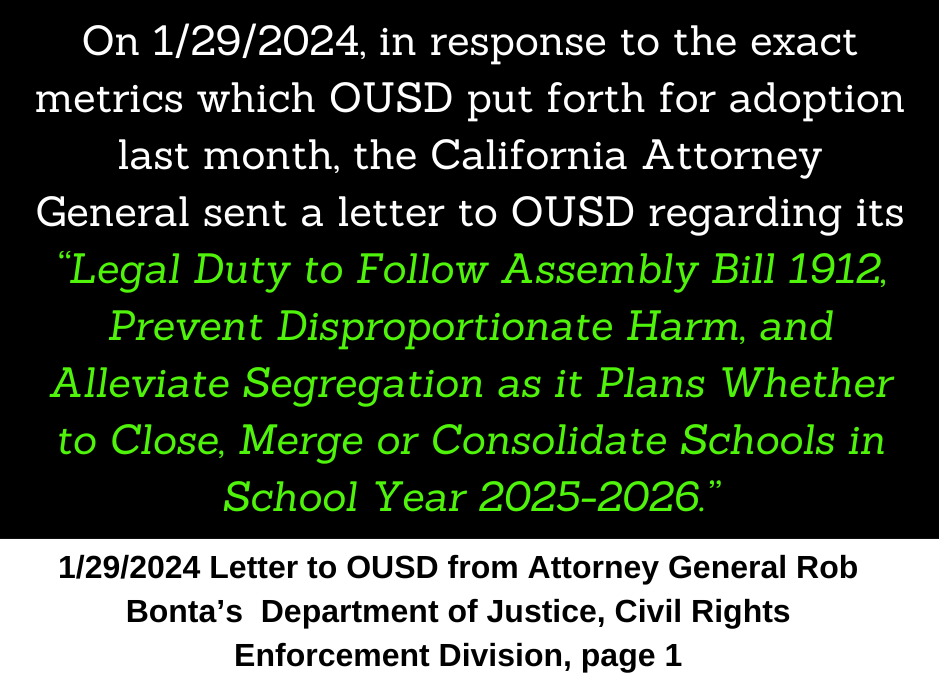
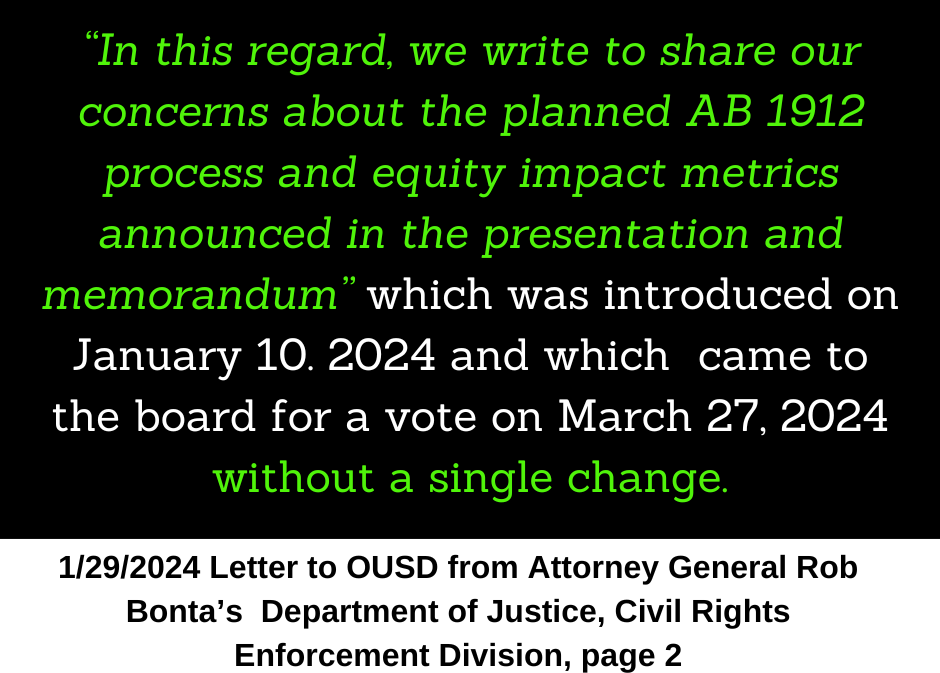
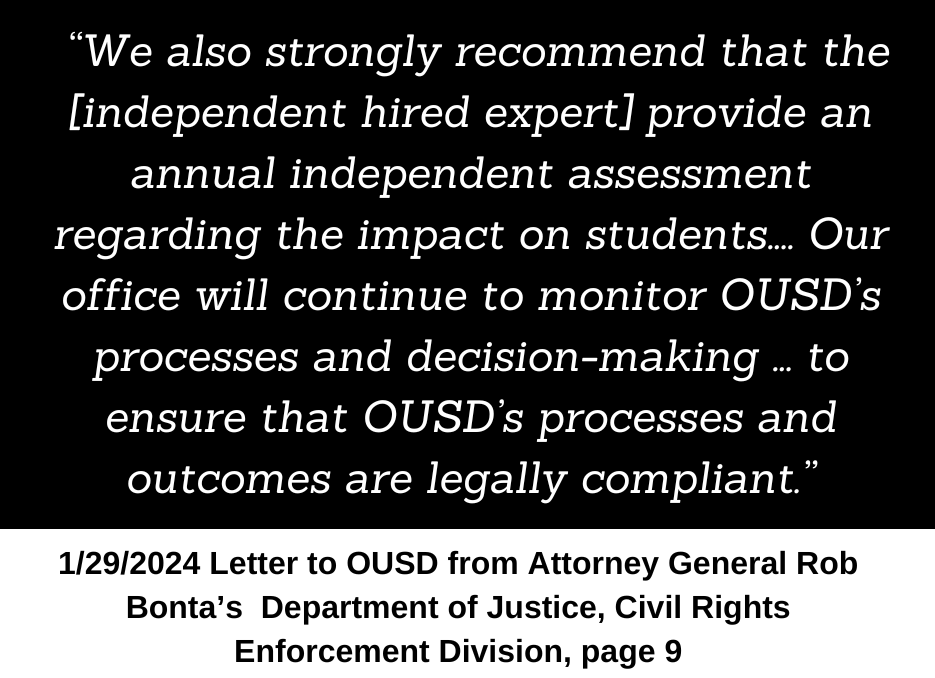
OUSD staff presented the Equity Impact Metrics to the Board January 10, 2024 including the same racist and discriminatory “Sustainability” metrics that have been used since 2004, which resulted in a letter from the AG’s office dated January 29, 20244 outlining the AG’s concerns with those metrics. After failing to adopt the identical metrics on March 27, 2024, the OUSD State appointed Trustee warned the board that because they failed to take the steps necessary to “merge” 10+ schools as promised in the 2023 budget resolution, the Trustee would not allow them to negotiate compensation increases for OUSD union employees. In response, Board President Sam Davis has scheduled a vote on a revised set of metrics this Wednesday, April 10th.

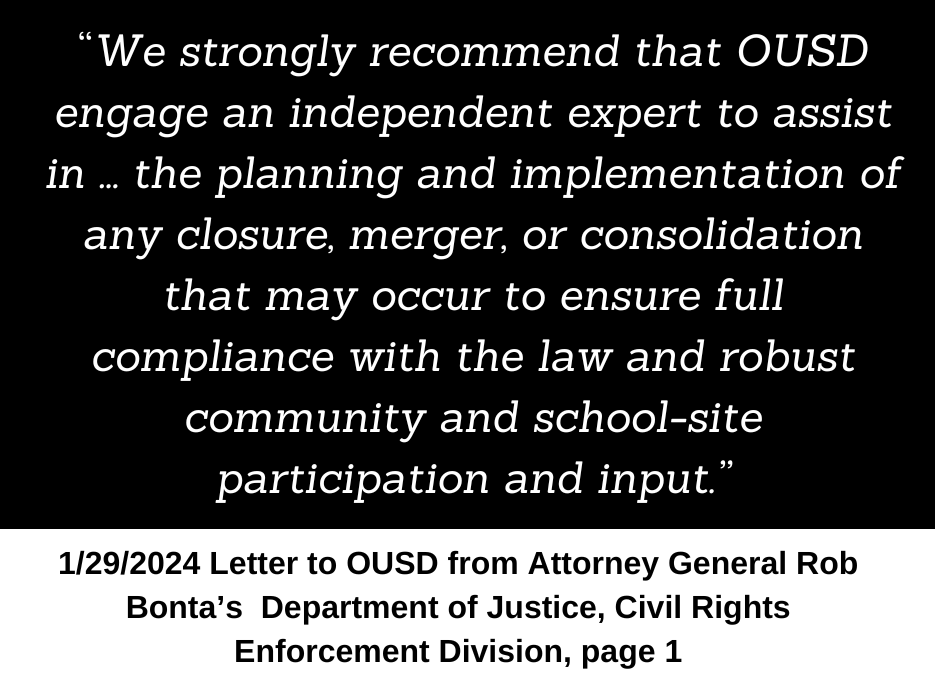
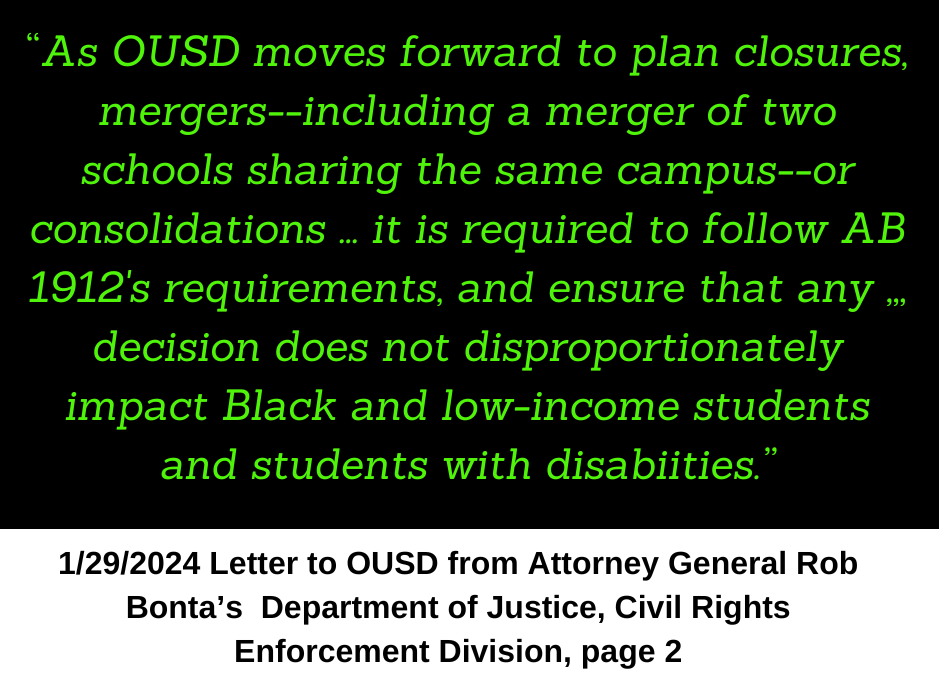
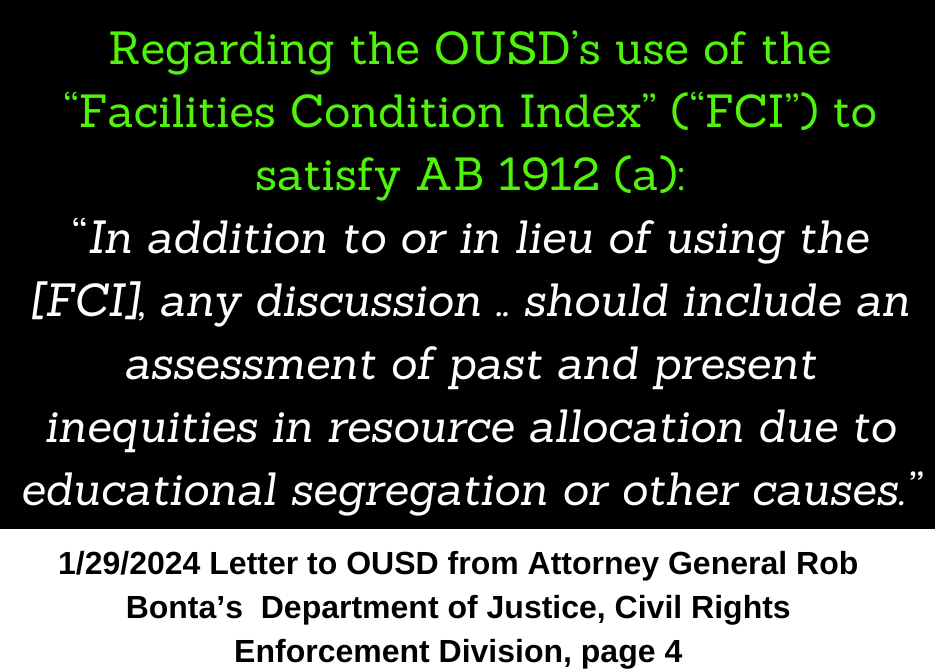
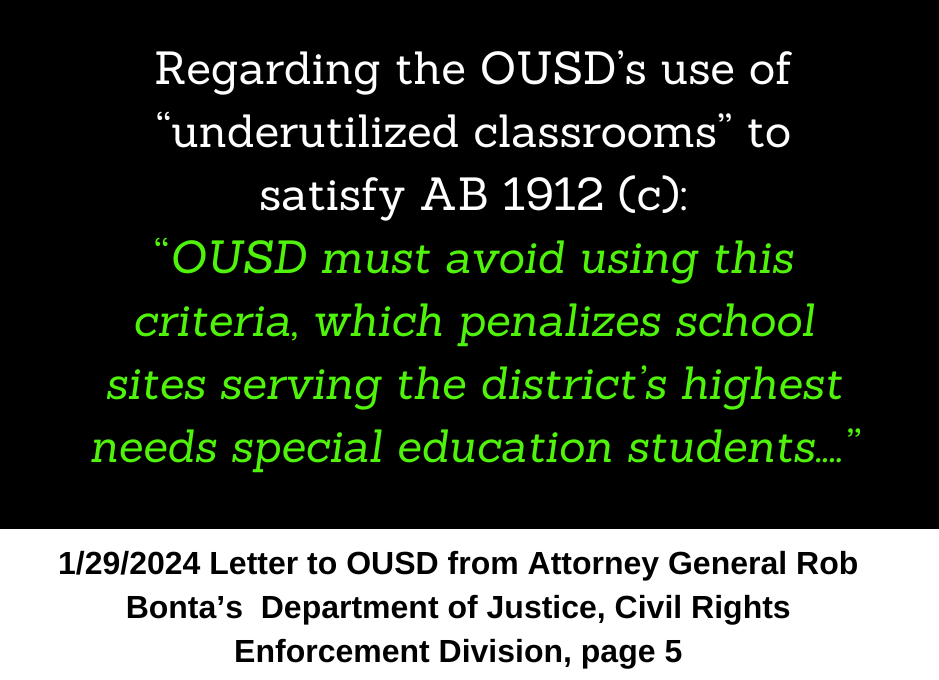
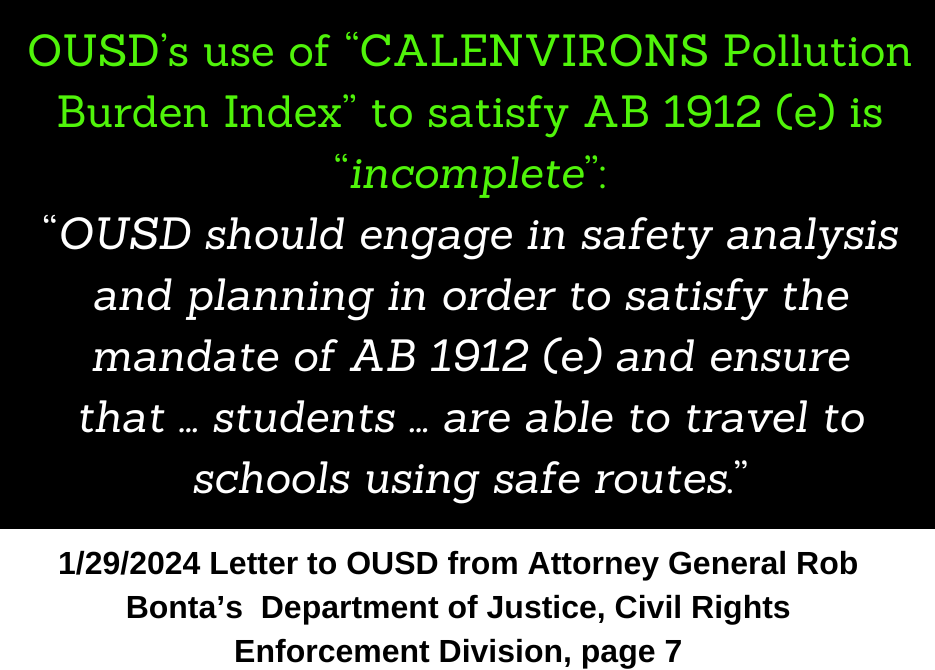
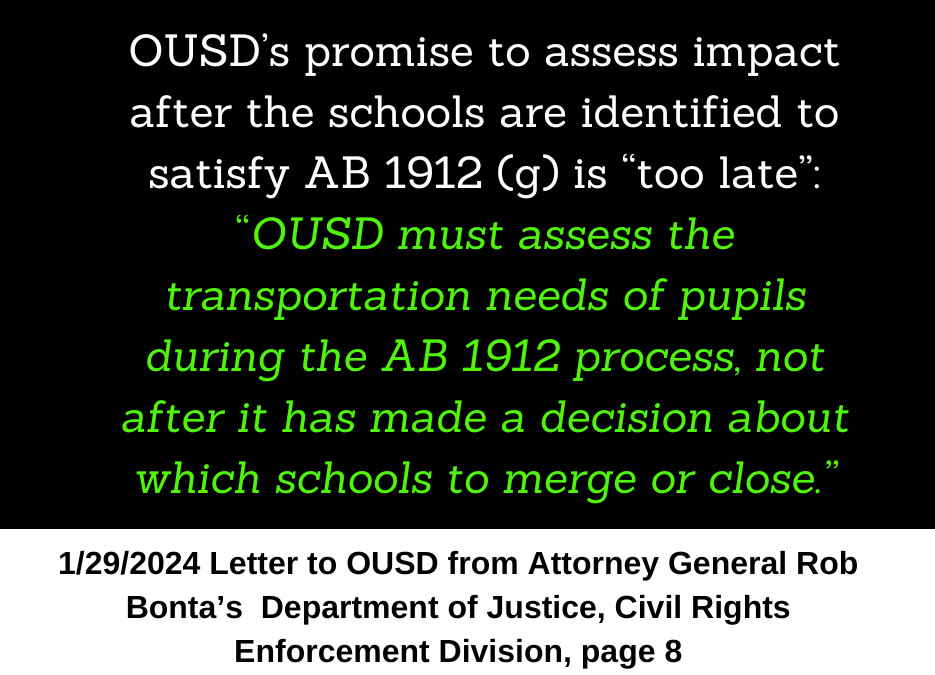
What guidance did the AG provide to OUSD? We summarized it so you don’t have to.

So what does the AG have to say about the SPECIFIC metrics that OUSD is proposing?

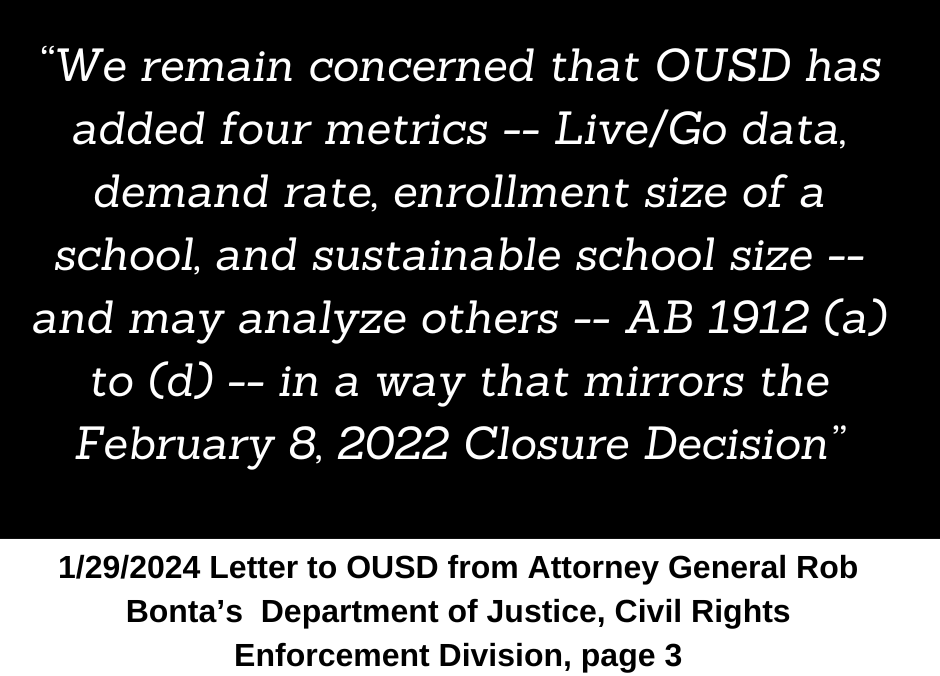
We are grateful to staff and the Board for removing the four “Sustainability” metrics from the proposal that the AG made clear would repeat the same disproportionate harm as in past years. But the proposed metrics also include other metrics that the AG found problematic or incomplete. The Board should heed the following advice from the AG.

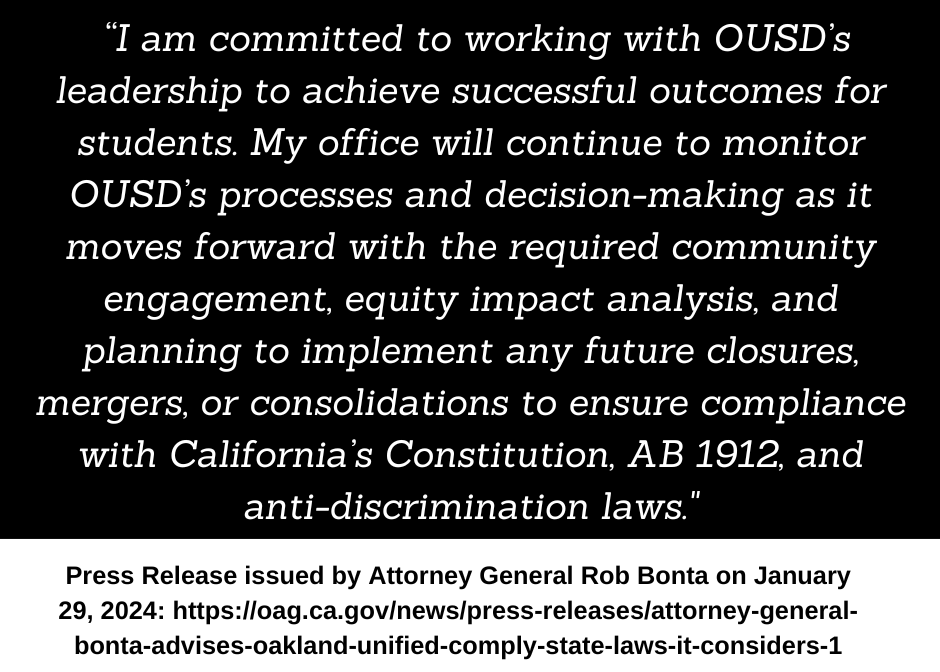
The AG will continue to monitor OUSD as they plan for mergers next year, and any closures or consolidations in the future. OUSD MUST ensure that they take actions that are constitutional, legally compliant, and repair harm to Black and Disabled students rather than replicate it.

We urge the board to make additional changes to the metrics necessary to ensure that they comply with the constitution, the law and the guidance of the California Attorney General. We also urge them to mandate a robust and transparent community input process throughout any decision-making or implementation process.

  1. OUSD board minutes 1/4/2004 ↩︎
  2. https://www.aclunc.org/sites/default/files/2022.04.11_J4OS_Complaint_to_AG%20Bonta_re_OUSD_Closures.pdf ↩︎
  3. https://oag.ca.gov/system/files/media/letter-school-districts-school-closures-04112023.pdf ↩︎
  4. https://oag.ca.gov/system/files/attachments/press-docs/CalDOJ.LettertoOaklandUnifedRePotentialClosures.1.29.24.final_.pdf ↩︎

Lighthouse Charter School wants to increase its enrollment despite its long history of failing to serve Black students. Why is OUSD letting them do it?

Charter Schools must serve all students in a way that is reflective of the population of the district as a whole

Under California law1 charter schools must serve a representative population of students, and the plan to do that is a required element of its charter petition as described here: “The means by which the charter school will achieve a balance of racial and ethnic pupils, special education pupils, and English learner pupils, including redesignated fluent English proficient pupils, as defined by the evaluation rubrics in Section 52064.5, that is reflective of the general population residing within the territorial jurisdiction of the school district to which the charter petition is submitted.”2. Although OUSD has not historically used this as a ground for denying a charter renewal or material revision, former Executive Director of the OUSD Charter Office Sonali Murarka made clear in June, 20203 that OUSD would expect charter schools to fulfill that promise moving forward, and that the failure to increase enrollment of identified groups could in fact result in the denial of renewal petitions, and by extension, material revisions, based on the fact that the plan identified in the charter hasn’t resulted in a balance of students and that therefore “the plan is not reasonably comprehensive” under Ed Code section 47605(c)(5). A charter school that is subject to denial on this basis is also subject to denial under section 47605(c)(2) because the charter school is “demonstrably unlikely to successfully implement the program set forth in the petition” given that the plan to balance student groups is a required element of the charter petition. If the plan is not reasonably comprehensive, the required element is not met. Each of these sections could therefore be the basis of the denial of a renewal petition or material revision.
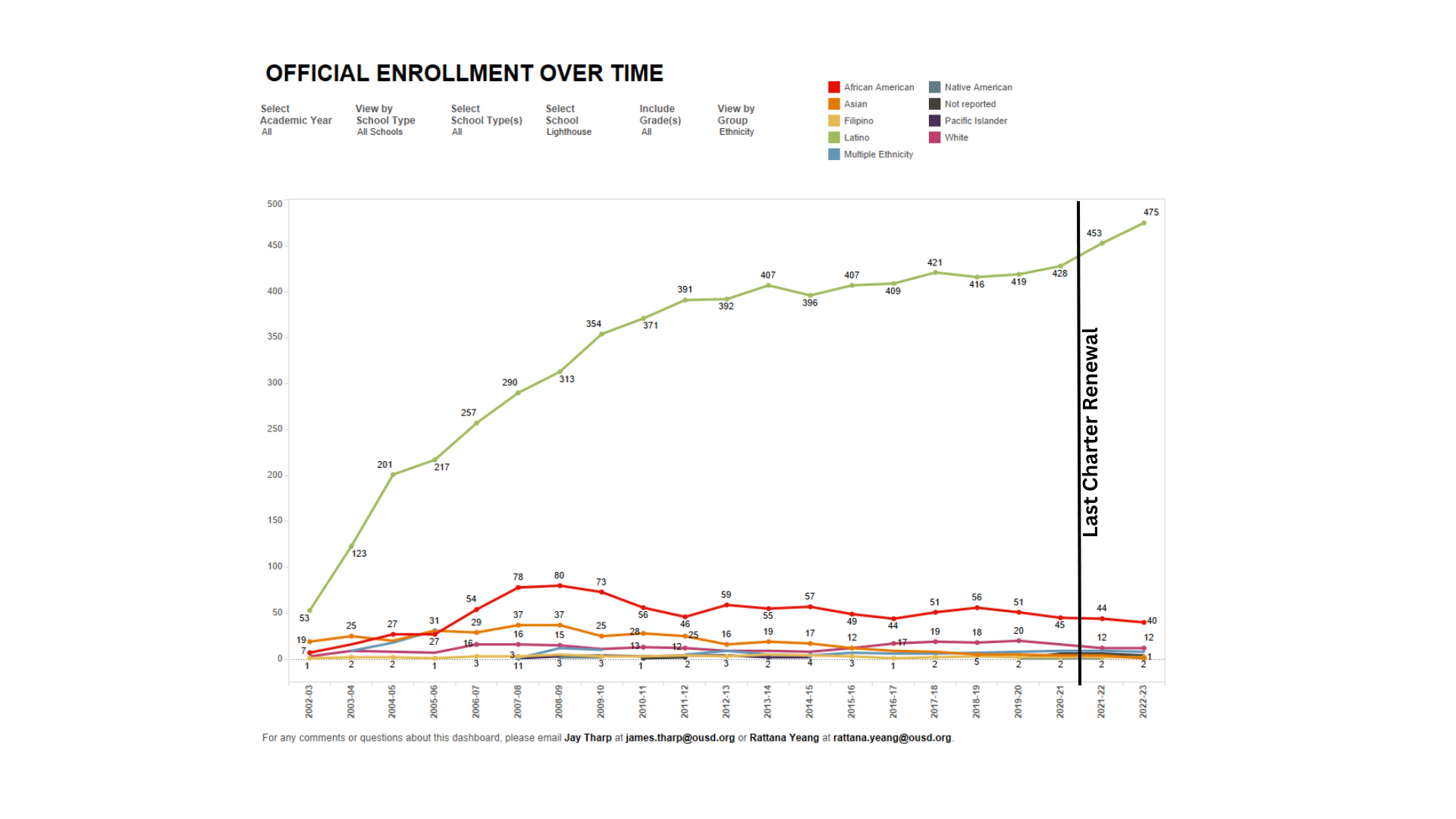
Lighthouse Charter School has consistently failed to enroll Black students over the last several charter terms. That finding is sufficient to deny the material revision sought here

According to the OUSD Staff presentation on the board’s agenda tomorrow night, Lighthouse Charter School K-8 (“Lighthouse”) serves the following student populations:

Shockingly, although OUSD as a whole serves nearly 3 times more Black students (as a percentage of overall enrollment) than Lighthouse, OUSD staff did not even note this discrepancy in its findings, focusing instead on low-income students, English Learners and students with disabilities:

This failure to even mention Lighthouse’s underenrollment of Black students is particularly problematic given the acknowledgment in 2020 by Lighthouse staff that OUSD had pushed them “to increase their enrollment of Black students” over the last several charter terms and asserted that their new enrollment priorities would address this disparity. Lighthouse staff stated that they were “certain” that their plan to achieve that balance would result in an increase in Black student enrollment during their charter term.4 That has not happened. In fact, enrollment of Black students, who have been consistently underrepresented at Lighthouse, has continue to decrease since the last renewal. The plan that Lighthouse identified in its renewal charter has not resulted in the required balance of students, and therefore the plan is not reasonably comprehensive under the charter law. That finding alone is sufficient for OUSD to deny the material revision.

OUSD should not reward Lighthouse with additional opportunities to NOT enroll Black students

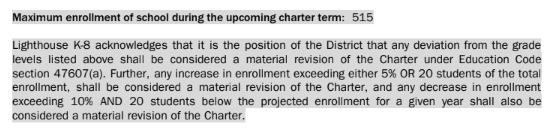
There has been much discussion about whether Lighthouse needs to seek this material revision to add Transitional kindergarten (“TK”) classes, but that is not relevant. TK is not a separate grade level from kindergarten, and so Lighthouse does not need a material revision to add TK classes. Lighthouse must seek a material revision because they are seeking to increase enrollment by 65 students over the maximum enrollment set forth in their charter petition. Language in that petition makes clear that any enrollment exceeding either 5% or 20 students above the maximum enrollment requires this action:

OUSD previously denied a Material Revision to add enrollment filed by Aspire ERES in 2021, choosing there to use Ed Code sections 47605(c)(7) and (c)(8)5, but for some reason the OUSD staff failed to do this analysis here. It should have, and staff should explain why they failed to use those sections of the charter law in considering this material revision.6 But the OUSD board can still deny this material revision based on sections 47605(c)(2) and 47605(c)(5)(G) as set forth above.

Lighthouse, by its own admission, is not serving Black students in a way that is reflective of the community as a whole. OUSD has made a commitment to ensure that OUSD authorized charter schools serve all student groups in the community. If OUSD were to grant this increase in enrollment for Lighthouse, with the same inadequate plan to balance student groups in place, we can expect more of the inequitable exclusion by Lighthouse of Black students. The OUSD board must not reward Lighthouse for bad enrollment behavior by giving them the opportunity to further fail to enroll Black students. The OUSD board must be consistent in its commitment to ensuring that charter schools are serving a representative population of Oakland. We call on the OUSD board to deny the Lighthouse Material Revision and require that Lighthouse return to its maximum enrollment of 515 in the fall.

  1. California Education Code section 47605 et seq ↩︎
  2. Ed Code section 47605(c)(5)(G) ↩︎
  3. See presentation and video of that discussion here: https://ousd.legistar.com/LegislationDetail.aspx?ID=4650883&GUID=4A0928BE-69F2-4295-926C-92377C356E76&Options=ID|Text|&Search=1505 ↩︎
  4. https://ousd.granicus.com/player/clip/1779?meta_id=631170 ↩︎
  5. These two sections were added in 2020 as part of newly passed AB 1505 and provide additional reasons to deny new petitions and material revisions (but not charter renewals). 47605(c)(7) would be a finding that the “charter school is demonstrably unlikely to serve the interests of the entire community in which the school is proposing to locate” and 47605(c)(8) relates to the fiscal impact on OUSD: “The school district is not positioned to absorb the fiscal impact of the proposed charter school.” ↩︎
  6. There has been some discussion that OUSD has been threatened with a lawsuit by the charter industry if OUSD denies this material revision on this basis. We should not be blackmailed into approvals, and it is unlikely that the threat would be carried out. Aspire is a large charter chain, and they chose not to sue OUSD when OUSD used C7 and C8 to deny in 2021. It is highly unlikely that if OUSD denies this material revision based on the failure of Lighthouse to serve Black students as required by their charter and the law that any entity would argue that they should not be held accountable for that discriminatory action. ↩︎

OUSD is planning “across the board” school site budget cuts that disproportionately harm Black and Brown schools while also using Learning Loss funds to give most of our affluent, whiter elementary schools extra staffing that other schools have to pay for out of their limited (and reduced) site budgets. That is NOT #BudgetEquity!

School budgeting is complicated. Right now, site principals are trying to create budgets for their schools from a “one pager” – the budget document created every January for each school showing how much money and staff that they will receive in the following year1. We know, because the board approved budget “adjustments” for 2024-25 as part of last year’s long-term budget planning2, that school sites will lose $10 – 20 per student (dependent on grade level) in “base” funds, and also $110 per student in “Supplemental” funds received based on their Unduplicated Pupil Percentage (“UPP”)3. UPP is measured by counting the number of low-income students, English learners and Foster Youth in a school community and converting that to a percentage4. It is easy to understand how cutting the Supplemental funds across the board disproportionately harms the primarily Black and Brown students who generate the Supplemental funds in the first place – the more wealth in a school community, the smaller the cut.

But it is also true that “across the board” cuts in Base (per pupil) funding disproportionately impacts lower income communities who do not have other means to make up the difference.

see citation below

In 2017 when faced with drastic budget cuts, some board members asked for a more “equitable” process than the “across the board” strategy, and staff responded that it was just too difficult:

“Sondra Aguilera, deputy chief of student services for OUSD, told board members Wednesday that this is the “best option.” She said a more tailored approach for cutting the budget at each school would be difficult, in part because some parent-teacher associations raise their own grants but are not required to report those funds to the district. “We began to see this rabbit hole that we were going to go down mapping all the different sources,” Aguilera said. “You can’t possibly map all the different sources that school sites receive.””

https://www.kqed.org/news/11635537/oakland-unified-proposing-9-million-in-midyear-budget-cuts-to-schools

OUSD is willing to implement “across the board” budget cuts which they know disproportionately impact low-income Black and Brown families because it’s harder to figure out how much money PTAs pull in for their schools.5 That is NOT #BudgetEquity.

Given that OUSD understands that “across the board cuts” disproportionately harm Black and Brown schools, why is OUSD giving even MORE of our students’ precious resources to higher income, whiter schools?

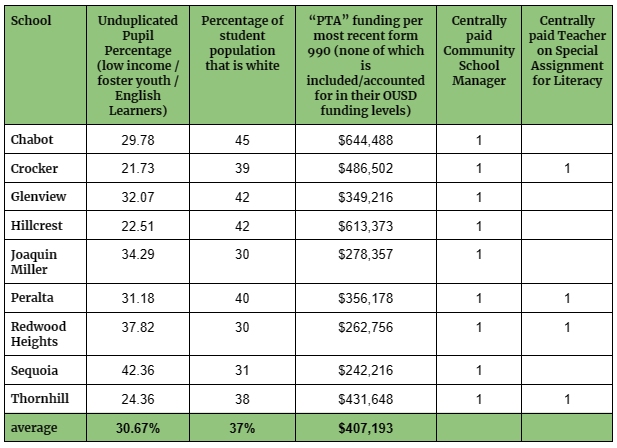
According to the OUSD School Site Funding Profile (“Proposed Budget”) the following wealthy, primarily white elementary schools are receiving “additional centrally provided” Community School Managers (“CSM”) (and a few are also receiving additional centrally provided Literacy Teachers on Special Assignment “TSAs”):

These schools are getting “free to them” Community School Managers despite the fact that they are not community schools6, and do not qualify as community schools per the California Community School Partnership Program (“CCSPP”) grant because their UPP is below the 50% threshold7. In fact, most of the schools on this list fall far short of that UPP and represent 9 of the 10 schools with the highest percentage of white students in OUSD.8 These schools collectively reported nearly $3.7 million in PTA revenue in their most recent disclosures.9

Some OUSD Community Schools receive partial funding for their CSM (about half of the cost) as part of their “enrollment based” staffing, but 10 schools receive no CSM allocation, and so must pay for their CSM out of their discretionary funds – thereby decreasing the amount left for important student services. It is hard to understand why OUSD, when considering which schools to “centrally provide additional” staff to in the most equitable way – a value which OUSD claims to hold at the center of everything they do – decided to provide “free to them” Community School Managers to elementary schools which are not Community Schools (and cannot qualify under CCSPP) instead of providing them to the 10 elementary schools which received NO allocation (not even partial) for their CSM. Given the history of anti-Blackness in OUSD, it is not surprising that 7 of the 10 elementary schools which received no CSM allocation are 7 of the Blackest elementary schools in OUSD10.

OUSD must redo the one pagers to reflect #BudgetEquity by eliminating “across the board” cuts and reallocating “centrally provided staffing” from affluent, white elementary schools to the primarily Black elementary schools which have NO allocation for Community School Managers.

Equity is not just a buzzword, it is enshrined in OUSD Board Policy 503211 which states: “we hold the powerful belief that equity is providing students with what they need to achieve at the highest possible level” and “to interrupt patterns of institutional bias at all levels of the organization”. Continuing to offer disparate and inequitable funding levels to majority Black schools is not interrupting that pattern. The OUSD board must direct staff to revise these and other areas of inequity in the budget to make the changes that are necessary to create #BudgetEquity.

  1. There are three general categories included in the One Pagers: (1) dollar allocations which schools can decide how they want to spend; (2) staff allocations based on enrollment and student population; and (3) centrally provided additional staff placed at the discretion of OUSD staff (which are “free” to the school and in addition to the staffing generally provided to other schools). ↩︎
  2. From a staff presentation to the Budget and Finance Committee on October 12, 2023. https://ousd.legistar.com/View.ashx?M=F&ID=12354388&GUID=E0330B30-D391-4BA3-BB28-C142E0CD19A5 ↩︎
  3. This is part of the “Local Control Funding Formula” (“LCFF”) adopted by California in order to provide more funding to school districts with higher proportions of higher need students. Beginning in 2013-14, school districts would receive equal “Base” funding per pupil, but also would receive “Supplemental” funding for higher need students, and “Concentration” dollars for the highest need students. OUSD, which has a UPP of 77.96% according to 2023-24 adopted budget, receives significant additional Supplemental and Concentration funding generated by its high need populations. For information about LCFF see https://publicadvocates.org/our-work/education/public-school-funding/lcff/ ↩︎
  4. The count is “unduplicated” because each student is only counted once, even if they fall into multiple categories. So if a student is a Foster Youth AND an English Learner, they are only counted one time. ↩︎
  5. That is not quite true. PTAs and similar “tax exempt” parent organizations are required to file federal forms called 990s that identify how much revenue is raised, and how that money is spent. You can find them on public websites like ProPublica: https://projects.propublica.org/nonprofits/ ↩︎
  6. There are two other Elementary schools which received this centrally provided additional staff member, Cleveland Elementary and Piedmont Avenue. Each of those schools meets the CCSPP threshold and are not included in this analysis as a result. ↩︎
  7. 50% is the base threshold, but the competitive grant threshold (in practice) was 80% UPP (https://cslx.org/assets/g-files/CCSPP-Grant-QA-V1.pdf). ↩︎
  8. The only affluent, white elementary school not on this list is Montclair Elementary which is 34% white and has an UPP of 29.49%. We are not clear on why only this “Hills” school was not included. ↩︎
  9. See the ProPublica website, ibid. ↩︎
  10. The elementary schools which did not receive a CSM allocation are, including percentage of African-American (AA) or Black students: Burckhalter (50%), Grass Valley (53%), Laurel (31%), Lincoln (9%), Montclair (12%), Carl Munck (43%), OAK (formerly Howard) (44%), Manzanita SEED (11%), Prescott (51%) and Sankofa (36%) ↩︎
  11. https://boepublic.ousd.org/Policies.aspx  ↩︎

It’s just 10 Days out from the Election. We have a clearer (but still incomplete) picture of each District 5 candidate’s finances. Here’s what we know.

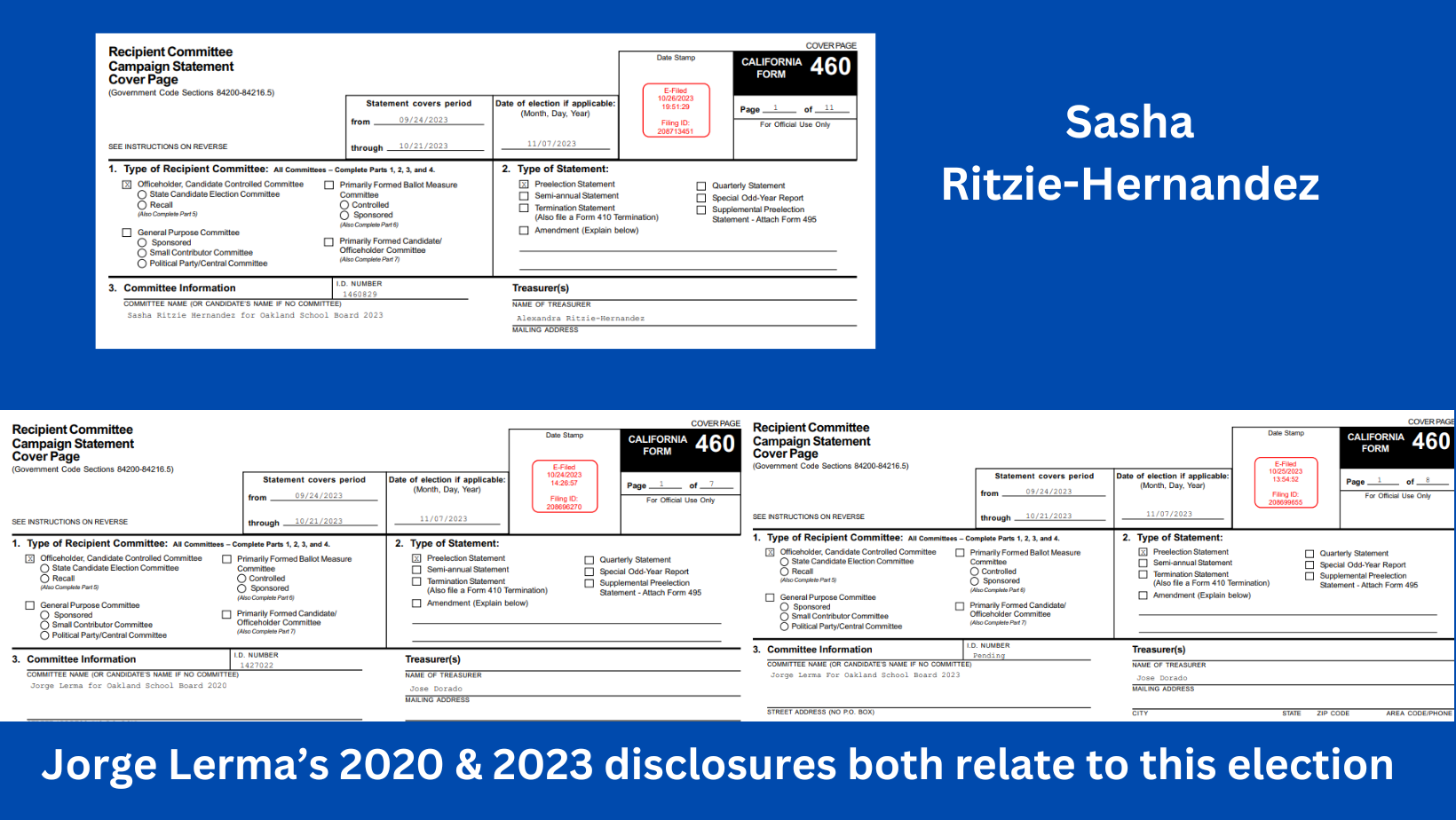
The most recent financial disclosures are in1, and although we have a good idea who is supporting each candidate, there are still some serious problems with Mr Lerma’s disclosures. In short, Mr Lerma continues to commingle funds in his 2020 and 2023 campaigns (which we discussed at length in an earlier post) and is not fully disclosing expenses (more below). We assume that the contributor list is finally complete and up to date, allowing us to understand who is behind each candidate, so we can take a look at that.

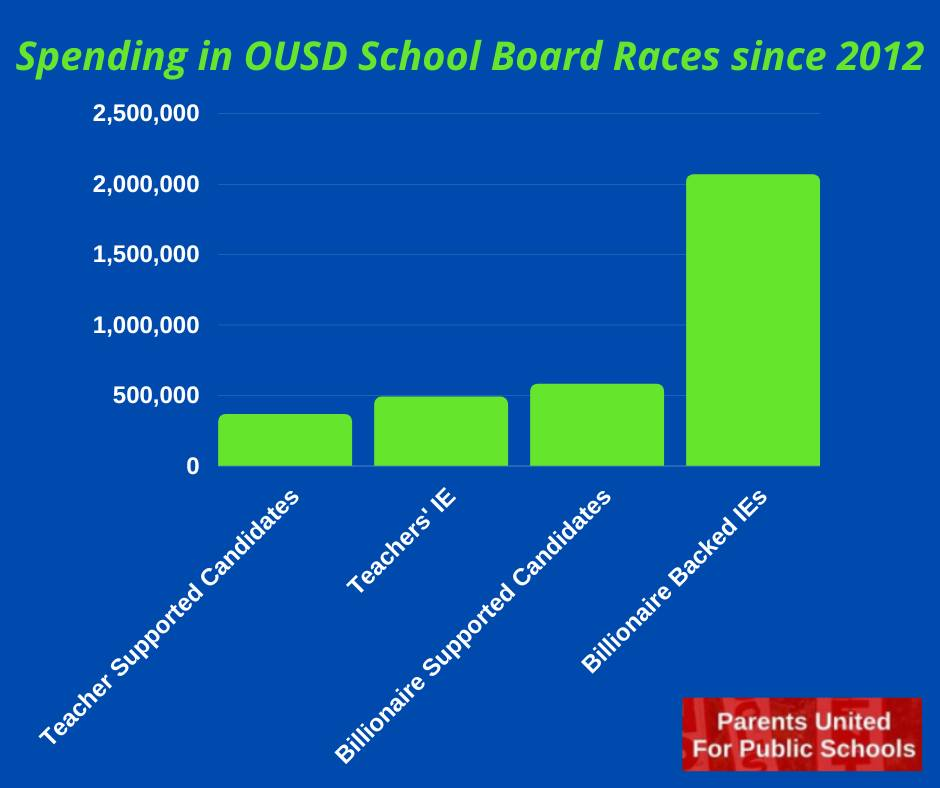
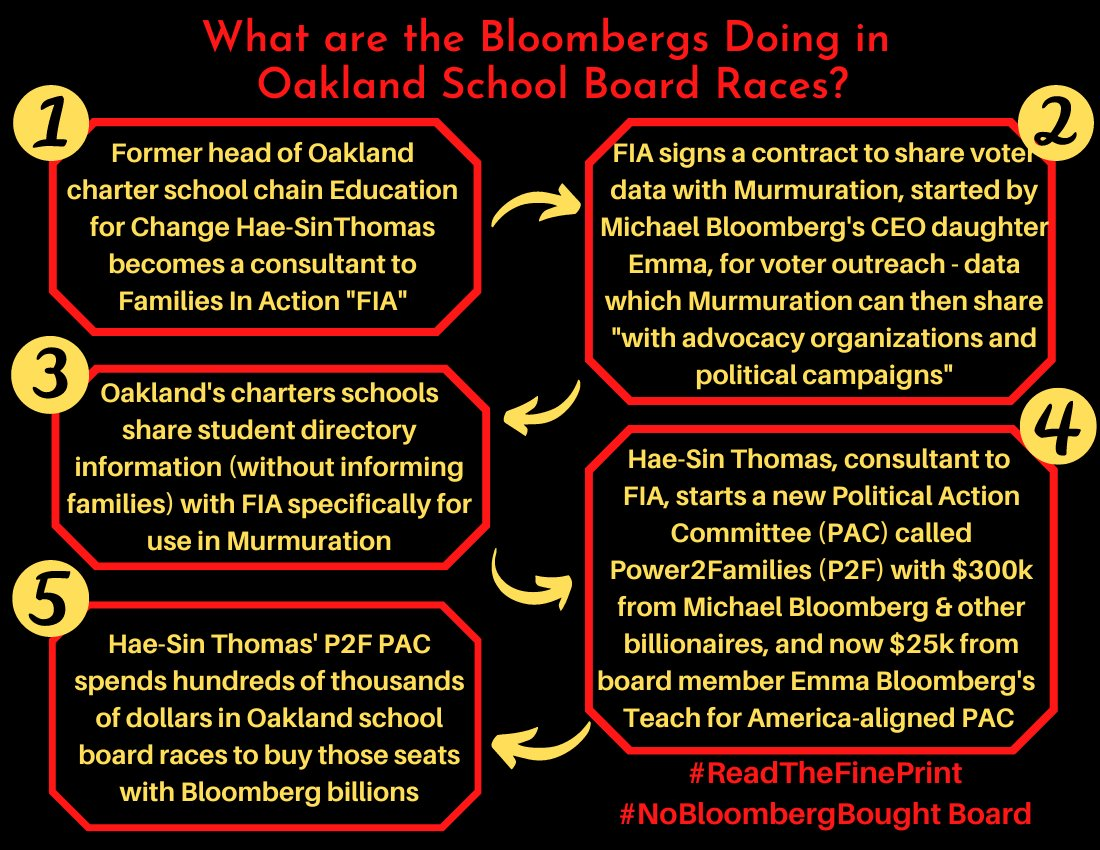
Knowing who is supporting each candidate is important information to help voters determine where the candidates stand on issues that are important them, which is why we #Followthemoney in every school board election. Since 2012, there has been a LOT of billionaire money coming into school board elections from outside of Oakland to support privatization, school closures and charter schools. In response to all that big PAC money, the unions that represent the educators, classified staff and district workers in OUSD have created their own Independent Expenditure committees funded by their workers to support candidates who support the public schools that they work in, and the unions that they belong to.

In 2016, GO Public Schools and the California Charter School Association (“CCSA”) spent an astonishing $785,000 in 4 races (while OEA spent less than $25,000), and the charter backing GO/CCSA slate won all 4 seats. By 2020, the charter alliance spending (flush with $500,000 from former NYC Mayor Michael Bloomberg and more from CCSA) of $678,500 still dwarfed the teacher spending ($250,000), but 3 of 4 teacher backed candidates won seats on the board. It was clear that voters trust their teachers and workers, and do not want out-of-town billionaires deciding what happens in our schools. The charter alliance clearly understood that their super PAC strategy no longer worked in Oakland, and so they have changed tactics. There may still be billionaire backed PAC spending to come late (so as to hide it as long as possible) but in the meantime, the local charter industry supporters have thrown their money directly to Mr Lerma’s campaign.

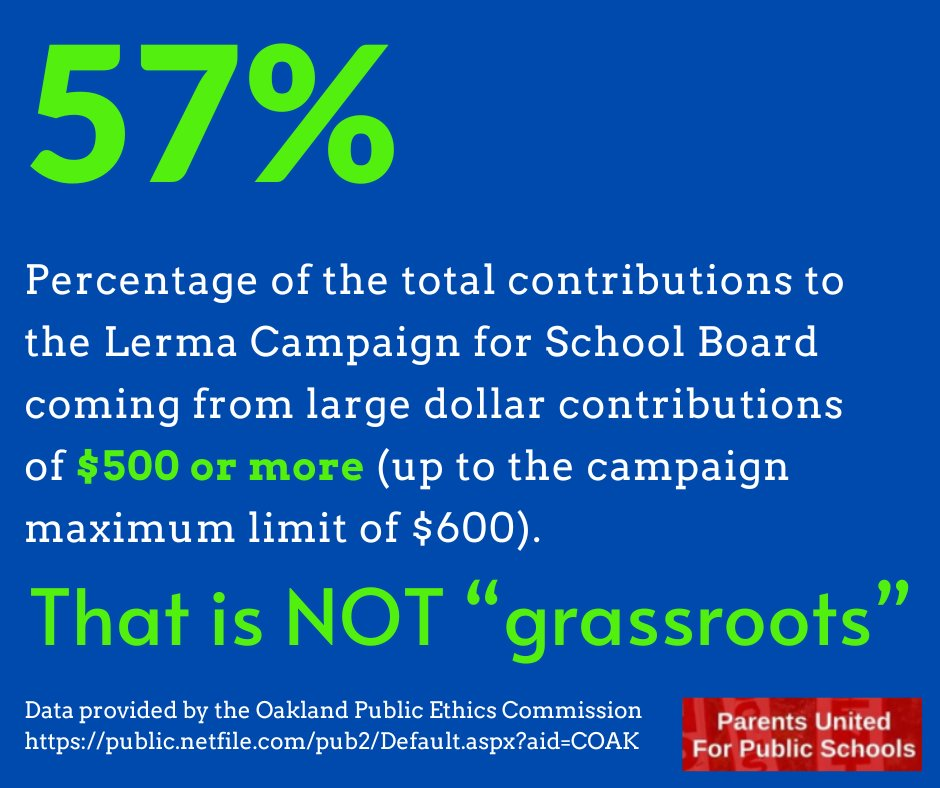
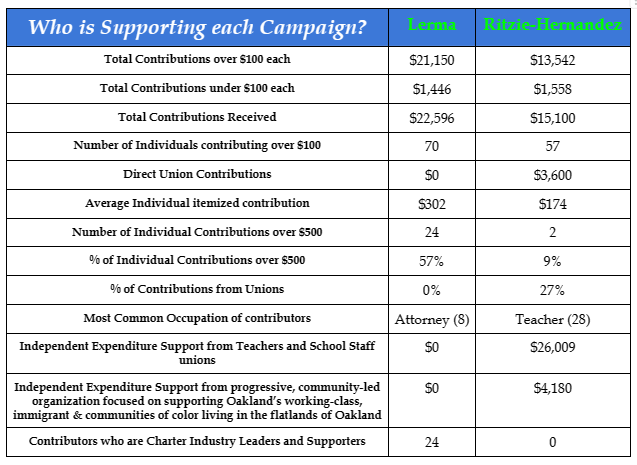
So looking at the numbers, who is supporting each candidate? Mr Lerma has received contributions from 70 plus individuals, $21,150 in enumerated contributions of over $100, with an average contribution amount of $302 per contributor. Mr Lerma also received $1,446 in small dollar donations – those less than $100 which do not need to be itemized. Although Mr Lerma has claimed to be running a “grassroots” campaign2, his contributor list tells a different story.

Mr Lerma has 19 Contributors who donated the maximum allowed amount and 24 who contributed $500 or more (as compared to Ms Ritzie-Hernandez who had 2). One of the new strategies being used by the billionaire backed GO/CCSA crowd is to have its donors contribute DIRECTLY to candidates instead of spending large amounts of money through a PAC, and it is clear that thus far this is the case. It is also possible that in the last ten days leading up to this election these billionaire backed PACs could dwarf all spending that has happened to now. In 2022, $121,000 came in just in the ten days before the election to support the privatization candidates.

Ms Ritzie-Hernandez raised $13,542 total, $3,600 from 3 unions (plumbers, laborers and SEIU classified staff) and 57 individual contributions averaging $174 per contribution, plus $1,558 in small donations. Most of her contributions come from teachers and just 9% of total funds raised came from contributions of $500 or more. Ms Ritzie-Hernandez does benefit from spending by the unions of OUSD teachers and staff as well as the Oakland Rising Action PAC which is “a community-led political organization focused on supporting candidates and issues that drive a progressive agenda for Oakland’s working-class, immigrant and communities of color living in the flatlands of Oakland.3” There is a significant difference between spending by PACs which are fully funded by out of town billionaires like Michael Bloomberg and Stacy Schusterman who know nothing about Oakland’s kids, and spending by local unions and progressive groups who work every day with Oakland students and families.

It is clear that both Ms Ritzie-Hernandez and Mr Lerma have roots in the District 5 community. Mr Lerma ran for school board in 2020 (when he was not the chosen charter industry candidate), and ran a much more “grassroots” campaign with just 7 contributions over $500 and just 2 GO major donors. Interestingly, just 5 contributors from his 2020 campaign chose to contribute this time around. This time, it is clear that the billionaire-backed charter industry believes that Mr Lerma is aligned with them on school closures and charter schools, and that is alarming. That is why it is so important to know who is funding his campaign, and why his delay in reporting was so troubling.

We appreciate that Mr Lerma’s campaign filed his 460s in a timely manner in this second reporting period, but there are still some very concerning ethical problems with his filing. As we have previously reported, Mr Lerma continues to use his 2020 campaign to raise funds, despite (finally) having a bank account for the 2023 campaign to collect them. To this day, his campaign “donate” button still uses the 2020 campaign FPPC number, contrary to law. Commingling of funds is absolutely prohibited and makes it impossible to accurately track campaign spending. We are concerned that Mr Lerma is not able to manage his campaign finances, which does not bode well for his ability to manage an $800 million district budget.

Even more concerning, however, is his continued failure to fully disclose his expenditures. We don’t know everything that Mr Lerma has spent money on, but we do know that he failed to disclose the expenditures for at least two mailers that went out to voters in the relevant period. This is not a small oversight, a forgotten receipt, this is likely thousands of dollars for printing and postage that do not show up on his reports, either as a payment, or an amount due. This is truly astonishing and reinforces our concerns about Mr Lerma’s ability to lead District 5 in a way that is competent, ethical, transparent and accountable to students.

If you live in District 5, please vote. You should have received a ballot in the mail, with just this one item on it, which you can fill out and return in the mail (no postage needed) by November 7th. You can also drop your completed ballot at one of two drop boxes (Peralta Hacienda and Cesar Chavez Library4). Finally, starting October 28th, you can vote in person in just one location: Think College Now Elementary School, 2825 International Boulevard. In person voting ends at 8 pm November 7, 2023. #vote

  1. All campaign expense data is taken from the Oakland Public Ethics Commission site found online at https://public.netfile.com/Pub2/Default.aspx?focus=SearchName ↩︎
  2. See for example https://archives.kpfa.org/data/20231025-Wed1430.mp3 ↩︎
  3. https://oaklandrisingaction.org/about/ ↩︎
  4. 2496 Coolidge Avenue, 3301 E. 12th Street ↩︎

Here is everything we now know about OUSD District 5 candidate Jorge Lerma’s campaign finance violations, and why it matters.

Spoiler alert: Mr. Lerma illegally used his failed 2020 campaign to solicit contributions and make expenditures for his 2023 campaign in an attempt to hide who is financing his campaign.

TIMELINE

  • 7/25/2023: Mr. Lerma filed his Candidate Intention Statement (form 501) for the 2023 special election for Oakland School Board, district 51
  • 8/11/2023: Date that the qualification threshold of $2,000 in campaign activity is met, starting the clock on the ten-day window to file a Statement of Information (form 410) for the 2023 campaign (but the form 410 wasn’t filed until 10/12/2023 – two months late)2
  • 9/7/2023: Mr. Lerma hosts a campaign mixer fundraising event with a link to donate and a note that says “Paid for by Jorge Lerma for Oakland School Board 2023 FPPC#1427022“, which is the Fair Political Practices Commission (“FPPC”) number from the 2020 campaign. This event was attended by former board members Gary Yee and Jumoke Hinton as well as charter industry leaders Kimi Kean and Hae-Sin Thomas, who were affiliated with the Bloomberg/Schusterman funded super PAC that spent hundreds of thousands of dollars on past school board campaigns3 4
  • 9/19/2023: Libby Schaaf hosts a fundraiser for the 2023 Campaign, attended by various former politicos and charter industry leaders5
  • 9/21/2023: Mr. Lerma or his experienced treasurer (a tax accounting professional who acted as treasurer for the 2020 campaign, as well as the 2016 re-election campaign of Oakland City Council Member Noel Gallo) transferred $12,927.15 in 2023 Campaign funds illegally collected using the 2020 Campaign committee from the 2020 account into the 2023 Campaign account (which demonstrates that Mr. Lerma knew that he could not just use his 2020 Campaign for the 2023 Election)6
  • 9/28/2023: Date that every candidate for office in November must file a form 460 identifying all contributions and expenditures made between July 1 and September 23 – Candidate Sasha Ritzie-Hernandez files as required, Mr. Lerma does not file for either the 2020 OR the 2023 Campaign. If he had a good faith belief that he could use his 2020 campaign for the 2023 election, he would have filed the 460 for the 2020 campaign (showing all of the expenditures and contributors to the campaign) on time. Mr Lerma had filed every previous required disclosure for his 2020 campaign on time without issue.7
  • 10/10/2023: Parents United initial twitter post about the election finances, raising concerns about Mr Lerma’s failure to file his form 460
  • 10/12/2023: Mr. Lerma finally files (52 days late) his Statement of Organization for his 2023 Committee entitled “Jorge Lerma for Oakland School Board 2023” (form 410) which was due not later than 8/21/20238
  • 10/13/2023: 2023 campaign is issued an FPPC number 14635209
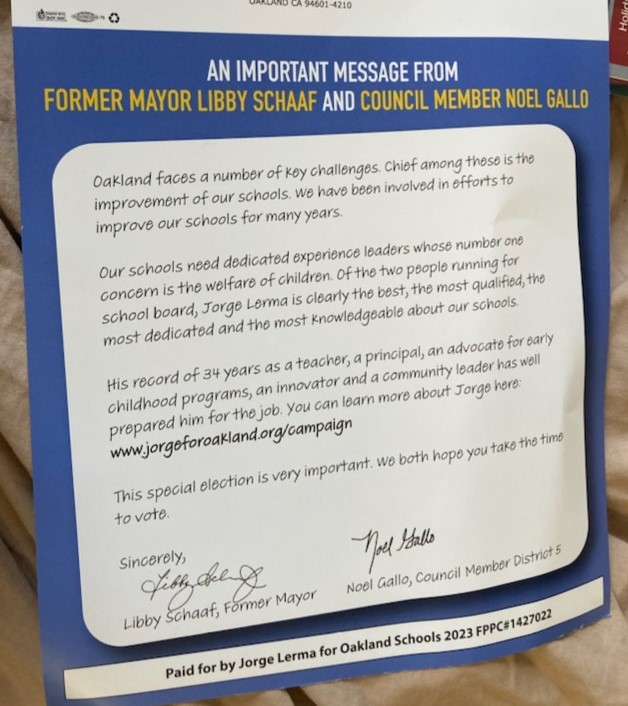
  • 10/14/2023: Approximate date that Mr Lerma uses the United States Postal Service to mail a two page flier to voters, with the notification that the mailing was “paid for by Jorge Lerma for Oakland School Board 2023 FPPC#1427022” – again illegally using the FPPC number for the 2020 campaign in what may be a federal violation of law in addition to state and local laws10
  • 10/17/2023: Mr Lerma files his form 460 for the 2023 campaign (19 days late) which indicates NO CONTRIBUTIONS (despite having attended at least 2 fundraisers) and NO EXPENDITURES (despite having created lawn signs, mailers, door hangers and other expenses)11
  • 10/19/2023: Mr Lerma files a form 460 for the 2020 campaign (21 days late) which finally lists WHO has contributed to his campaign and what he has spent money on.12
  • 10/20/2023: Voters receive another mailer from the 2023 campaign committee, using the 2020 campaign FPPC# 1427022 rather than the 2023 Campaign FPPC number 1463520 issued a week earlier13
  • 10/22/2023: Website continues to illegally list the 2020 campaign FPPC number on its “donate” page.14

On October 10, 2023 we posted (on the platform formerly known as twitter) what we planned to be the first in our regular “Follow the Money” series for the Oakland Unified school board races15. Since 2016, billionaires like Michael Bloomberg, Stacy Schusterman and Arthur Rock have flooded our school board elections with millions in out-of-town dollars to buy a school board that supports charter schools and privatization,16 and Parents United has shared that important information with voters to ensure that we elect candidates who support our Oakland public schools.17

Tweeted on 11/02/2020 by @parentsuniteoak

As of October 10, 2023, only one of the two District 5 candidates in this special election had filed the disclosures that are required to be filed by all candidates not later than September 28, 2023: first time candidate Sasha Ritzie-Hernandez. We were surprised and concerned that candidate Jorge Lerma – who knows better given his long history of involvement in Oakland politics and failed 2020 campaign for this same seat – had not yet filed. We knew from social media posts that he had held at least two campaign fundraising events, and that he had purchased lawn signs and other campaign materials, so why did he not file his form 460 as required?

Now we have a much fuller picture of what happened. Mr. Lerma, contrary to state and local law, was using his 2020 campaign to raise and spend funds instead of using his 2023 campaign as is required. It is important to understand that each election is completely separate, and the fact that an individual ran a campaign in the past does not mean that they can just use that same campaign account to run in the future, as clearly laid out by the City of Oakland Public Ethics Commission.18

The Oakland Public Ethics Commission is an extremely helpful resource to candidates (as well as to the public), and every candidate is given information about resources that they have created to help first time (and repeat) candidates comply with the campaign rules which maintain the integrity of our electoral system. They even have an entire page entitled “Starting your Campaign” which walks candidates through the process, step by step.

Mr Lerma is not a first-time candidate, he ran (unsuccessfully) for the district 5 seat in 2020, so he knows the rules. During his 2020 campaign, Mr Lerma filed all of his disclosures on time without a problem. Mr Lerma also has an experienced Treasurer working on both his 2020 and 2023 campaigns. Jose Dorado is a tax accounting specialist who is listed as the campaign treasurer not just for Mr Lerma’s 2 campaigns, but also the campaign treasurer for the “Re-elect Noel Gallo for Oakland City Council 2016” campaign,19 It is impossible to believe (and highly disturbing if it were believed) that they did not know the rules for campaign finance.

Had Mr Lerma and his treasurer been truly confused about whether they could raise and spend money for 2023 through the 2020 campaign with the old FPPC, they would have simply filed the form 460 for that 2020 campaign ON TIME when due on 9/28/2023 as he had done for every 460 filed by the 2020 campaign in the past. Mr Lerma cannot claim ignorance of the law now when he had previously complied appropriately.

In addition, Mr Lerma (prior to anyone having any idea of what was happening) transferred funds from the 2020 campaign account to a different account presumably set up for the 2023 campaign on September 21, 2023. The ONLY reason for the campaign to do that was because they knew that it was illegal to use the 2020 campaign account for the 2023 campaign. At that point, given there was campaign activity in the 2023 campaign account, Mr Lerma should have filed the 2023 campaign form 460 on September 28, 2023 when it was due. The fact that he did not do so makes clear that this was not his ignorance but his desire to keep his contributors hidden as long as possible so that voters were not aware that his campaign was financed largely by those connected to the charter school and privatization industry.

Mr Lerma, when he ran in 2020, was not the “charter industry” candidate. He was not supported by the various Bloomberg and charter founder Jerry Brown funded PACs – that candidate was Leroy Gaines, who also lost the election. Mr Lerma knows that being supported by charter leaders and polticos who support charter schools and closing schools (which has proven to be very unpopular with voters) is not likely to help him win this seat the second time around. He could have just declined the support of those charter supporters, but he apparently decided instead to hide his financial backers by funneling contributions through his old campaign. The only campaigns required to file the 9/28/2023 disclosure are those vying for the November election, so absent all of this illegal campaign activity, the 2020 Lerma campaign would not have had to disclose all of these contributors. Once they were caught, they had no choice but to file the disclosures, and so we now can see clearly what the intent of this shell game of campaign finance was all about: ensuring that voters did not have the important information about who was financing his campaign until it was too late to make a difference. Unfortunately, we noticed, and the Oakland Ethics Department will notice. Mr Lerma must not be rewarded for his unethical behavior.

  1. https://public.netfile.com/Pub2/RequestPDF.aspx?id=208542770 ↩︎
  2. https://public.netfile.com/Pub2/RequestPDF.aspx?id=208660150 ↩︎
  3. https://www.eventcreate.com/e/jorgelermamixer ↩︎
  4. https://www.linkedin.com/posts/jorge-lerma-014ab189_ousd-community-schools-activity-7105903190688112640-bN8k?utm_source=share&utm_medium=member_desktop ↩︎
  5. https://www.facebook.com/samdavis99/posts/pfbid02VDkgpEJg7dz2MFf4W4MoscgPz3y66vsxDxYaQdJPXkHXgr5kbdLtFQvXtzdtx73al ↩︎
  6. https://public.netfile.com/Pub2/RequestPDF.aspx?id=208674687 ↩︎
  7. https://public.netfile.com/Pub2/AllFilingsByFiler.aspx?id=189891640 ↩︎
  8. https://public.netfile.com/Pub2/RequestPDF.aspx?id=208660150 ↩︎
  9. https://cal-access.sos.ca.gov/Campaign/Committees/Detail.aspx?id=1463520; date confirmed by Secretary of State’s office by phone ↩︎
  10. https://ousdparentsunited.com/2023/10/17/ousd-district-5-candidate-continues-to-spend-campaign-funds-without-disclosing-its-source-that-is-against-the-law-and-should-disqualify-him-from-the-office/ ↩︎
  11. https://public.netfile.com/Pub2/RequestPDF.aspx?id=208674687 ↩︎
  12. https://public.netfile.com/Pub2/RequestPDF.aspx?id=208681958 ↩︎
  13. see image posted below ↩︎
  14. https://secure.actblue.com/donate/jorge-lerma-for-school-board-2023 accessed 10/22/2023 at 3:15pm, see image posted below ↩︎
  15. https://x.com/ParentsUniteOak/status/1711781089243718096?s=20 ↩︎
  16. https://time.com/5792383/michael-bloomberg-charter-schools-donations/ ↩︎
  17. https://ousdparentsunited.com/2020/10/09/show-me-the-money/ ↩︎
  18. https://cao-94612.s3.us-west-2.amazonaws.com/documents/OCRA-Guide-2022-FINAL-REVISED-4-20-22.pdf ↩︎
  19. https://public.netfile.com/Pub2/RequestPDF.aspx?id=161825762 ↩︎

Candidate Jorge Lerma finally filed his Form 460, but disclosed no contributors and no expenditures. So where are all those mailers, door hangers and lawn signs coming from?

In our last post, we called on Mr Lerma to finally file the form 460 for his campaign committee “Jorge Lerma for Oakland School Board 2023” that was due on September 28, 2023 so that the public could see who was supporting his campaign and paying for all of the campaign materials, including a USPS mailer, that we knew that the campaign had created. Shortly after that post came out, Mr Lerma’s campaign did file a Form 460, and we learned that, according to that form, he had NO contributors and NO expenditures to report. Wait, what? How can that be true when we know that he has spent significant amounts of money and held several fundraising campaign events?

Well, it seems that Mr Lerma has been hiding all of his contributions and his expenditures by using the account for his failed 2020 campaign to raise and spend money for his 2023 campaign, which is a serious violation of campaign finance law. Before Mr Lerma declared he would run in the 2023 special election, the 2020 campaign balance was $5,391.99. On September 21, 2023, the 2020 Campaign transferred $12,927.15 to the 2023 campaign, meaning that the 2020 campaign had $7,535 more than 3 months earlier. That $7,535 likely represents the difference between the contributions received for the 2023 campaign less the expenditures for the 2023 campaign such as lawn signs, door hangers, lit pieces, fundraising costs and of course the mailer that was sent via US mail. That $7,535 in transferred funds was improperly raised using an old campaign account, and those contributions and expenditures lack transparency because an old campaign account is not subject to the same reporting laws as a campaign for an upcoming election would be.

So what does all this mean? It means that we are 2 1/2 weeks away from this special election and Mr Lerma’s 2023 campaign has not disclosed a single contributor to his campaign. That is important information that voters need to properly cast their ballots, and the fact that Mr Lerma is trying so hard to hide it tells us that he likely has supporters he doesn’t want voters to know about.

It also means that Mr Lerma has certainly committed multiple violations of electoral reporting and disclosure laws, by:

  • Failing to timely file a Form 410 “Statement of Organization Recipient Committee” within 10 days of reaching the qualification threshold – due 8/21/2023 but not filed until 10/12/2023 (two days after Parents United first commented on the campaign disclosure violations)
  • Failing to timely file a Form 460 “Recipient Committee Campaign Statement” for 7/1/2023 through 9/23/2023 – due 9/28/2023 but not filed until 10/17/2023, and without including any of the 2023 campaign contributors or expenditures
  • Failing to disclose ANY campaign contributions towards his 2023 campaign
  • Failing to disclose ANY expenditures of his 2023 campaign
  • Sending a mailer through the United States Postal Service without a proper California Fair Political Practices Act (“FPPC”) number for the 2023 campaign
  • Using an improper FPPC number on his website, donation site, and possibly other materials in order to induce campaign contributions to his 2023 campaign that he thereafter failed to disclose as required by law
  • Using an improper FPPC number on a campaign mailer sent through the United States Postal Service, intended to induce voters to believe that he had a valid political campaign and induce support for that campaign

But perhaps most importantly, it demonstrates that Mr Lerma is not fit to be elected to the Oakland Unified School Board on November 7, 2023. Mr Lerma has shown us that he does not feel bound to follow the laws that all others, including his opponent, are bound by. He shows a total lack of concern for the transparency, fairness and accountability that we should expect from our elected leaders. Mr Lerma has demonstrated that he does not feel obligated to exercise the fiscal responsibility that is a key component of a school board member’s job. Given these clear and serious ethical violations, Mr Lerma should immediately suspend his campaign for school board in District 5, apologize to the voters and begin to clean up the ethical mess he has created.

Voting with your values: Thank you OUSD Board Directors Williams, Brouhard and Bachelor for standing firm and voting against school mergers and layoffs of our classified staff that support our most vulnerable students

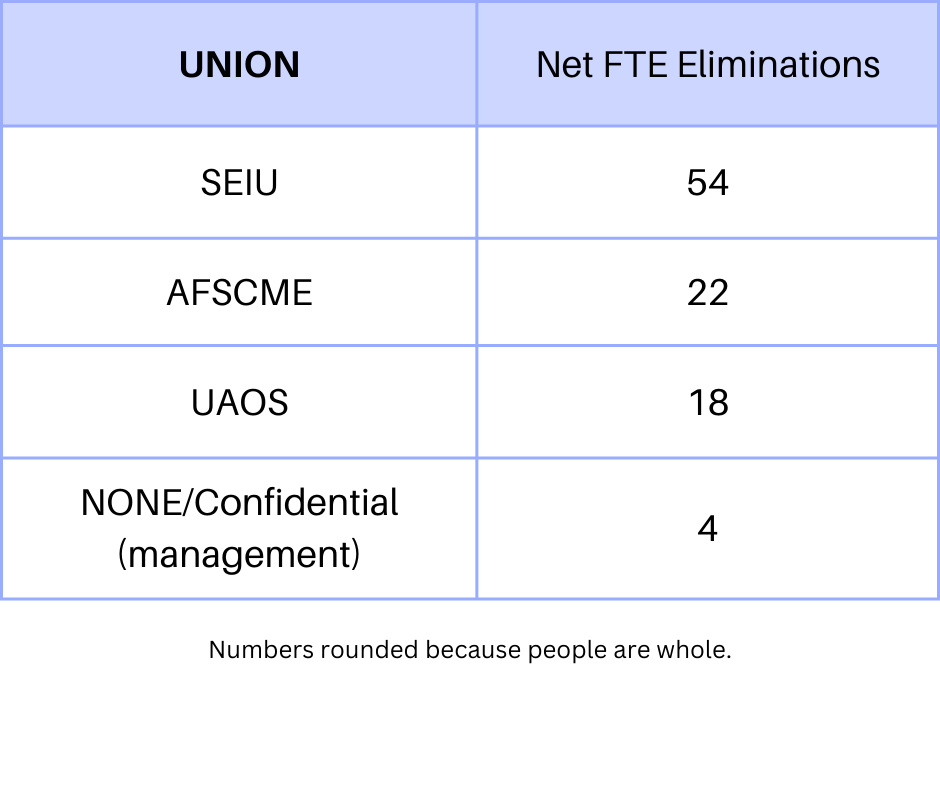
Last night at a special board meeting, the Oakland Unified School District (“OUSD”) Board of Education considered a series of “budget adjustments” that Board President Mike Hutchinson and Superintendent Kyla Johnson-Trammell stated in a letter were necessary to fund ongoing investments in alignment with district priorities. We learned for the first time that President Hutchinson and Superintendent Johnson-Trammell intended to “merge at least ten schools” in order to achieve a purported $2.5 million in staffing costs (by eliminating 5 principals, 1 teachers and about 11 site staff.) In addition, the plan included laying off a net 98.88 “FTE” (full time employee equivalents), nearly all of them our lowest paid workers who work directly with students, such as case managers, literacy tutors, restorative justice facilitators and special education staff. Just 4 employees are “confidential” or unrepresented employees who generally cost far more in wages and benefits to the district and usually are not directly interacting with students. You can see the entire presentation on OUSD’s website.

Although OUSD did not assign numbers to the staff layoffs it appears to be somewhere in the $8 million range and includes the School Security Coordinator that was added by the George Floyd Resolution implementation. The total reductions total about $21 million (including $2.5 million achieved by merging schools) plus “funding shifts” to either restricted funds ($15 million) or one-time funds ($11 million – which will eventually go away and so cannot be used to pay ongoing expenses like key salaries) for a total of about $39 million in proposed general fund savings. There were some small changes to central staffing, but absolutely not the kind of systemic reform needed.


Directors Brouhard, Bachelor and Williams stood firmly with the community and our critical classified staff who support students every day.

The two new board directors Jennifer Brouhard (district 2) and Valarie Bachelor (district 6) were elected because they promised to stand with students, educators and community against school closures and with our most vulnerable children, teachers and staff. Director Williams (district 3) was elected in 2020 on that same platform, as was now Board President Mike Hutchinson (district 5). So it should not have been a surprise to district staff that this Board would demand a different kind of budget balancing, one that looked for creative ways to restructure spending, especially at central office, to keep any adjustments as far from children and the people that work with them every day as possible. After overturning school mergers and closures in January, it should have been crystal clear that unexpected school mergers or closures of “at least” ten schools would not fly. Yet the budget adjustments that Superintendent Johnson-Trammell and Board President Hutchinson co-sponsored (according to the joint letter issued 24 hours before the vote was scheduled) were from the same draconian cuts and closure playbook that has been used over and over again in OUSD and has resulted in a district that values high paid administrators and outsourcing to consultants over classrooms and kids. The Board did not pass the “reduction” package presented, with President Hutchinson and Vice President Thompson voting in favor of the cuts and unidentified school mergers, Director Davis abstaining and Directors Brouhard, Bachelor and Williams voting no.

Just last year, President Hutchinson voted against a similar budget reduction scenario that involved school closures and mergers, plus more than 100 classified staff reductions.

We all know that OUSD must balance its budget and also that OUSD cannot use one time money to fund ongoing raises for its staff. But as this video from March 9th, 2022 shows, there are many ways to balance a budget in accordance with your values, and President Hutchinson was clear on those values just a year ago. At that time, faced with “budget reductions” that included school closures and the elimination of classified staff, then Director Hutchinson pulled the same “budget and staff reduction” item last year as they did last night, and made clear that he stood AGAINST school closures and voting to cut employees and staff:

“I expect everyone who’s watching in the community to know, to pay attention and to remember, because people aren’t allowed to say they’re friends of … labor [while cutting staff]. We’re sitting school board directors, all that matters is our votes. And you won’t ever be able to escape your voting record. Nobody is going to forget these votes … to close our schools, to cut employees, at a time when we see we’re running a budget surplus.”

See Director Hutchinson’s comments here:

//ousd.granicus.com/player/clip/2079?view_id=4&redirect=true&h=f32620b03e4695551650b1fde5b5945a&entrytime=24628&stoptime=24702&autostart=1&embed=1

We know that President Hutchinson has a great deal of responsibility as the President of the Board, but he must exercise his power in accordance with the values he has always espoused, and upon which he was elected. We therefore ask President Hutchinson to work with Directors Williams, Brouhard and Bachelor to find the funds necessary to meet our District priorities, including providing raises to all represented staff, in alignment with the values that we know that they all have in common, without closing or merging schools (especially without deep community participation beforehand) and without eliminating key health, safety, special Education and other positions that serve our students directly and are among the lowest paid employees in this district. We are counting on you all working together to revamp and reorganize our district to align with our shared student centered vision.

The entire discussion and vote from March 9, 2022 can be found at the link below.

//ousd.granicus.com/player/clip/2079?view_id=4&redirect=true&h=f32620b03e4695551650b1fde5b5945a&entrytime=24480&stoptime=25027&autostart=0&embed=1

Our newly elected, progressive OUSD Board majority just reversed school closures. Now it’s time to get to work to realize our vision of a community led, anti-racist, people-over-profit centered school district.

.

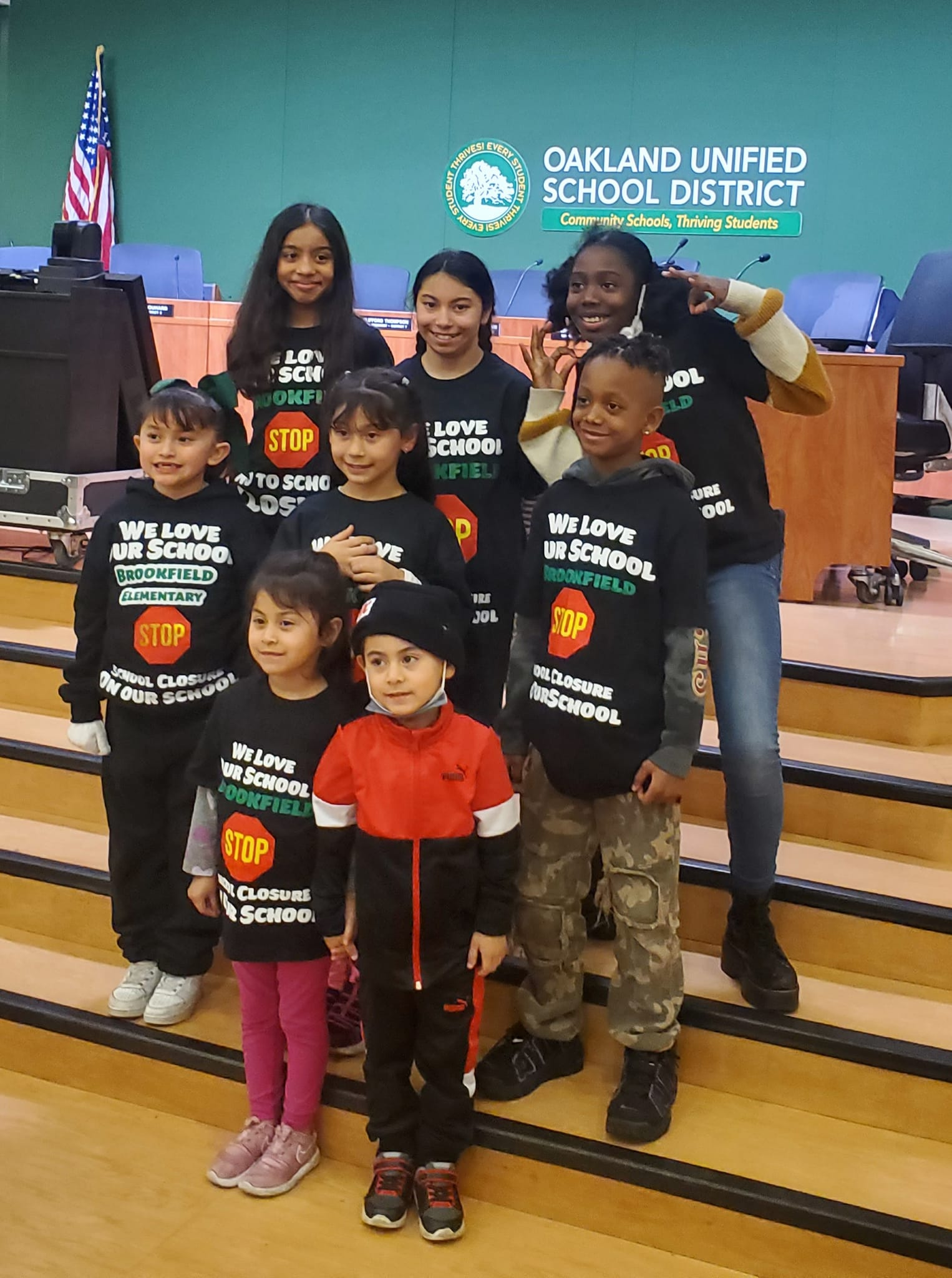
Brookfield students showed up for the vote to keep their school open! Photo credit to Corrin Haskell

On Wednesday night, in the first official act of the new progressive majority, the Oakland Unified School District (“OUSD”) Board of Directors voted to rescind planned closures of 5 elementary schools and 1 middle school program at the end of this school year. Students, parents, educators and community were on hand to witness newly elected board members Jennifer Brouhard and Valarie Bachelor join with sitting directors VanCedric Williams and Mike Hutchinson to fulfill the mandate of the 67% of voters who supported their platform of ending school closures which target schools in Black and Brown neighborhoods and destroy communities while fueling the gentrification of Oakland. 

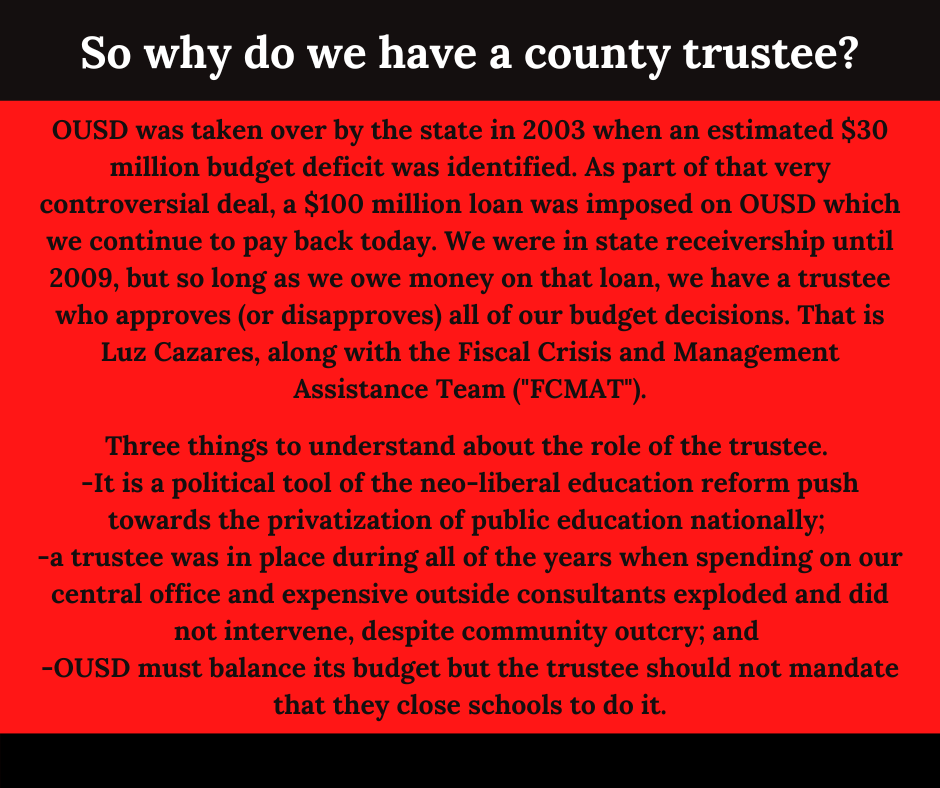
The fight is not over. No sooner was the vote complete than the Alameda County trustee Luz Cazares, appointed to oversee OUSD’s finances, informed OUSD that they reserved the right to stay and rescind the board’s action to end school closures, because OUSD did not provide a Fiscal Impact Analysis as required by its own board bylaws prior to the vote.

District staff should have prepared that Analysis as soon as the matter was introduced by Director (now President) Hutchinson on November 30th, but failed to do so, and it appears that both Director Sam Davis and Director Hutchinson, who had each declared their intention to become board President, allowed staff to delay the Fiscal Impact Analysis until January 25th. This was done despite the urgency of needing to fix the enrollment system immediately to include the targeted schools and begin the budget development for school sites. That willingness to delay and worsen the harm to students led to Director Williams being elected president and immediately calling a special meeting for Wednesday, January 11th for a vote on the rescission resolution, which passed. President Williams’ decision to act immediately to help the targeted school communities jump start planning their futures was also a rebuke against the deliberate slow rolling by staff and politicking by board members. We are grateful for his leadership and for putting students first.

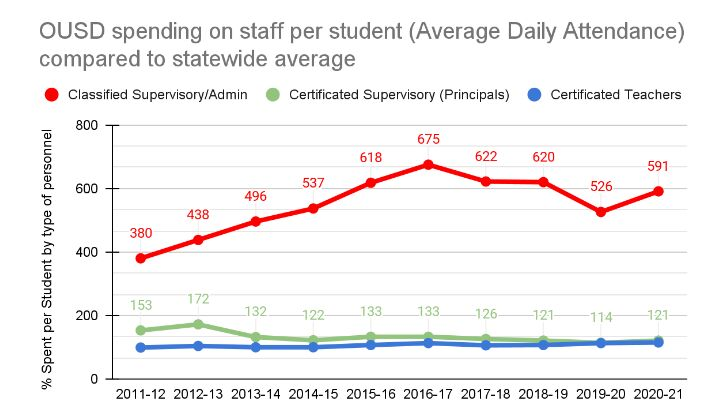
It is now up to District staff to prepare the necessary analysis so that we can avoid action by the County trustee and move on with the planning for how we support the targeted schools to repair the harm done by years of uncertainty and underinvestment. We must also rethink our solvency strategies to ensure we are no longer balancing our budget on the backs of our most vulnerable students. We must restructure our district from a top heavy, consultant-dependent “business model” to a district built from the bottom up, where we prioritize students and classrooms in true Community Schools. We must push our city, county and state leaders to support us in creating a district that serves the whole child, addressing community needs so that students are prepared to learn and excel in life. It is possible to educate students in equitably funded neighborhood public schools with staff who are valued and paid a living wage. 

OUSD receives more money per student than almost any other large school district. It is time we invested those funds in the classrooms where they belong. Let’s get to work.

The Registrar has spoken: District 4 voters elected Mike Hutchinson for School Board. Now, Nick Resnick must honor the will of the voters and support the recertification of the election

The Alameda County Registrar of Voters (“Registrar”) told the Board of Supervisors yesterday that it had incorrectly configured its electoral software and that when the software was properly configured, in accordance with the Oakland City Charter, Mike Hutchinson was the winner of the Oakland Unified School Board Election for District 4. Yet candidate Nick Resnick, who had previously been incorrectly certified as the winner of this seat before the error was identified, issued a statement making clear he does not accept the correct outcome and has hired an attorney to help him thwart the law and the will of the voters. Mr Resnick must put his personal interests aside and honor the vote of the people.

The Oakland Unified School Board has acknowledged that it has much work to do to build trust with the OUSD community. At a special new board member orientation this week, OUSD’s consultant Dr Franco talked about Ethical Leadership and Building Trust and said that key to building trust is to demonstrate “at all time qualities that will evoke confidence and trust.” If candidate Resnick insists on being seated on the OUSD school board when everyone in the community knows that he was only certified due to a technicality he will undermine rather than evoke confidence and trust. For the good of our community, candidate Resnick must work with the rightful winner, Mike Hutchinson, to ensure that the legal winner is seated as the next District 4 school board member, much as Director Hutchinson congratulated candidate Resnick when the result was incorrectly certified, despite having apparently lost by only 42 votes. As urged by Dr Franco, candidate Resnick must “let right be done.”

PEMDAS 

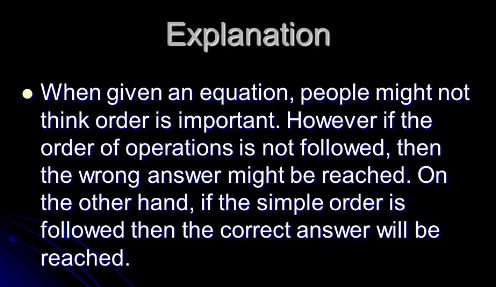
Every child in elementary school will learn a fundamental rule about the order of operations in mathematics: PEMDAS. When given a set of numbers, you must follow the PEMDAS Order of Operations to find the correct answer, and if you fail to use PEMDAS using those same set of numbers, your answer will be incorrect. Every math teacher (even former ones) understand this basic concept and every child will learn it over the course of their studies. 

When setting up the software for this election, the Registrar’s office forgot about the Order of Operations – the “PEMDAS” in this situation. They failed to apply the rule (as codified in the Oakland City Charter) which determines how you tabulate the results, so that when they finished counting all of the votes and applied the Order of Operations, they got the wrong answer. Once the correct Order of Operations was applied, the correct answer was revealed and we all now understand that was a majority of votes for Mike Hutchinson. It’s that simple. 

Candidate Resnick wants the Registrar to pretend that no mistake was made

The disappointment that Candidate Resnick must feel is understandable, and the fact that this preventable error was not discovered earlier needs to be investigated fully and appropriate action taken to ensure that it never happens again. But doing what is right is more important than Mr. Resnick’s disappointment, and it is clear that by law Mike Hutchinson received a majority of votes and should be seated as the next school board director in District 4. 

In a statement posted on Candidate Resnick’s campaign facebook page he makes a variety of anti-democratic objections to the correction of the results, none of which addresses the simple fact that using the correct “order of operations” means that Mike Hutchinson is the rightful winner:

  • “We question the authority of the Registrar to conduct a re-tabulation” – in other words, once the Registrar became aware that a mistake was made, they shouldn’t have investigated to see if it impacted the outcomes of our election. Winning is everything for candidate Resnick (who lost another election in 2016 for community college board), even if it is on a technicality which deprives voters of the legitimate result.
  • “There was no proper public oversight of the Registrar’s process, which by their own admission was initially flawed. A recount includes a more thorough review of all ballots and not just the ballots the Registrar chooses to include, as was done here.” Candidate Resnick admits that the process that resulted in his certification as the winner was “flawed” and claims that public oversight of a “recount” is required. To be clear, this is not a recount of ballots, they have been publicly counted in accordance with the law. This is taking those same votes cast and applying the correct order of operations to get the correct result.
  • “We question the validity and integrity of the revised results provided by the Registrar. If there were mistakes the first time, there is also a chance there are mistakes the second time.” The Registrar has already admitted that a mistake was made in certifying candidate Resnick as the winner because the tabulation wasn’t done in accordance with the Oakland city charter. Applying the proper “order of operations” ensures that no mistake is made the second time. The Registrar made clear on Thursday there were only two choices for how to tabulate the “suspended” ballots at issue here and the first choice was wrong. There is no question about whether the retabulation is correct and questioning the “validity and integrity” of the results is outrageous.
  • “This unfortunate situation brings to light the errors that can happen in any election race where rank choice voting is utilized and I want to ensure that our election processes are fair.” To be clear, candidate Resnick was certified as the winner because of Ranked Choice Voting that he now claims to be error-filled and unfair.  Mr Resnick received less than 40% of the first-place votes, before the application of ranked choice voting. He is only now complaining that the result is not “fair” because the correct Ranked Choice Vote result is not in his favor. 
  • “We question whether the new results accurately reflect the intent of the voters who filled out the ballots in question.” The process for determining how “suspended” ballots are tabulated is set forth in the Oakland City Charter, but now candidate Resnick wants to substitute his judgment for the law. 
  • “Registrar unilaterally moved up” and “second guessed” voter intention. Wrong. The corrected result was based on the clear and unambiguous intent set forth in the Oakland City Charter, and while the Registrar has much to account for, he is not substituting his judgment for that of the voters in the way that candidate Resnick has done.
  • “When voters are confused about the voting process or when the process isn’t transparent, voters lose faith in the results and mistrust the process.” There is no indication that voters were confused, and the Registrar of Voters was very transparent in explaining the process at yesterday’s meeting. In our “stop the steal” electoral environment, it is irresponsible for candidate Resnick to stoke the flames of distrust when in reality he just doesn’t like the outcome.

This entire incident has been painful and confusing and should never have happened. Those who made this mistake have acknowledged that fact and are correcting the mistake by making this information public once it was determined that applying the law properly would have resulted in a different outcome. Certainly, it would have been easier and less embarrassing for the Registrar’s Office to have just ignored it altogether, and to use the excuses that candidate Resnick is proposing to allow an anti-democratic outcome to this election. Instead, we know what we know, and we must do the right thing. 

Mr. Resnick must let right be done

This was always going to be an historic election, regardless of the outcome. On the ballot were a trans-identified parent and two Black candidates. Whoever won would be a first for District 4, which is majority white and more conservative than other districts in Oakland and which has never elected either a Black candidate nor an openly trans-identified elected official, to our knowledge. According to an article in the Bay Area Reporter (Ballot count blunder means trans dad didn’t win Oakland school board seat :: Bay Area Reporter (ebar.com)), candidate Resnick’s “status as the Oakland Unified School District’s boardmember-elect for the District 4 seat meant Resnick was set to become the first transgender person elected to oversee a K-12 public school district in California. And it made him only the second trans man elected to an education post in the Golden State.” District 4 and Oakland should take great pride in this accomplishment. 

But as instructed by Dr Franco in her training about “ethical governance” it is time for us all to “let right be done.” Under the Oakland City Charter and the order of operations specified therein, Mike Hutchinson has won this election and Nick Resnick must honor the outcome as corrected. Parents United urges the following actions:

  • Mr. Resnick should immediately notify the Registrar of Voters, Mr. Hutchinson and the Superior Court in which Mr. Hutchinson has been forced to file a complaint that he acknowledges Mr. Hutchinson is the duly elected District 4 School Board representative and will support the recertification of this election in Mr. Hutchinson’s favor;
  • Mr. Resnick should decline to take the Oath of Office set to be administered on Monday, January 9th; 
  • The Alameda County Registrar of Voters as a Real Party in Interest to the complaint must ask the Superior Court to recertify the election with Mr. Hutchinson as the winner; and 
  • The Alameda County Board of Supervisors must vote to pay the costs and attorney’s fees incurred by Mr. Hutchinson in challenging the certification which was necessitated by the mistake of the Registrar.

We look forward to Mr. Resnick, and all interested parties, doing the right thing.