#OneWestlake

Photo of student from letter with Mr KThe letter below was written by a former Westlake Middle School student about Mr. K, Westlake’s Principal, who is being removed from the community he has led for the last 15 years. Mr. K is a visionary leader who has the full support of the Westlake community. It is widely believed that Mr. K is “being punished for not keeping a lid on parent and teacher protests last June, when the district unsuccessfully tried to force the school to ‘co-locate’ a charter high school at the site.” This former student’s words show why Westlake needs Mr. K, and why our District’s leadership needs to support the Westlake community, not tear it apart. #OneWestlake

A Commitment to Excellence

I remember back when V and I (who took his own life after eighteen years on this Earth) would make the journey down to Laney College after school on Wednesdays in hopes that we’d come up on an iPod or a nice watch. I remember when R, J, and I would go down to MacArthur and pick up an ounce from Marv for $20, in hopes of flipping it on the block after school got out on minimum days. I remember M catching his cousin after school down the street from Whole Foods and stomping him out on the curb for stealing a TV from their grandma’s house. I remember B pulling a gun on my little brother.

I don’t recall these things with pride, or to scare away any family thinking of sending their children to Westlake—I attended Westlake seven years ago, and all of my experiences were the product of me actively looking for trouble. If I’d continued down the road I was headed in my preteen years, I would be writing this either from a jail cell or from the beyond. It was in my eighth grade year that I changed course, and I have Westlake Middle School to thank for my life; a Westlake Middle School under the leadership of Misha Karigaca.

When I was caught in the halls of Westlake in my final year, with more than a couple of dimes and intent to sell, it was Mr. K that gave me my wake up call.

“What do you see yourself doing in four years…?” He sat next to me. Even though he was much wiser than the students, he never made us feel small. I’ve dealt with my fair share of authority figures in Oakland, but Mr. K was one of the most successful because he treated each and every one of his students with respect. He knew our parents names, our aspirations (if we had any at that point), and what we intended to do about it. Each of us was a person; not just a student ID number in a computer that could affect the school’s funding.

“Well, I guess we’re supposed to go to college, right? But that’s done now.” My lip quivered. I’d just been caught with weed on me at school, all packaged up and ready to go. I was also thirteen. In that moment, I thought my life was effectively over.

“Why? Because you made a mistake?” He asked me. I nodded slowly. There was a window that looked out to the front yard in the front of the school. Some of my friends were watching me. I wasn’t gonna cry. “If you want to go to college, this isn’t gonna stop you. But what do you want to do?”

Mr. K, who is very open about his experiences growing up in Oakland Public Schools, has successfully (to my own understanding) and lovingly nourished an environment with resources that he had wished for and needed as a young black male in Oakland. Westlake is a place where young people from all racial and social backgrounds come to learn, to succeed, and to thrive. He’s made a commitment to excellence for all of his students, but I think his unique perspective on this is what makes him indispensable to Westlake.

Unlike many other teachers and principals I’ve encountered, Mr. K knew that in the diverse setting of an Oakland Public School, my excellence was not my peers excellence. He knew me as I was in my seventh and eighth grade years: cutting school so much that administration sat me down and had me draft a school law that prevented other students from abusing the middle school office bureaucracy the way I did. But he also remembered who I wanted to be—hanging out with my English teacher after school on Fridays because I didn’t want to go home, making spoofs of body wash commercials and writing poetry.

After being removed from Westlake classes with two months left until my promotion to ninth grade, I went on to become very involved in the arts. I got my diploma, took my SATs, got into college, and went in a different direction. At eighteen years old, I’m supporting myself while living in New York City—working to make ends meet while battling bipolar disorder and following my dreams. Mr. K created an environment that helped me find my calling, and gave me the ambition to pursue it. It was my experience in Westlake and the opportunity given to all students for unique self-searching and reflection that would later lead me to seek a diagnosis for my own quarrels with my mental health.

That understanding of the individuality of young people by an administrator and leader is crucial for individual and group success. If your definition of excellence is defined by your ability to breed cookie-cutter students that can recite helpful acronyms for standardized test-taking, and no outlet for their personal expression and experiences, perhaps Westlake would be better off with a principal that is not Misha Karigaca. That definition of success is a school that produces students that look good on paper—they get accepted into a very great University, where they have a wonderful dorm room with a nice window they can consider jumping out of during their first nervous breakdown halfway through their freshman year. I can’t promise I’ll be sending my children there.

However, if ever you are looking for a man who is committed to the individual excellence of young people, and strives to encourage each student’s specific interests, feel free to offer Mr. K his job back.

Update: Board Meeting Recap

11112717_904128046275068_7725102537898882594_nParents spoke, board members heard, but ultimately they didn’t listen. Parent emails changed the process – instead of being voted on without discussion, the Oakland Public Education Fund (“Ed Fund”) item was pulled from the consent agenda so that questions could be publicly raised, and Director Gonzales asked the questions we had posed.. That would not have happened had parents not let board members know of their concerns before the meeting. Ultimately, however, the board voted unanimously to approve the Ed Fund contract extension. Parent questions also guided the discussion about the proposed Charter school revised Measurable Pupil Outcomes, and since that item was not voted on last night, there is time for the Board to address parent concerns. We appreciate that Director Gonzales and others asked our questions, but are disappointed in the vote and especially in Director London’s statement that she didn’t really think parents knew what they were writing about. Director London is wrong – Parents understand, we are watching and we will have accountability.
Serious Concerns From Tonight’s School Board Agenda

The following email was sent to OUSD’s Director’s this afternoon (2/24/16) regarding two very concerning items on this evening’s school board agenda:

  1. An item which will give all fiscal authority and staffing oversight over privately-financed OUSD funds to the private Oakland Public Education Fund, and pays the Ed Fund a 7% fee for it’s services. This item will take all spending of private funds out of the public’s eye and control, something parents should be very disturbed by. This item is a total abdication of the Board’s fiscal oversight of District funds.
  2. An item which requires certain charters that have opted-in to report additional pupil outcomes to the District. While good on face-value, the proposal does not include any indication that the District will take steps to assure that charter reporting is done on time or with accuracy, despite clear indications that these measures will be used to compare charter schools to District schools.

We encourage you to send your own email to them at the following addresses: james.harris@ousd.org, jody.london@ousd.org, aimee.eng@ousd.org, jumoke.hintonhodge@ousd.org, nina.senn@ousd.org, roseann.torres@ousd.org, shanthi.gonzales@ousd.org. Please copy us at ousdparentsunited@gmail.com.

OUSD PARENTS UNITED

Dear OUSD Directors:

We are writing with concern about two items on tonight’s Board agenda, but also with an overall concern about what seems to be an ongoing pattern of structuring Board meetings and discussions to discourage authentic public review and participation in the decision-making process.

While California open meetings rules require the District to provide a minimal notice of its board meeting agenda, that requirement is only a minimum, and you are permitted to provide a much longer notice. The board, however, consistently waits until the last possible minute to post board agendas, effectively limiting the public’s ability to fully understand, review and provide feedback on agenda items.

As we continue to hear from more OUSD parents who want to be informed, we’re concerned that last minute items without public engagement are a serious accessibility issue which doesn’t uphold the board’s values around equitable community participation. Especially in a week where the board has had two meetings, it is difficult for busy, working families to give the board’s work a thorough review.

While we have concerns about many of the items on your agenda for this evening, our two biggest concerns are as follows:

  • OAKLAND PUBLIC EDUCATION FUND AS FISCAL AGENT

 Our first item of concern is item 16-0357, “Charitable Fund Management Agreement.” We encourage you to reject this item. In addition to concerns about whether it is even a fiscally sound decision to pay 7% of District revenues to a private entity, and the fact that approving this item will result in the continued signing away the District’s oversight and control of projects to be carried out within District schools and other District operations, this item will:

  • Take all privately-funded work out of the public eye. The Ed Fund, as a private entity, is not covered by California’s public records laws or open meeting laws, making it impossible for members of the public – including you, parents, and students – to have ANY oversight over how these funds are distributed. This will make work being carried out within and on behalf of our District secret from the public – which is certainly not within the spirit of California’s public records and open meetings’ laws, if not an actual violation.
  • Make employees paid by these funds – including people working within District schools and administrative offices – employees of the Ed Fund, removing them from not just public oversight, but all rules and regulations that cover District employees. Having clear accountability and control over people working within our public school system should be of paramount concern to you all.
  • Sign-away all rights to intellectual property (such as copyrights) that could, in the future, be used to the benefit of the District.
  • Allows the Ed Fund to use the funds – funds intended to be used to carry out District programs and improvements – to lobby the District. The possibility that the Ed Fund will use District funds to lobby District officials is especially outrageous.
  • Allows the Ed Fund – in addition to the regular 7% administrative fee – to collect additional fees to provide additional services – yet these services are not spelled out in the agreement.

In fact, it seems clear that a vote for this item is such a clear abdication of your jobs as the fiscal oversight body of the District, that we could only take it as a sign that you do not want, or are not capable of, doing the work that you were elected to do by Oakland voters.

  • NEW CHARTER REQUIREMENTS RE: MEASURABLE PUPIL OUTCOMES

Our second item of concern is 16-0374, “Measurable Pupil Outcomes (MPO) Material Revisions – Alignment With Local Control Accountability Plan (LCAP) Metrics and the District’s School Performance Framework – Named Charters.” While this item seems positive on face value – because it will require charter to comply with additional and more consistent reporting of educational outcomes – we have some concerns and encourage you to delay your vote on this item.

First and foremost – there has been no previous discussion of this item at Board meetings and the public has just now become aware of this proposal. We believe that parents, students and teachers deserve more time to consider these changes and understand how they will be carried out, and respectfully request that you delay this vote to allow time for stakeholders to better understand the proposal.

Additionally, because – as District staff has admitted repeatedly during the push for Common Enrollment – we all know that some (if not most) Oakland charters engage in practices prohibited by state law in regard to reporting (namely: “pushing out” of SpEd and other students around test-taking times, effectively manipulating their testing numbers), and our District currently does little to track those practices down and hold charters accountable, it seems questionable whether there is either the will or the means to hold charter accountable to this new reporting.

Further, the agenda item does not include any mention of how the District intends to ensure that this reporting – which will clearly be used to compare charter school performance to public school performance – is accurate. Surely any plan passed by the board should include a clear schedule for monitoring and comprehensive auditing (by qualified professionals) of all charter school reporting on these metrics.

Finally, it is important to understand why nearly a quarter of OUSD authorized charter schools refused to sign on to this. There is no discussion in the Staff Recommendation as to why these charters did not believe it to be in their best interests to agree to a shared metric for reporting charter school performance. At the very least, this information should be discussed prior to this vote.

We hope that you will take our concerns seriously and vote against making the Oakland Public Education Fund the District’s Fiscal agent and delay your votes on the MPO reporting item to allow time for more meaningful public understanding of the District’s ability and intent in regards to accountability. Oakland parents and students deserve better than rushed votes on unwise and unclear proposals.

Sincerely,

OUSD Parents United Steering Committee Members

Tony Daquipa

Kim Davis

Ann Swinburn

Mona Treviño

Michael-David Sasson

Charter Advocates Intentionally and Strategically Kept Board Members and Parents in the dark about Common Enrollment

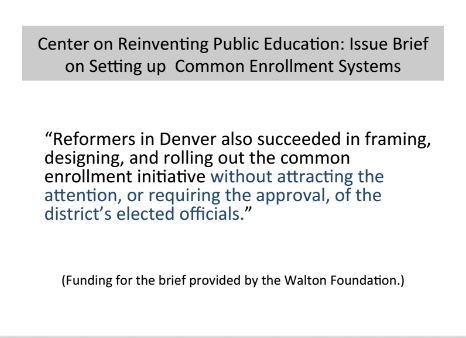
Common Enrollment is being brought to Oakland by the same consultant that led the process in Denver where charter school advocates *intentionally and strategically* kept parents, teachers, community members and even School Board Members in the dark about their true goal: not improved enrollment, but Common Enrollment. Sound familiar? Here is a quote from a presentation by (Walton Foundation-funded) C.R.P.E. about the strategy used in other cities, which is now being replicated in Oakland.

Common Enrollment CRPE quote from boston (2)

Here is a link to the actual report: CRPE issue brief: Stakeholder Engagement for Common Enrollment Systems

Community Objections cause OUSD to push back vote on “Common Enrollment” Proposal

Oakland’s ‘common enrollment’ proposal fans the flames of great charter school debate

By Joyce Tsai jtsai@bayareanewsgroup.com

POSTED:   01/08/2016 04:50:32 PM PST | UPDATED:   A DAY AGO

OAKLAND — To some, it’s a streamlined system that allows families to more easily navigate a daunting array of school applications to find the best fit for their child. To others, it’s another Silicon Valley-backed reform tool that would undermine a struggling public school system by promoting charter schools.

A novel proposal by school district leaders to overhaul the school enrollment process would make Oakland the testing ground in the state for a universal enrollment system that allows parents to fill out a single application for their top choices for schools, both district-run and charter.

Charter schools have been school options for Oakland families for decades, despite the fact that some residents in the city’s highly segregated neighborhoods with high poverty levels may not realize it, said Superintendent Antwan Wilson. And it’s been difficult for the city’s most disadvantaged families to learn what all their options are, he said.

“Having a system that is as easy as possible and that doesn’t require them to go through multiple steps to enroll is important,” he said. “And that’s not a pro-charter strategy; that is a pro-child strategy.”

The system has already been adopted, some say with mixed results, in Denver, New Orleans, Washington, D.C., and Newark, New Jersey.

Advertisement

But like in Oakland, proposals for Boston and Philadelphia are meeting resistance because charters compete with public school districts for the same limited education dollars. Opponents fear that an exodus of students to charter schools would decimate the public schools. They say that charter enrollment policies allow them to “cherry pick” students and deny entry to those who will not further their academic goals.

That could be a concern. Some districts that have adopted common enrollment did not require charter schools to align their recruitment and retention policies with their respective public schools, and others allowed charters to opt out of the new program.

In response to critics, Wilson is pushing for the signing of a district-charter school compact, called an “Oakland Public Schools Equity Pledge,” which would help ensure an equitable playing field for all Oakland public schools.”It’s all grounded in the principles of equity and ensuring that our students get what they need to be successful,” said Wilson, who came from the Denver school district but did not spearhead the switch to common enrollment there.

Oakland’s current enrollment system, which district officials say is inefficient and outdated, allows families to fill out a common application to enroll at any of its public schools, ranking their top choices. But the charter schools have separate applications.

The district spends about $1.8 million annually on its enrollment system, and the new common enrollment system would cost an additional $1.4 million to start up. Philanthropic organizations would likely foot that startup bill, but only if charter schools were included, because that’s the best way to ensure an equitable system for students, said Gloria Lee, executive director of Educate 78, a pro-charter school group that is linked with Silicon Valley-backed NewSchools Venture Fund and the Bill and Melinda Gates Foundation and Walton Family Foundation.

The group made a $300,000 investment to fund the initial outreach and development of the system, which sparked more angst among opponents.

“Why is the district allowing a private entity with their own agenda to market this?” asked Kiera Swan, who has two kids in Oakland public schools. The so-called common enrollment system would allow parents to use their smartphones or visit enrollment centers to do easy side-by-side online comparisons of both charter and district-run schools throughout the city and apply for them in a common application, regardless of school type.

A computer algorithm would generate a single match for students, streamlining the process for families, who currently have to navigate through a hodgepodge of different deadlines and requirements for charter schools. The exact mechanics and algorithm will likely be shaped based on additional community input and school board guidance, said OUSD spokesman Isaac Kos-Read.

Kim Davis, co-founder of OUSD Parents United, warned that results are mixed in districts that have adopted the system.

In Washington, D.C., the feedback from families and schools has been “overwhelmingly positive,” even though 5 percent of charters have not opted in, said Shayne Wells, a special assistant to D.C.’s deputy mayor for education. He said the percentage of students in charter and public schools has remained relatively unchanged at 44 percent at charters and 56 percent at public schools.

In Denver, which has had the system since 2012, many parents are satisfied with the system, with about three in four students matched to their first-choice schools, said Van Schoales, Chief Executive Officer of A+ Denver, a community-based education reform group that supports charters. But he admitted that parents from low-income areas remain frustrated by their access to the best schools because they often require traveling across the city and such spaces are limited.

And in Newark, universal enrollment didn’t cause a migration to charter schools from public schools; it was already happening, said author Dale Russakoff. Her book “The Prize: Who’s in Charge of America’s Schools?” chronicled the impact of Mark Zuckerberg’s $100 million donation to reform the Newark’s public school system.

The exodus, particularly from the highest-poverty ward of the city, where student performance is the lowest, led to hundreds of teacher layoffs and one-third of district schools being closed, consolidated, repurposed, relocated, restaffed or turned over to charters the first year of universal enrollment, she said.

“The bottom line is that if there had been more charter slots available, there would’ve been a larger exodus from the traditional public schools,” she said.

All the more reason that Oakland shouldn’t be encouraging an enrollment system that would pave the way for many students to apply to schools that aren’t district-run, critics say.

“We will absolutely lose students in the public schools to charter schools, which is a great concern,” Davis said. “And we don’t want to do anything to undermine the success of district-run public schools, so that our public schools lose more funding and support.”

Community unrest surrounding the proposal has delayed a board vote on the measure, which was planned for January, at least until June. Even still, the district on Monday is rolling out a test version of a school finder tool (ousd.org/schoolfinder) that could be used with common enrollment. It will allow users to find nearby schools, both district-run and charter, and review each one’s academic performance and enrollment information.

Board President James Harris said that he believed the charter compact would need to be to signed first, before common enrollment can be considered. School board member Shanthi Gonzales agreed, adding that too many questions on the proposal’s impact on district schools remain unanswered.

“And I don’t think private money and private agendas should be shaping policy,” she said. “If we don’t have the money ourselves, then we wait.”

Lee, of Educate 78, said it was unfortunate that the impression was that the pro-charter groups’ advocacy was somehow done secretly.

“There’s definitely been lots of outreach and parents from public schools, who were involved with these sessions,” she said. “But I guess in retrospect, I wish we’d done a lot more media about the opportunities for input.”

Contact Joyce Tsai at 925-945-4764. Follow her at Twitter.com/joycetsainews.

oakland schools By the numbers:

  • The number of district-run schools: 86
  • OUSD-authorized charter schools, which would be included in Common Enrollment: 32
  • County-authorized charters, which would not necessarily be included in the new system: 6
  • Number of Oakland School-age children: 65,740
  • Students in OUSD-run schools: 36,392
  • Students OUSD-authorized charter schools: 10,348
  • Students in Alameda County-authorized charter schools: 1,428
  • Students not in either district or charter schools, including private schools: 17,572
  • Percentage of Oakland’s school age children attending district or charter schools: 77

http://www.insidebayarea.com/breaking-news/ci_29361396/


We Need Enrollment Reform, Not Common Enrollment

OUSD is currently considering a proposal to significantly reshape our enrollment process. Most Oakland parents and teachers agree that we need to make our enrollment process accessible, transparent and fair for all Oakland families. There are a lot of good ideas on the table, including adding regional enrollment centers, providing online tools, and conducting greater outreach to families throughout the process. Oakland parents support enrollment reform.

However, Oakland parents are concerned that the Superintendent’s proposal to add privately-operated charter schools to our enrollment system could destabilize our district schools, leading to school closures and teacher layoffs. This is exactly what has happened in some other cities where this proposal has been pushed through.

What Can We Do?

The time for Oakland parents to weigh-in on this issue is limited as the Board currently plans to vote on Common Enrollment on January 27th. Email or call your Board member today and let them know that you want enrollment reform, not common enrollment. 

Oakland parents are hosting a series of house parties over the next month to come together and talk about what a Common Enrollment system would mean for Oakland families, and what we can do to fight for real enrollment reform that will make our schools stronger. Check here for a (growing) list of house parties, and email us for the address. If you are interested in hosting a house party, email us at ousdparentsunited@gmail.com.  

COMMON ENROLLMENT FACTS

Common Enrollment Will Not Hold Charter Schools Accountable for Selective Enrollment, “Creaming,” or Otherwise Pushing Out Students They Deem Undesirable:

Advocates of this proposal — which is being pushed by, and will be funded by, Wall Street-backed charter school advocates — say that adding charters will allow the District to hold charter schools more accountable to enrollment standards. However, nothing in the proposal will hold charters accountable – their participation is voluntary, they will continue to be allowed to set their own enrollment criteria, and the policy does not have any real enforcement mechanisms. In fact, at a recent school board meeting, Chief of Schools Allen Smith said that charters that don’t follow the new rules will be subject to “real conversations” with District staff. (video here – Smith speaks from 2:27:50 to 2:29:10) 

This is not real accountability. In fact, our OUSD Charter School Office already has data on the push-out patterns at Oakland charter schools – we could have “real conversations” right now without adding charters to our enrollment system.  

Common Enrollment Will Destabilize our District Run Schools for which our School Board is Responsible

Charter schools are not required to participate and, in fact, the Superintendent has previously said that he expects that there will be charters who will elect not to participate. The charter schools that are already content with their enrollment and student population will not participate because there is no reason for them to do so. Charter schools that are under-enrolled need more students to function, so they will participate in order to increase their enrollment – those students will necessarily come from our District Schools, thereby undermining the fiscal integrity of those District Schools.

Members of our School Board, which is charged with maintaining the financial well-being of our District Schools, have raised questions about the impact of Common Enrollment on our school system and rightly so. So far, District staff has not provided satisfactory answers to these questions. Some other Districts where this same Common Enrollment system has been pushed through have seen school closures, teacher and staff layoffs and greater instability of the District as a whole.

Common Enrollment is Not Necessary to Make Public School Enrollment More Stable:

Advocates of this proposal also say it is necessary to provide our public schools with more stability at the beginning of the school year when some parents hold seats in both public schools and charter schools, leading to enrollment uncertainties for some public schools. However, in addition to not being able to provide hard data on how often and at what schools this situation arises, the District has not tried other methods to help alleviate this, including shortening the date by which students must attend school in order to keep their seat or adding temporary staff (or volunteers) to help confirm families before the school year starts by phone or by knocking on doors. Ending waitlists at our public schools will certainly also help this problem – a piece of the current proposal that many parents support.  

Common Enrollment has not Increased Equity in Other Cities:

This very same common enrollment system has not resulted in more equitable schools in other Districts which have already adopted it. In Oakland, the majority of OUSD families don’t use the options process in the first round. In other cities, the switch to common enrollment hasn’t increased the participation rates of lower income parents of color, and in fact has primarily benefitted those who already benefit under our system: white middle class families. In Denver, students of color participate in the Common Enrollment process at rates of up to 20% less than their white counterparts, further widening the equity gap.

The Public Engagement Process Has Been Manipulated to Ensure a Predetermined Outcome:

The process to develop a Common Enrollment process for Oakland was designed by, pushed for and funded with private money from charter school advocates with a predetermined agenda to include charters in our enrollment system. The Steering Committee that created the proposal – composed primarily of charter supporters and the Superintendent’s staff – was created by invitation only, formed in secret and not open to all Oakland parents, teachers and students. “Parent Advisory Groups” were formed secretly, and not open to all OUSD parents. Public feedback sessions were not well-publicized or well-attended, they were stacked with staff from charter-supporting organizations (who often hid that fact from parents in the room) and public feedback collected was manipulated and misrepresented in reports. 

In addition, an online survey that the District and charter supporters claim shows widespread support for this proposal was only filled out by 500 participants, the majority of whom (61.7%) live in the two wealthiest school board districts. In addition, survey questions were designed to elicit responses favorable to adopting a common enrollment process, the survey was not controlled to assure that participants only submitted it one time or even that participants were actual OUSD parents. Finally, some parents (and school board members!) reported that they had trouble even taking the survey and Board members requested that the survey be redesigned and reissued to ensure representative results. 


HELPFUL LINKS

Community Objects to Privately-Funded OUSD Enrollment Reform,” Post News Group, 12/4/15.

Charter School Advocates Push Enrollment Shift in Oakland,” San Francisco Chronicle, 12/1/15.

School Board Considers Options for Proposed Enrollment Policy,” Oakland North, 12/3/15.

Debate Grows Over OUSD Common Enrollment Proposal,” Post News Group, 11/27/15.

Teachers Say Common Enrollment Would Funnel More Students to Charters,” Post News Group, 11/20/15.

From Boston:Walsh Taking Heat Over School Agenda,” Boston Globe, 12/4/15.

From Boston: Public School Mama on “The Demands of Phantoms,” Blog post on the similarities between Boston and Oakland. 

From Newark: “Cami’s Newark Enrollment Plan Collapses in the Heat,” Blog post on the failures of Common Enrollment in Newark.

From Denver: CRPE Report “An Evaluation of Denver’s School Choice Process 2012-2014

Board Members and Community Object to Privately Funded Common Enrollment Plan

[School Boardmember Shanthi Gonzales] objected to how the administration is moving ahead on enrollment reform.

“It’s deeply problematic that we didn’t do an open call for anybody (in the community) to participate in this,” she said. “It was privately organized (and) funded by private dollars (that) led the planning process.”

“These are our public schools,” she said. “I don’t think people who potentially have other agendas (should be) shaping our public policy.”

http://postnewsgroup.com/blog/2015/12/04/community-objects-privately-funded-ousd-enrollment-reform/


Common Enrollment Not the Solution

From the Oakland Post:
DEBATE GROWS OVER OUSD “COMMON ENROLLMENT” PROPOSAL
Kim Davis, an Oakland parent and co-founder of OUSD Parents United, says she has attended two community meetings sponsored by the district about common enrollment and is not impressed with the proposal.
“They talk about what is wrong with the current enrollment system, but the system they have designed will not solve most of the problems they identified.”
Charter schools that “cream” off the top students can continue to do so, she said, because they do not have to join the new system. The charter schools that do participate do not have to follow district enrollment priorities, but are free to continue to set their own admission policies.
In addition, Davis objects to OUSD’s community outreach. “This isn’t authentic engagement. It’s more like they have decided what they want, and they want us to want it, too.”

http://postnewsgroup.com/blog/2015/11/27/debate-grows-ousd-common-enrollment-proposal/

Board Member Gonzales Raises Questions about Common Enrollment

“School Boardmember Shanthi Gonzales said she sympathizes with the superintendent’s goal of correcting the lack of transparency in the system and the inequities in the way charters currently recruit students, but she remains skeptical about the plan.

“‘It is very troubling that the staff have not provided board members any information about how moving toward a common enrollment system could decrease enrollment in OUSD schools. Moving forward without knowing whether such a system may lead to school closures if irresponsible.’

“‘What are trade offs going to be for OUSD families? Is it worth it?’ she asked. ‘Will we lose 2,000 students and end up laying off staff and closing schools?'”

http://postnewsgroup.com/blog/2015/11/27/debate-grows-ousd-common-enrollment-proposal/

Charter School Advocates push Common Enrollment

“Across the country, the idea of common enrollment is coming from market-driven reform groups, which believe that parental choice and competition for students will force low-performing and under-enrolled schools to innovate and improve.

“That’s a bad idea, said Kim Davis, co-founder of OUSD Parents United, which advocates increased community involvement in city schools.

“‘We need to give our public schools the support, leadership and resources they need to become great, not throw them into competition with well-resourced charters and let them duke it out,’ she said.”

http://www.sfchronicle.com/bayarea/article/Charter-school-advocates-push-enrollment-shift-in-6668509.php?t=73fb1b7f09#photo-9041718


Kaplan for Kids

Public education focusing on Denver, Colorado.

Cloaking Inequity

A website focused on education and social justice research

Reclaim Reform

by Ken Previti

deutsch29: Mercedes Schneider's Blog

Mostly Education; a Smattering of Politics & Pinch of Personal

Diane Ravitch's blog

A site to discuss education and democracy

CLASSROOM STRUGGLE

Strategy and Analysis to Defend and Transform Public Education

Toner Deeski

Ah yeah, that's me!